In 2019, no shortage of press was dedicated to the impending demise of Harley-Davidson as a consequence of boomers aging out of the hobby. Social media and the comment section of such articles were loaded with remarks about “grey beards” being out of touch, killing the brand, and so on. Ironically, what has not been discussed, is how a related demographical shift may likely have a larger impact on our motorcycle community and even the bikes themselves… globally.
Aging demographics
Demographics is less than an exciting topic on a motorcycle website, but hang with me, it’s relevant. Back in the 80s, folks in Japan realized they were on the cusp of population decline. Quietly, the Japanese began moving their factories from the mother island to the United States; utilizing the booming American workforce as a means to filter profit back to their homeland where labor was becoming scarce. As a result, today Honda’s are arguably the most “American made” automobile in the U.S., and Japanese companies like Toyota are the most in-demand vehicles on dealer floors. Meanwhile, Japan’s population is shrinking at a rate of about 800,000 people a year.

While Japan is the most notable example of population decline and economic-demographical shifts, there are other major regions headed this direction. Russia has been in (birthrate) population decline since the 90’s, but more concerning on the motorcycle front is Europe, and especially China. Some demographers believe that China’s population may have actually peaked in 2021. Germany, the 4th largest economy in the world (after the USA, China, & Japan), is struggling with a birthrate of 1.5, but is still managing to sustain its population through immigration; experts question if this is sustainable. Italy’s population has been in decline since the mid-2000s, while much of Eastern Europe is in far worse shape with extremely low birth rates and a rapidly aging population. As of now, western Europe, especially France and the UK are maintaining, however, most of the first world, the United States included, have birth rates lagging behind the replacement rate; presently hovering around 1.6.
Inversely, today much of Sub-Saharan Africa is leading the world in population growth (Niger’s birthrate is 7.2). As motorcyclists however, we would be wise to notice that as of this year, India has surpassed China as the most populated nation on earth, and unlike much of the first world we know, India is still holding up a birth rate above 2. For folks unfamiliar, India is the home of Bajaj, Hero, and Royal Enfield. Royal Enfield likely needs no introduction, but domestically, Hero and Bajaj are less than household names. Based in New Delhi, Hero MotoCorp began as a joint venture between Hero Cycles and Honda in the 80s but evolved into an independent company around 2012. Dakar fans will undoubtedly recognize Hero as they’ve been competing in the endurance rally since 2016. Bajaj on the other hand has made lots of headlines in recent years from its partnerships with premium brands like KTM and Triumph. The Bajaj Group currently manufactures KTM’s single-cylinder Duke models, along with the powerplant (if not more) of the new Triumph Scrambler 400.
Unanticipated consequences
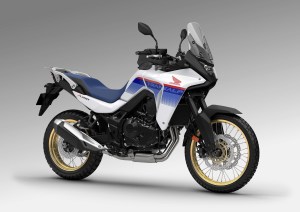
While I see Yamaha as an exception, the Japanese monikers have become stale. Honda and Suzuki have both launched new powerplants in recent months, unfortunately, both companies continue to “play it safe” with offerings that aim center mass at target customer use-case while offering the sex appeal of the Sears catalog. Suzuki is said to have one foot in the grave for years now, but regarding Big Red, I want to be excited for the new TransAlp. Unfortunately, I continue to scratch my head when I consider Honda’s approach to the ADV market. The heavier, more displacement, or higher priced the model, the more off-road it leans; seems inverted to me. All 4 Japanese companies formerly dominated off-road but now seem to be ignoring the growth of hard enduro, while softly conceding an 18-inch rear wheel, and if you’re lucky, a 6th gear for hare scrambles. Again, Yamaha has kept their sole two-stroke mill on life support, but it’s tough to be optimistic considering Japan’s almost sole focus on track racing, be it on or off-road. Certainly, I welcome views to the contrary, regrettably, I believe these behaviors are indicative of the cause. It’s a dramatically aging population, with a shrinking workforce. Combined with cultural risk aversion, this has led to slow to no innovation and development in our niche (hobbyist) industry.
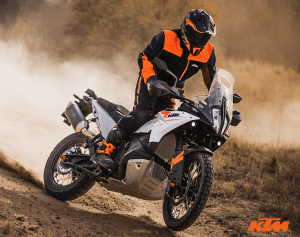
Europe is still selling smoking hot bikes, but outsourcing is growing in popularity. It’s interesting to think that the Bavarian company (known for boxer twins) offers its middleweight adventure motorcycle fitted with a Chinese powerplant. That’s not an insult, simply an observation to draw attention to the stark contrast from its former nationalism; combined with an interesting partnership of contrasting (perceived) stereotypes regarding quality & precision. The other German-speaking brand, KTM follows suit, including their 790 Adventure arriving on U.S. Shores in 2024. While I don’t see BMW nor KTM being damaged by outsourcing, in fact, quite the contrary, I mention these two examples because I believe it’s a hint of the future. Intellectual property is likely to be driven from the countries of corporate origin, however, manufacturing is likely outsourced to “younger” demographics that can more affordably assemble the products.
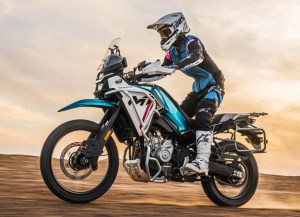
I hate to say it, but I fear China is a flash in the pan. I took a ride on the CF Moto Ibex 800 last September. Probably one of the best test rides I’ve had since I can remember; that bike was bonkers and even better on my favorite “roads”. With that, I’m extremely excited to see a new 450 twin adventure bike on the market. That said, as best as we can tell, much of what is coming out of China is a result of a partnership, not invention. Historically Chinese companies have had a reputation for intellectual property theft. As stated above, we know that designs making the headlines have originated in Europe but are built in China and then licensed for alternative applications. As I see it, we’re on the cusp of a Japanese invasion-like moment akin to the 1970s with regard to China. However, China’s population, culture, and politics are dramatically different than that of Japan circa 1980. Unfortunately, I fear that by the time Chinese companies perfect design and innovation on par with name brands, it may be too late for Chinese manufacturing and infrastructure. Even with a reliable outsourcing model, China has some steep hurdles ahead as the shadow of the “one-child policy” looms over the labor force.
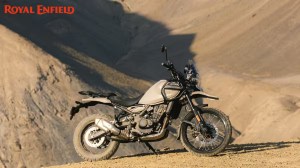
India however, is just hitting its stride. Royal Enfield (RE) is the easy example here. The longest continuously operating motorcycle manufacturer in the world; there’s a caveat of course, because RE made the exact same bike for decades. However, they have a whole new plant, with all new models; innovation is increasing, as is the national population. India, and the motorcycle companies based there, are hitting the sweet spot as industrialization is offering locals the opportunity to specialize. Intellectual property is being generated under the same (proverbial) roof as manufacturing, which avoids the consequences of outsourcing. And as of now, labor costs are lower, relative to the consumer. Bajaj of course is benefiting from European development, however, India is not fighting the same headwinds of political and demographic struggle facing the Chinese. As Triumph, KTM, and others bolster single-cylinder offerings in their lineups, it will be interesting to see what new innovations may emerge from India in the future.
History is littered with false prophecies
I want to reiterate, this is speculation on my part. Moreover, I don’t wish ill will on any person, company, or nation. I read the news, I watch behavior, and draw conclusions. Conclusions that could be blatantly false. The demographics aren’t exactly fixed, but for many, the die has been cast. Outside of Japan, much of the industrialized world only knows a “system” of continuous growth. As more and more citizens shift to fixed income, and fewer and fewer young people enter engineering and tool trades, economic contraction stunts industries, and exports will change. I work in engineering and automation; perhaps the future will be similar output with fewer humans and more robots. Plausible solution, assuming we can maintain the customer base and investment capital. Nonetheless, demographics are undoubtedly going to shape the motorcycle offerings of the next decade.
A thousand words have been dedicated to my theory. How do you see this playing out?
Notes:
- Beyond observing statistics and motorcycle corporation behavior, much of this theory stems from Peter Zeihan’s Book: “The End of the World is just the beginning: Mapping the Collapse of Globalization”. I listened to it on Audiobook twice already. Perhaps another false prophecy, but interesting things to consider.
- Peter Zeihan on Joe Rogan discussing China.


 Moto Adventurer
Luv the Enfields, but having to service the damn things every 3k miles is absurd. Never ridden a Chinese bike, but I saw one recently that was the best looking Sportster that HD never made. I luv the Transalp and would have bought one if our only choices weren’t all black or all friggin black.
I suspect it will go on somewhat the way it always has. Young people will buy bikes with spec sheet bragging rights. People with mid life crisis will buy huge adventure bikes to ride to Starbucks. People that want to travel will buy HDs or Goldwings. The kewl kids will buy Low Riders to stunt.
I was just at the HD dealer. He had 4 with sold signs. Another guy bought one while I was there (not a gray beard). Then, my stupid gray beard bought another one.
As someone who rides a lot, it’s hard to argue with putting gas in them, changing the oil every 5k miles and the tires every 20k miles. Not to mention, they’re comfy as hell and can carry a passenger and luggage like nothing. And they may not be racebikes, but they’ll run down the highway all day long at 100 mph w/o breaking a sweat if you’ve got sufficient spare points on your license to supply the state.
LikeLiked by 1 person
Good points. FWIW, the new RE mill is rumored to have modern service intervals. We’ll see how that pans out.
I certainly don’t stunt my Harley, but your assessment of “ease of ownership” is dead on. It’s the one bike in my garage that requires no work at the moment. 3 others are in significant need of repair or service.
LikeLiked by 1 person
Who knows what the work forces will be like in one, two, and three generations from now. Blurred by migration too. Then there is the factory worker building Harleys and Indians who might like to assemble automobiles for better job longevity, pay, and benefits. Yeah, probably enough to step into any vacancy; but, if demand of Harleys and Indians slows enough for store owners to close their doors, production could slow. Reduced sales and higher compensating MSRP’s and how many 20, 30, and 40 something years olds are buying these $25-40k motorcycles where just paying to exist has risen so much over the past couple/few years?
India and motorycles may have a good thing going for them. History, experience, brand name, design, and manufacturing in one county-something you mentioned too. At some point, all these small motorcycle companies sell-out to larger companies. Just consider how KTM and Husqvarna did and now Gas Gas. Not sure where Beta is in there at the moment.
Region, payroll, MSRP, and paying customers are important to company thriving and expanding. This to me explains why all the sharp edges are knocked-off new models and end up being not as perceived upon release. Adventure bikes for expample. Buyers of adventure bikes are different as some are more road oriented and others off-pavement oriented. Have to build a bike that suits both needs; but, let the customer tailor the bike to their needs. Really, it’s not much different from the standard motorcycles of the 70’s where some became cafe racers and some became choppers. Remember the cycle accessory stores that carried bikini fairings and extended fork tubes?
Scooter segments in Taiwan, Indonesia, etc will continue to thrive because they have their market close and scooter don’t last forever. Plus they are affordable and cost less to operate and maintain.
Engineer grads? I feel like they are out there and are really attracted to aviation–commercial and military. Pay and benefits are better. Also, there are plenty of engineers that are picked-up by the USG as project managers at all levels.
Sure seems like we all would like to have a crystal ball to see a decade or two into the future.
LikeLike
Lots of great points here.
I see GasGas & Husqvarna very differently though, those were boutique brands trying to make a go with a defunct moniker, that’s definitely not Royal Enfield, and I assume not Bajaj (albeit I don’t know). GasGas doesn’t entirely meet the criteria, but also suffers from the decline of most of Europe, lack of growth in capital, infrastructure and consumer base. But your point is still valid.
Great points about scooters. Despite my criticism of Honda, they definitely make money in those markets and will continue to sell utilitarian products. This is arguably WHY I don’t think they understand the ADV customer in the developed, consumption based economies.
I understand your point about the ADV market, but other than the T7, I don’t feel like the American market includes ADV base models anymore, and the T7 is even evolving beyond that. From where I stand, I feel like ADV is sold on sex appeal and gadgets. They’re primarily status symbols, cheap talent, or comfort purchases because debt was cheap. I’m anxious to know what the ADV market looks like in 6 years.
Indeed, we’ve been living in very uncertain times for 3 years now. I hoped at the end of 2020 we would find a more stable normal. Seems impossible… or maybe I’m just getting older. Either way, the future will prove interesting if nothing else. Thanks again for reading!
LikeLike
I think the path forward will involve more mergers and possibly even a shakeup of the dealer market. Why does Honda have a separate building, utilities, taxes, employees to sell cars and bikes? Why not put them under the same roof and get some cross contamination of buyers? What if instead of just having Harley special edition Fords, they also sold Harleys at your local Ford dealership?
As for the ADV market, we’ve already screwed that up. The T7 and Transalp are in the right direction, but by buying them all up before they have touched the sales floor, we’ve told these companies that they got it perfect. They see Ducatis selling for twice the price and think, hmmm maybe if we add some more electronics we can charge a bunch more. When in reality I think a lot of us just want a 400lb 75hp bike with ground clearance and reliability at a price near $10k or less. I’ll add my own GPS and heated grips if I decide I need them, thanks.
LikeLiked by 1 person
I agree with those points as well. I have been debating an article on th dealer topic… perhaps it’s time to start a draft. The latter regarding the T7 is already formulating an outline in my head 🙌
LikeLike
Great post! I enjoyed reading about the shifting demographics in the motorcycle industry. It’s fascinating to see how changes in age groups, economic factors, and cultural trends are influencing bike ownership and the types of motorcycles people are buying. The discussion about younger riders preferring bikes with advanced technology and older riders sticking to more traditional models resonated with me. Also, the impact of economic pressures on the market was eye-opening, especially how manufacturers are adapting to these changes. Thanks for the insightful analysis—looking forward to more posts like this!
LikeLiked by 1 person
Young people are simply more apt to buy marketing gimmicks. Experienced riders buy what’s useful to enjoying the road.
LikeLike
Pingback: The Lightweight ADV Segment Evolves | Moto Adventurer