
May 2015 – February 2020

Matt Levatich was promoted to Chief Executive Officer at Harley-Davidson; at the time, H-D was listed on the Standard and Poor’s 500 leading publicly traded companies (S&P 500 or $SPX). During Levatich’s tenure, Harley stocks ($HOG) fell by 46%, while the rest of the S&P 500 gained 40%. Until the end of the first quarter of 2017, HOG stocks were keeping pace with the rest of the pack, but once off course, the drop continued until Levatich “retired” in late February 2020, just days before the pandemic crash.
March 2020 -March 2025
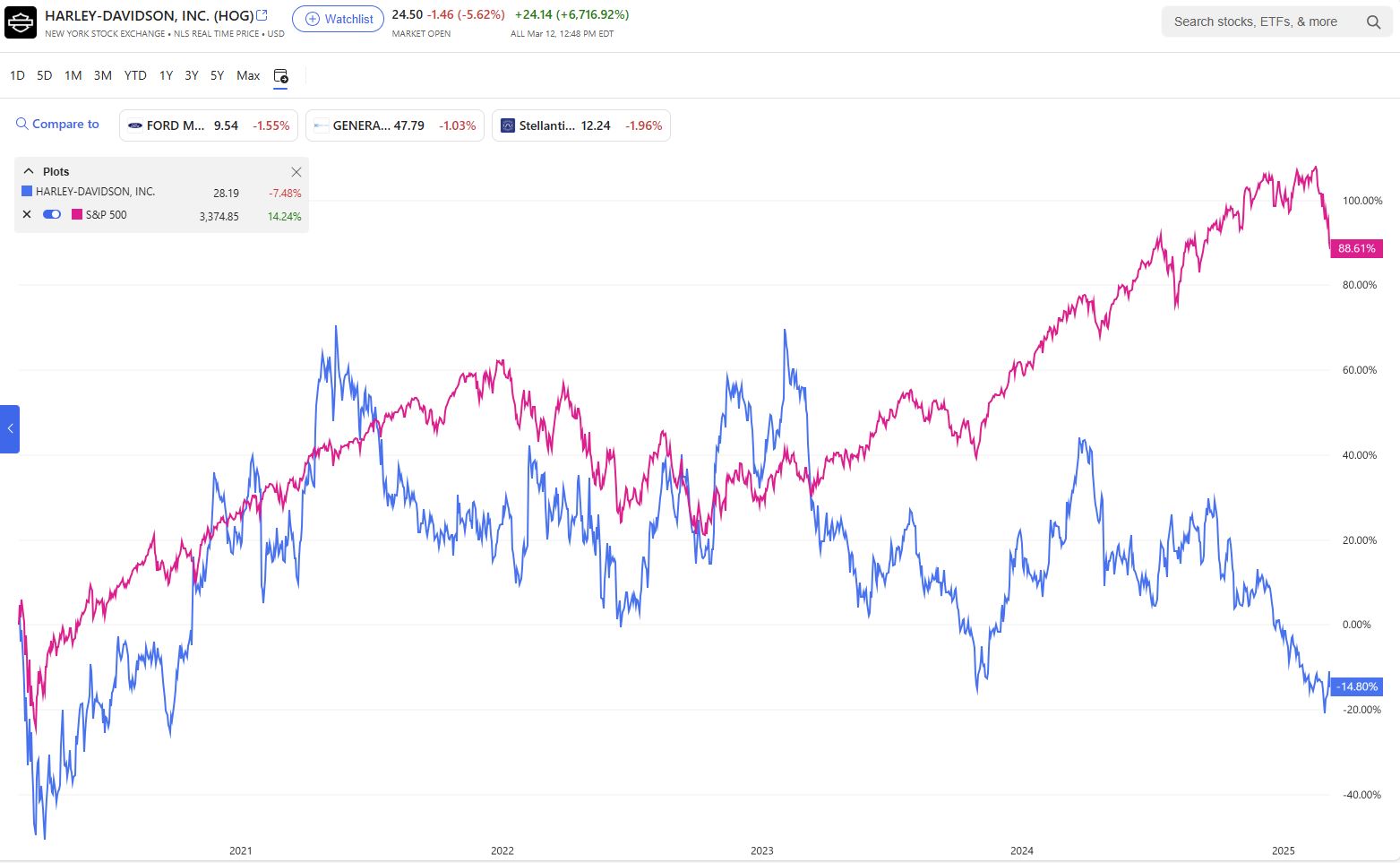
With Levatich “stepping down”, board member Jochen Zeitz was appointed interim CEO. Paired with internal turmoil, Harley stock fell further amid the pandemic market shock. In May 2020, Zietz was formally given the title of CEO; coincidentally Harley was removed from the S&P 500 and placed into the S&P Mid-cap 400 category in June. In the spring of 2021, Pan America models arrived on dealer floors and stock prices nearly doubled their value, rising above S&P levels. Hailed as “The top-selling ADV bike in North America”, stocks teetered around the S&P 500 until spring 2023. In the time since, stock values fell almost 75% to today’s value, overall down 14% from early 2020 when Zeitz took the reins. Yet, during Zeitz’s tenure, the S&P 500 has gained 88% value, with the mid-cap 400 gaining 60%.

After losing pace with the S&P 500 in 2017, Levatich announced the “More Roads to Harley Davidson” strategy in 2018. “More Roads” meant diversifying the lineup and finding new customers while strengthening relationships with the existing base. We now know this mission led to the release of the Revolution Max powerplant, Harley’s entrance to the ADV segment, a “Bronx” tease, and the creation of Live Wire.
Reinventing a brand predominantly associated with leathery grey beards, copious chrome, and life-saving loud pipes is an expensive endeavor. Per the commentary above, it’s evident that stockholders were unwilling to weather the storm necessary to successfully court younger riders. Instead, Zeitz, former sports shoe “C-suite” executive, brandished the side-cutters and scissors to roll out “Project Rewire” and “Project Hardwire” strategies, slashing the more roads project in favor of pursuing “increased profitability and maintaining exceptional desirability in their core market”.

The “Rewire” strategy seemed to play out well on the heels of the Pan Am launch. Unfortunately, two years later as buyers started developing “new bike fever“, along with news of numerous recalls and electrical gremlins, HOG’s stock success appeared short-lived. As of today, Harley Davidson is down 58% in operating income Year-over-Year (YoY). The Bar-N-Shield shipped 53% fewer units in the 4th Quarter 2024 as compared to the same quarter in 2023. “Live Wire”, its own independent company now (at least on paper), shipped a whopping 612 bikes in 2024. For context, Live Wire leadership claimed they expected to ship 750 – 2000 units in 2022. The Live Wire situation is actually worse than it sounds, 66% of Live Wire’s revenue is actually generated from the partnership with Stacyc electric bicycles for kids.
For folks that keep close eyes on the financial markets, news outlets are starting to hint very seriously at the “R-word”. A key recession indication, the “Yield Curve” inversion occurred some time ago, so the warning signs have been in clear sight for some time now. Considering Harley’s poor market performance over the last year or more, did Zeitz’s cut-and-slash strategy right the MoCo’s ship as it sails onto rougher economic seas?
What is the path forward?

The best I can tell, Harley-Davidson’s strategy is the same now as it was in 2021, cut expenses, promote “premium” status (whatever that means), bolster demand for “desirability”, and maximize profit margins. In addition, in recent news releases, there’s been mention of a special focus on protecting Harley’s dominance in the “Touring” market.
I’ve said this before, can an American Motorcycle company still demand premium stock shares by reducing unit output and shrinking its manufacturing footprint? Can a boutique Harley-Davidson command price premiums akin to Italian “special edition” bikes while still shipping sufficient units to attract shareholders that view Harley stocks as “desirable” as the CEO hopes their baggers will be?

While I must give credit to Harley, er, Live Wire for its “success” with Stacyc, there’s presently no bridge between electric bicycles and the new Sportster models (now starting at $10,499, down from $11,999). Yes, Ducati has since axed the Scrambler Sixty2, and now also has a $10k entry point for customers, but unlike HOG, Ducati is legitimately selling a red Italian sports vehicle. The brand from Bologna is actually racing in MotoGP and has been synonymous with performance and racing long before I was born. The Sportster, let alone the overall brand hasn’t been associated with performance in my lifetime. I get it, “sportiness” isn’t required for propping up a premium price tag. Thus I turn to the Bavarians; BMW is a force to be reckoned with in the touring and adventure category. Beemer’s new 1300 GSA will undoubtedly be recognized as the flagship for the heavyweight adventure segment; the K1600 GTL similarly for touring. On the other end of that spectrum, BMW offers a 310cc bike in no less than 2 categories. Can Harley-Davidson successfully attract young new riders when they have no domestic bridge to those customers? Can the Motor Company maintain desirability and build “brand loyalty” as the prices continue to rise out of reach of Millenial and younger generations?

Unless I missed the memo, the best I can tell, Harley-Davidson is the brand of blue-collar America. Folks walk around my office in Harley shirts all week, and the factory parking lot is full of batwings every Friday. Certainly, we can all appreciate the allure of a CVO Road Glide, but many of these same people have a love story, perhaps a closet love story, about their first Sportster. Years later I simply don’t see how the path of $30k baggers and $17k cruisers holds its “core demographic” and strengthens profitability whilst attracting younger riders to the brand. Harley’s offerings are simply too expensive for younger riders, and I’m apparently not alone in this view. I caught this quote on Seeking Alpha discussing Harley Stock:
“Frankly, there is little room for it to grow share—it owns the segment it competes in. It just needs to find a way to attract millennials to the touring segment, and thus far, there has been little progress.”
The last 4 years have been an interesting experiment in “controlling inventory, defining motorcycle culture, and igniting desirability“. Unfortunately, H-D is now clearly bleeding money, and if a real recession is at our door, I fail to see how that changes considering Zeitz’s strategy. I can’t help but imagine what the world would be like if a “More Roads” strategy wasn’t axed right before the 2020 “go outside” boom, arguably the biggest motorcycle renaissance since the 1970’s. Perhaps we’d be in the same position, but in any case, if sinking market value led to Matt Levatich separating from Harley Davidson, by several metrics, Jochen Zeitz has accomplished “more of the same” in the exact same timespan…
Is it time for Mr. Zeitz to also move on to greener pastures?


 Moto Adventurer
My only hope for buying a Harley Davidson was the Bronx with the Revoution Max engine.
LikeLike
Good read. This has been a problem for Harley ever since the Baby Boomers have purchased their Harley. As they age, they discover those Harley’s gets heaver. Those old bones don’t move that bike around like they use too. Attracting younger riders has been hard. Two roads Harley might ride on. 1. Harley Trikes. The older rides can still be out in the wind. 2. Make a true entry level motorbike. A 750 Sportster engine line. Flat Track, Standard, Scrambler etc. It is time for Harley to find a new CEO.
LikeLiked by 1 person
As always, thanks for reading Bud!
LikeLike
Wow, where to begin? First, Babyboomers are definitely aging out of the sport – so there is a need to attract the next generations of rider. That said, it’s tough to entice the younger crowd to a sport so heavily built up to be a macho endeavor. Certain folks in America have gone to great lengths to make Toxic Masculinity the eighth deadly sin, and have succeeded to a large degree at feminizing the American male. And before anyone bashes that statement, I’ve spent hours talking to the young men I work with – and they’ve all stated the risk related to riding motorcycles as one if the top reasons they won’t own a motorcycle. Scooters are in the same category. Bottom line? They’re scared.
Add to that the fact that many young people don’t even want a drivers license and you can see the battle ahead for Harley Davidson. And then, how can a young person afford one if they wanted one?
Honestly it’s political. We’ve vilified the hard, tough male and replaced him with a soft, sensitive, emotional pseudo dude. Just look at our culture and advertising today.
No wonder HD’s Globalist, Socialist CEO is talking about making bicycles again!!!
LikeLiked by 1 person