

I’ve been bullish on the Himalayan easily since 2017, especially now that we’re seeing so much growth in the lightweight ADV segment. When Dylan from Throttle Company came on Unscripted a few weeks back and suggested I take a Himalayan 450 on a test ride for a few weeks, I jumped at the chance. Dylan handed me the keys to his new Himalayan, no strings attached (short of ‘bring it back’, ‘don’t break stuff’, and ‘don’t break the law’.). I’m a little late to the “long-term” review party, but hopefully lengthy miles of east coast focused adventure riding can help riders decide if a Himalayan is the bike they’re looking for.
Over the course of 4 weeks, I took the Himmy Fo-Fiddy on my favorite day trips, twisty roads in rural Southwest Ohio, the Southern Ohio Adventure Loop (SOAL), A little teaser of Bluegrass Region Adventure Passageway (BRAP), Red River Gorge, and the Daniel Boone Backcountry Byway (DBBB) and all the Mom & Pop lunch stops I could find. This is my take after 2,000 miles in the saddle:
On the Center Stand
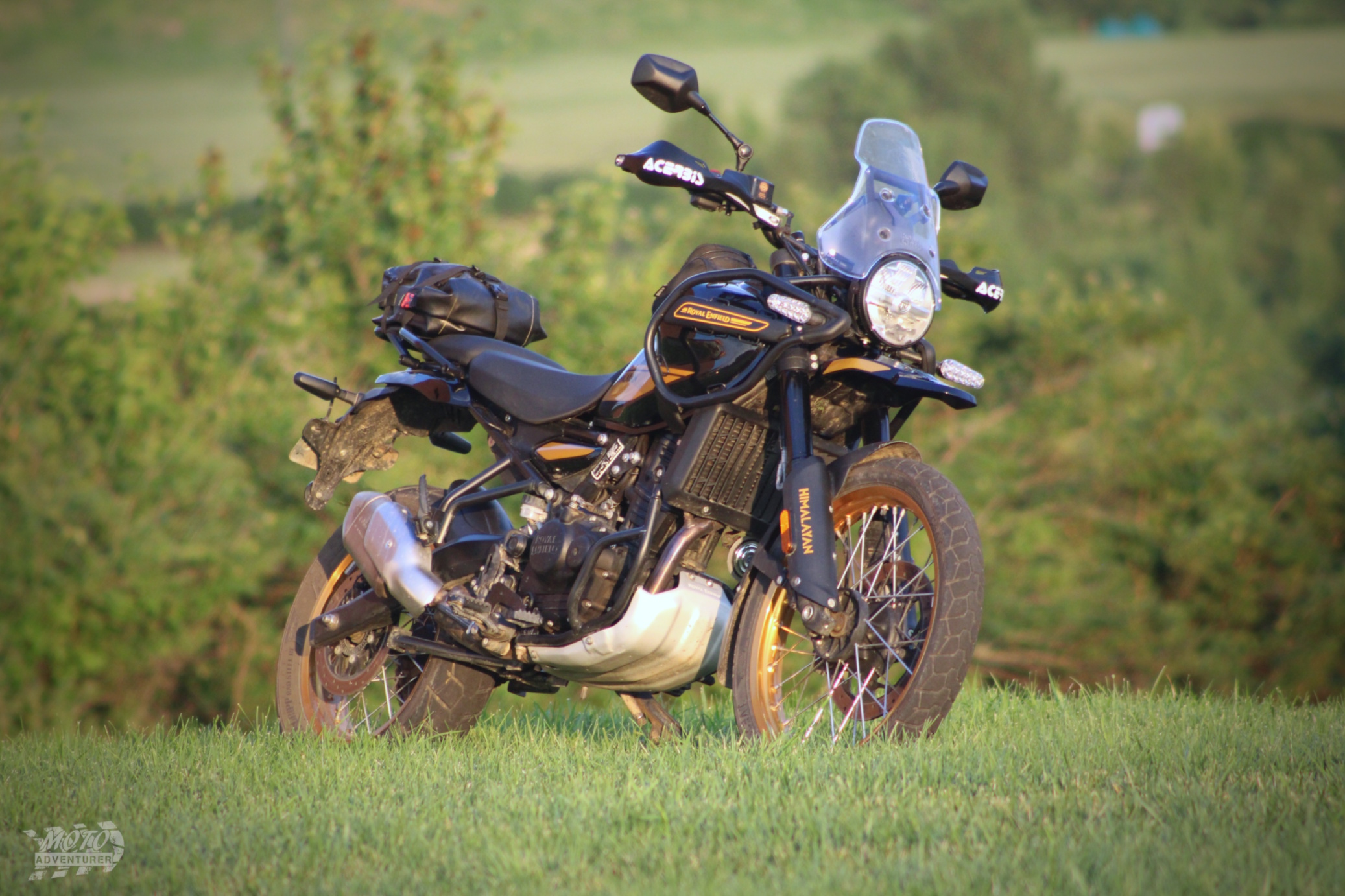
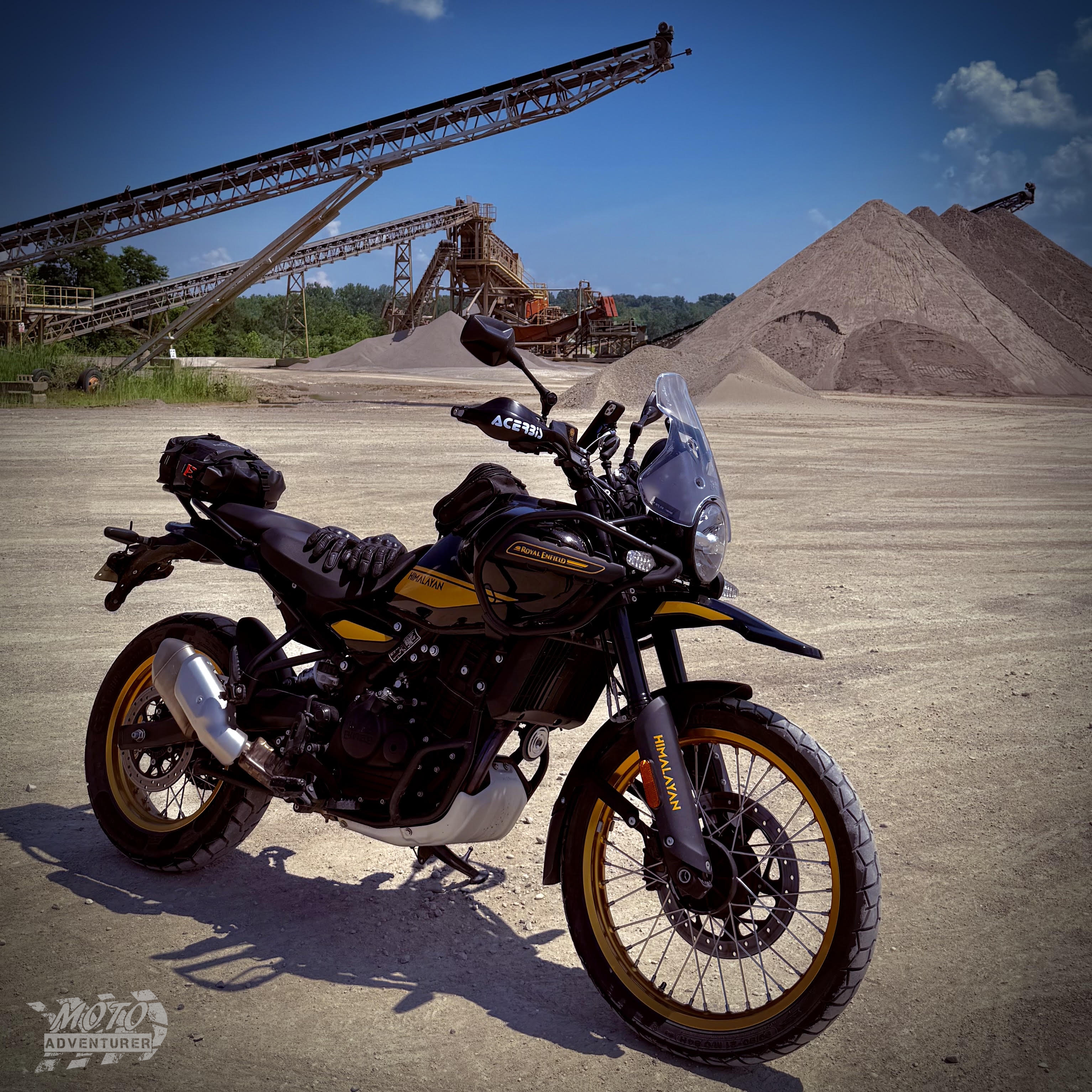
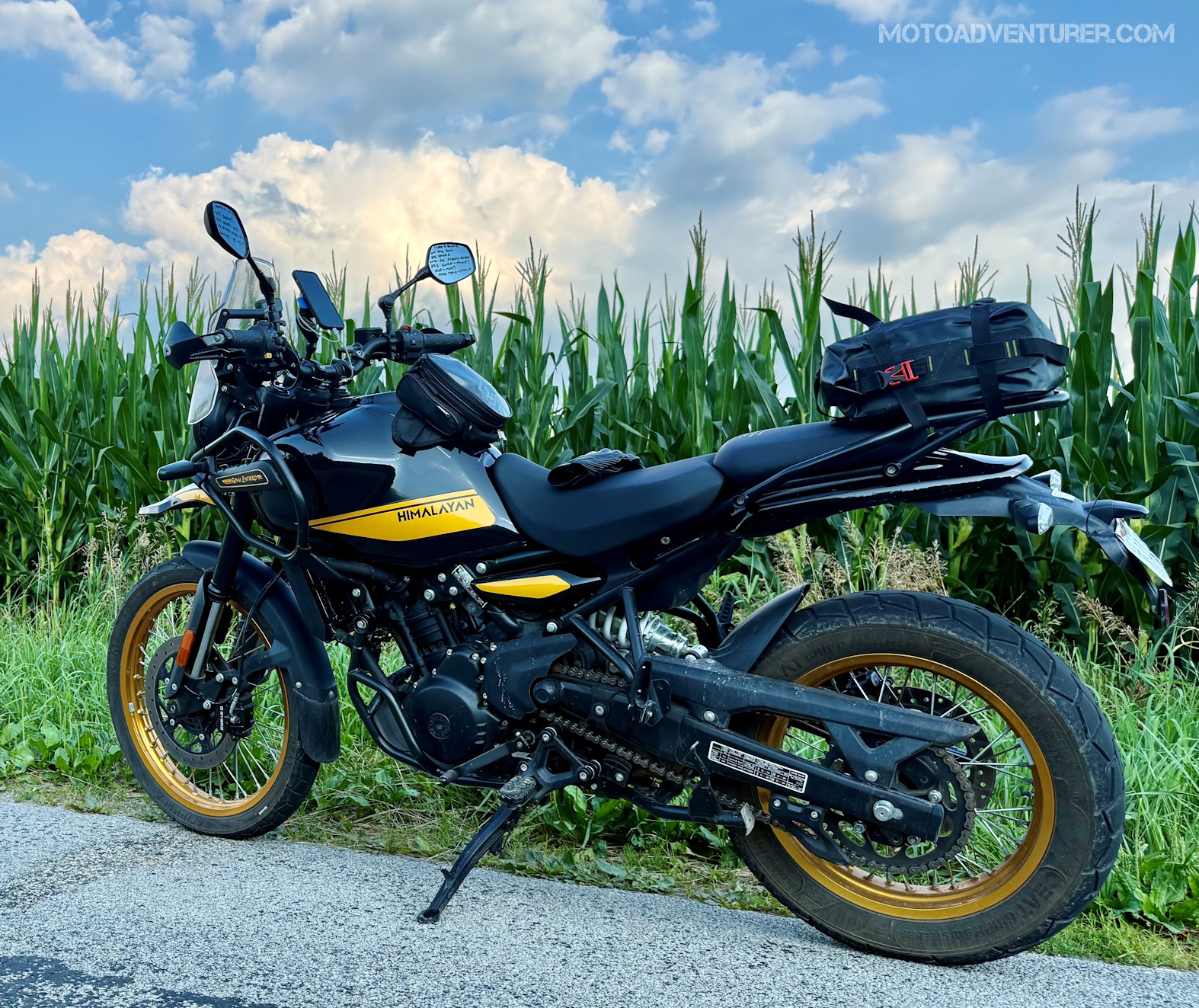
You read that right; center stand comes stock, and it was useful on multiple occasions over the course of a month. Now, I get it, love is in the eye of the beholder but gazing at the Four-Fifty in the parking lot, I find it more alluring than the outgoing 410. The new 450 tank is larger than its predecessor, accentuated toward the front of the bike, but shaped to accommodate rider mobility where prudent. Throwing a leg over the Himmy, it’s noticeably different than its predecessor. I’ve said elsewhere, in stock form the old Himalayan 410 was built for my 5’10” frame, everything is exactly where it should be. The new 450 is same, albeit with a modestly more aggressive rider triangle. Complimenting the tank, the seat is skinny toward the front, making it easy to flat foot or hug the tank with your knees when the riding becomes spirited. The saddle spreads out toward the back, offering more real estate to relax on for long-haul. All of the control surfaces where exactly where I wanted them, hat tip to Dylan again, the bike had a few thousand miles on it when it was transferred to my care, and the folks at Throttle Company took bike setup seriously. Settling into the saddle, I also note that the grips are a marginally larger diameter than I see on most ADV bikes shod with 7/8-inch bars; a welcome difference to me considering my preference for heated grips which are typically thicker.

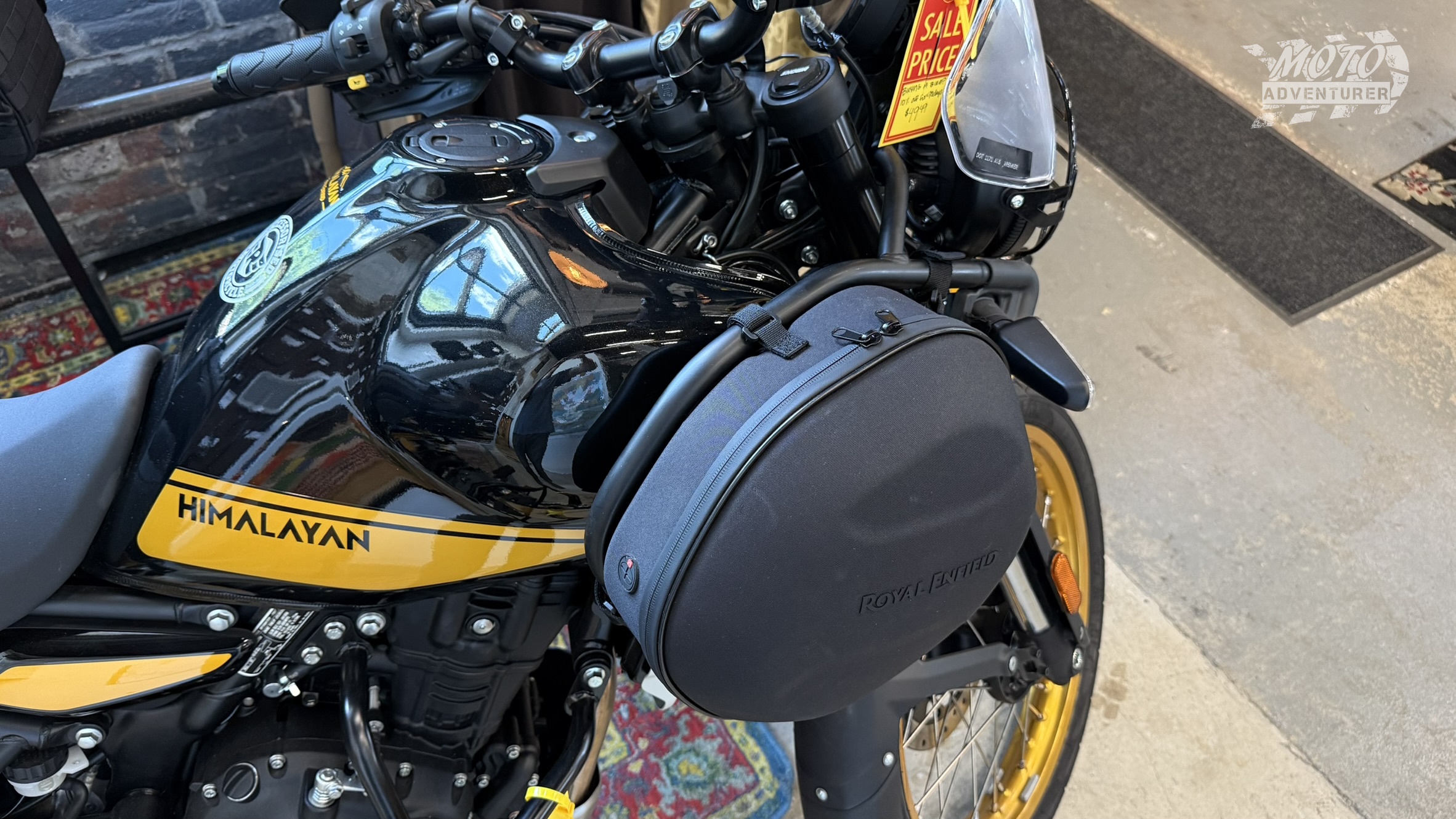
Looking over the Himmy 450, I’m a huge fan of the tank’s factory upper “crash bars” for two reasons. First, if you wander around the Appalachian woods long enough, you’ll encounter saplings or even a vine that can find its way between your tank and most aftermarket ADV crash bars I’ve seen. Unlike those, Royal Enfield (RE) has built these bars into the contours of tank, also at an angle from the headlight so it’s more likely to deflect any frontal collisions with foliage. Second, these crash bars are also luggage racks. Royal Enfield offers traditional pannier racks, but what I like most about the stock bars is that they help put the weight between the axles which will upset the chassis much less when it’s loaded down. I’ve unfortunately had some squirrelly encounters in the past on wet asphalt thanks to too much crap loaded on the rear end of the bike. Hand guards are not stock, but Throttle company saw fit to install a set from Acerbis; Royal Enfield also offers their own flavor for those interested. Serrated pegs with rubber inserts are also stock, along with a very robust serrated brake pedal. When I picked it up, the Himmy was also fitted with “adventure windscreen”, “rally” skid plate, and engine bars from Enfield ($120 & $325 add-ons). Per my request, this model came with “tube-type” wheels, but for a few extra Benjamins, you can get factory tubeless wheels from Enfield.
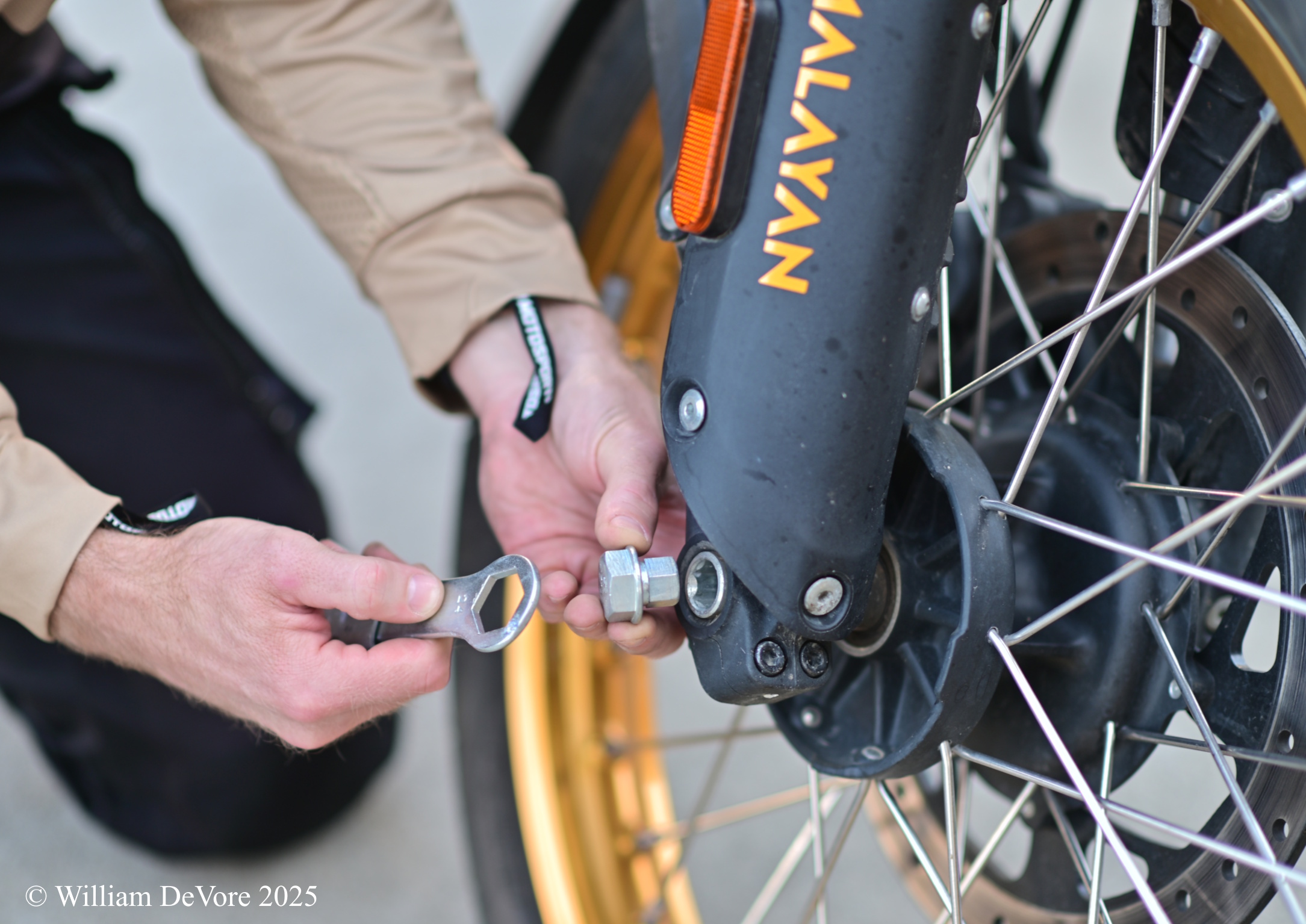
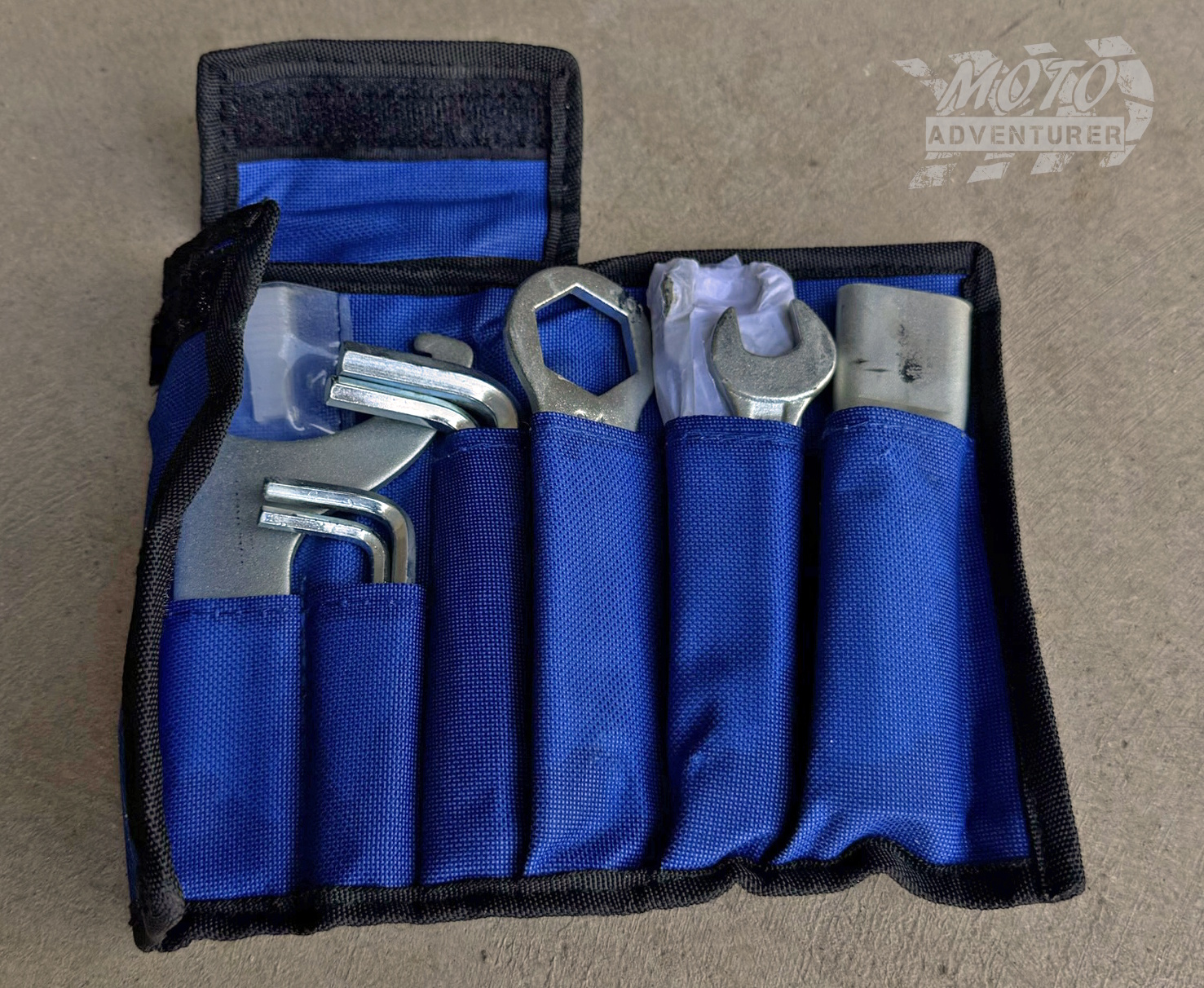
Something that sets the Himalayan apart from most bikes in the adventure space is the factory tool kit. The before mentioned rubber peg inserts require an Allen wrench to remove. Standing in the gas station parking lot, I used the ignition key to unlock the passenger seat; under which the tool kit was secured with a factory bungie strap. The tool kit includes hex keys, and a small assortment of hex wrenches and “cheater” bar. Sitting neatly in the subframe is a bespoke hex tool for removing the front axle. That’s a trick feature considering I have to carry a special hex socket in my personal kit for my T7; impressive RE saw fit to incorporate that into the design of the motorcycle.
Unlike the “traditional” equipment parked in my garage, the Himmy has a digital display. Speedo and tachometer are easy to read, and the controls are relatively simple, however I recommend having your dealer walk the function (I was foolishly too busy running my trap at the dealer). Trip odometer, fuel efficiency, temperature, and battery voltage are all available at the toggle of a thumb joystick and trigger button. The dash is wifi enabled to connect with your phone and offer turn by turn directions when connected to the Royal Enfield App. The rider mode thumb button is on the right switch-cube; offering riders switch-ability between “Performance” and “Eco” modes, along with “Rear ABS Off” options for each mode. As a guy who tinkered with 80’s UJMs way back when, rotating the off-on-run switch wasn’t new, but it’s definitely a rarer solution to today’s more common toggles, with the bright/dim switch operating in similar fashion. Riders are also offered a USB-C convenience port on the handlebars. I’m less than impressed with the 12V socket I have on my T7; Enfield put more thought into the Himmy’s USB outlet considering its spring-loaded dust cover and positioning to prevent water ingress when not in use.
On the Bitumen

Kicking up the kickstand and rolling away from a stop, the throttle by wire is smooth and forgiving off-idle. Somewhat reminiscent to the KTM LC8 throttle mapping, the Himmy is happy to play it cool under 35% twist on the throttle. As the revs climb past 5,000 RPM, the new “Sherpa 450” mill really comes alive until it bumps off the rev limiter around 8k. This was my first long-term experience with throttle by wire bike and as a self-identified luddite, I can’t complain. The throttle response was smooth and predictable, but you can’t be lazy; the Himmy knows you’re still holding the throttle open 5% when slowing down and keeps putting gas in the chamber, unlike my choked-up Scrambler that’s always trying to meet emissions standards and lets me get away with not closing the throttle completely before returning to idle revolutions. An interesting feature, the Himalayan 450 also “helps” the rider accelerate from a stop, if you don’t open the throttle, but release the clutch from a stop, you’ll notice the RPMs climb gently to help propel the bike without stalling. The clutch pull is light, akin to my old CRF250L, a completely benign activity on the pavement, but much appreciated when traction becomes unreliable.

As a seasoned ADV rider with multiple platforms to choose from at home, the bar position on the new 450 is comfortable. More street-oriented riders may find the reach a tad further than they’re used to, but it’s ideal for sitting or standing conditions making the transition to off-road riding more fluid. Many bemoaned the predecessor’s 400 displacement but “250-horsepower” (their words, not mine), but the new 450 brings 40 (claimed) ponies to the party with 27 pound-feet of torque. From enjoying the forgotten backroads to passing traffic on the interstate, the new 450 has plenty of poke to get you from A to B, and unlike the quarter-liter dual sports I’m intimately familiar with, the Fo-Fiddy doesn’t require a judiciously planned pass, simply twist and steer to circumvent a slow-moving tractor trailer. Related to comments about throttle response, the new Sherpa engine is definitely a “Rever” not a puncher; like my WR250R, the Himmy 450 likes to be kept on the boil when the riding gets spirited. Despite all the sound and emissions requirements, the Sherpa does sing a wonderful song from four to seven thousand RPMs. I’m obviously a sucker for character and the new Himmy mill apparently tickles me in all the right places; I’m very curious what it sounds like with an aftermarket Zard exhaust. The playful 450 is paired with a smooth six-speed gear box. In an odd twist, counter to most of my new bike experiences, finding neutral was always a non-event, meanwhile there were no false neutrals to be found. The Sherpa gear box also has a slipper clutch making the rev happy engine less jarring when clicking down gears into the corners.

Accenting the engine, the non-adjustable 43mm Showa forks soak up the bumps as expected but help the bike firmly hold the line when carving up the canyons. Assumedly to keep the delicate bits out of harms way, the shock linkage on the Himmy is unlike others I’ve seen. The shock is non-adjustable except pre-load, but at 170-pounds without gear, I actually backed off the pre-load to zero for bombing around the tri-state, both on and off-road.
Settled into the cockpit, the taller ADV screen was pleasantly appreciated. I tend to lean away from taller screens because I often find the buffeting worse than the windblast, but the tall screen from Enfield is exactly where it needs to be for a 5’10” rider, leaving the helmet in calm stream of air from the chin up. As mentioned, the plush part of the saddle is in the front, but when the pace relaxes, the narrow ergos have you sliding back to the skinnier padding where the front saddle means the pillion pad. After 2-and-a-half hours on the highway, the seat was adequate, however I expect long-distance riders will be exploring aftermarket options. Enfield offers a “rally” one-piece seat for the Himalayan; I unfortunately can’t offer first-hand experience with it.
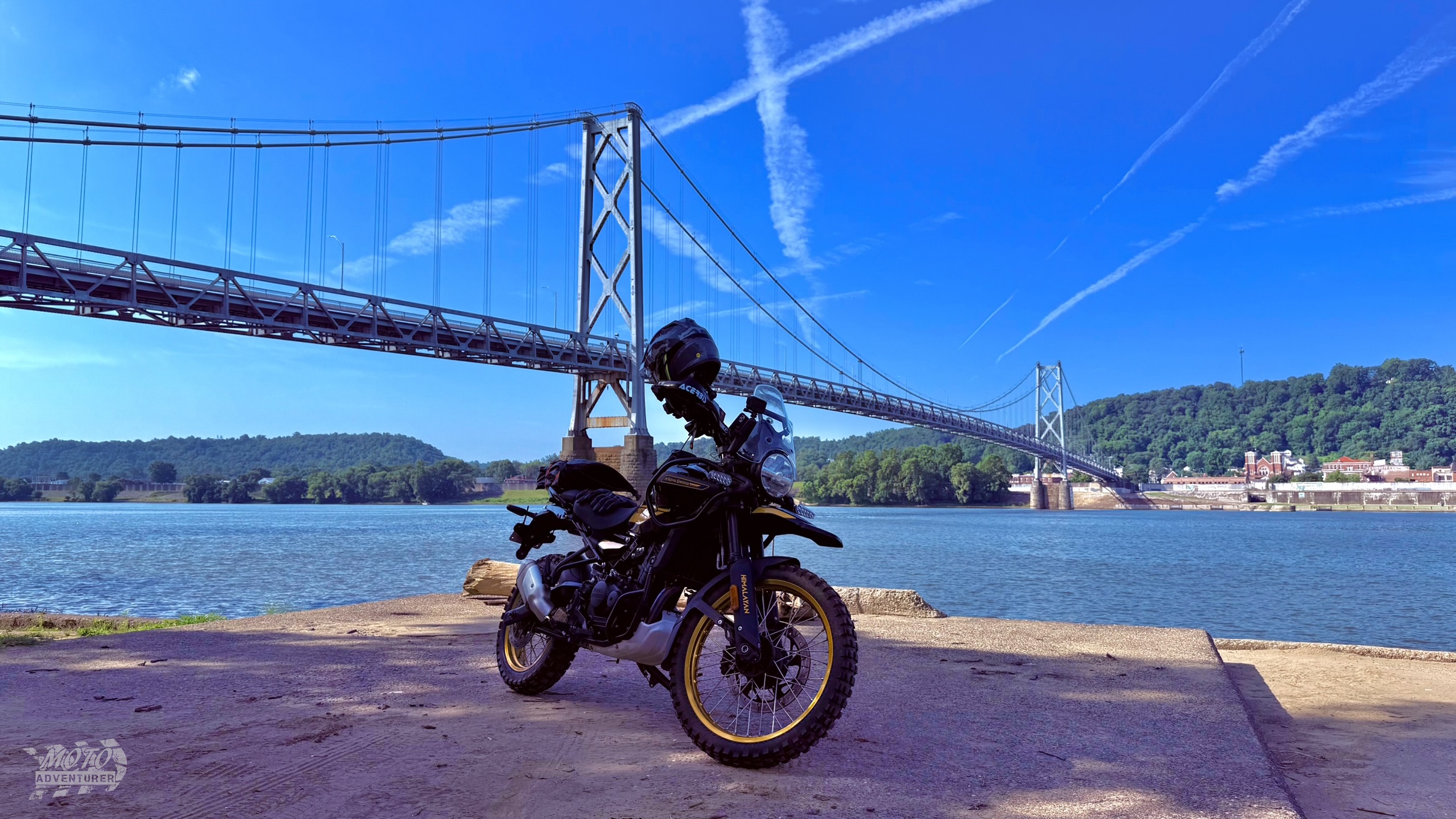
The lockable 4.5 gallon gas tank offers impressive fuel range. Running on regular unleaded I know first-hand the Himmy 450 can carry you 170 miles non-stop through a 70mph speed zone riding on the “performance” throttle map. With my hands at the controls, I saw fuel efficiency from 50 mph up into low 60’s on the display; I suspect if you keep your speed under 60 MPH you could probably carry 200 miles on a tank. Eco mode might offer similar or better results depending on the variability of your right wrist. Speaking of which, as many journalists would say, “I liked the bike best in performance mode”, however I found the utility in “Eco” mode multiple times over the last few weeks. I unfortunately spent more time than expected riding in the rain, including on ADV knobby tires. The more relaxed throttle response was appreciated, especially on the slickery tar snakes of rural Ohio. An interesting note, there’s a distinct difference in “aggression” from the throttle in Eco mode vs performance, however 5th and 6th gears feel very similar in both modes. Again, a welcome feature when riding on the highway.
Royal Enfield outfits the Himalayan 450 with ByBre calipers to slow your roll. For folks unfamiliar, ByBre is actually owned by Brembo. At any rate, braking power is sufficient to good depending on your taste. My decade old scrambler with single disk front and rear brakes that are hysterically terrible, the Himmy single disks are great. Admittedly, single disk up front doesn’t carry the stopping power of my dual disk T7, but at no point did I find myself looking to put a full hand’s grip on the binders despite spirited riding conditions or being spooked by wildlife. Also of notable, my T7’s rear brake feel is notably bad; I found the Himmy rear brake much more confidence-inspiring, especially off-road.
Where County Maintenance Ends

Seeing gravel up ahead, I would typically pull over, press the “mode” button on the right switchgear with my thumb until it said “Performance: ABS off” and waited 5 seconds. A “Rear” ABS off icon displayed on the screen, and I sped away. While I find the whole stopping to disable ABS irritating, it’s unfortunately still a very common practice in the industry so I can’t fault Royal Enfield for their programming choice. Re-enabling ABS can however be done on the fly but holding in the clutch and coasting for 5 seconds.
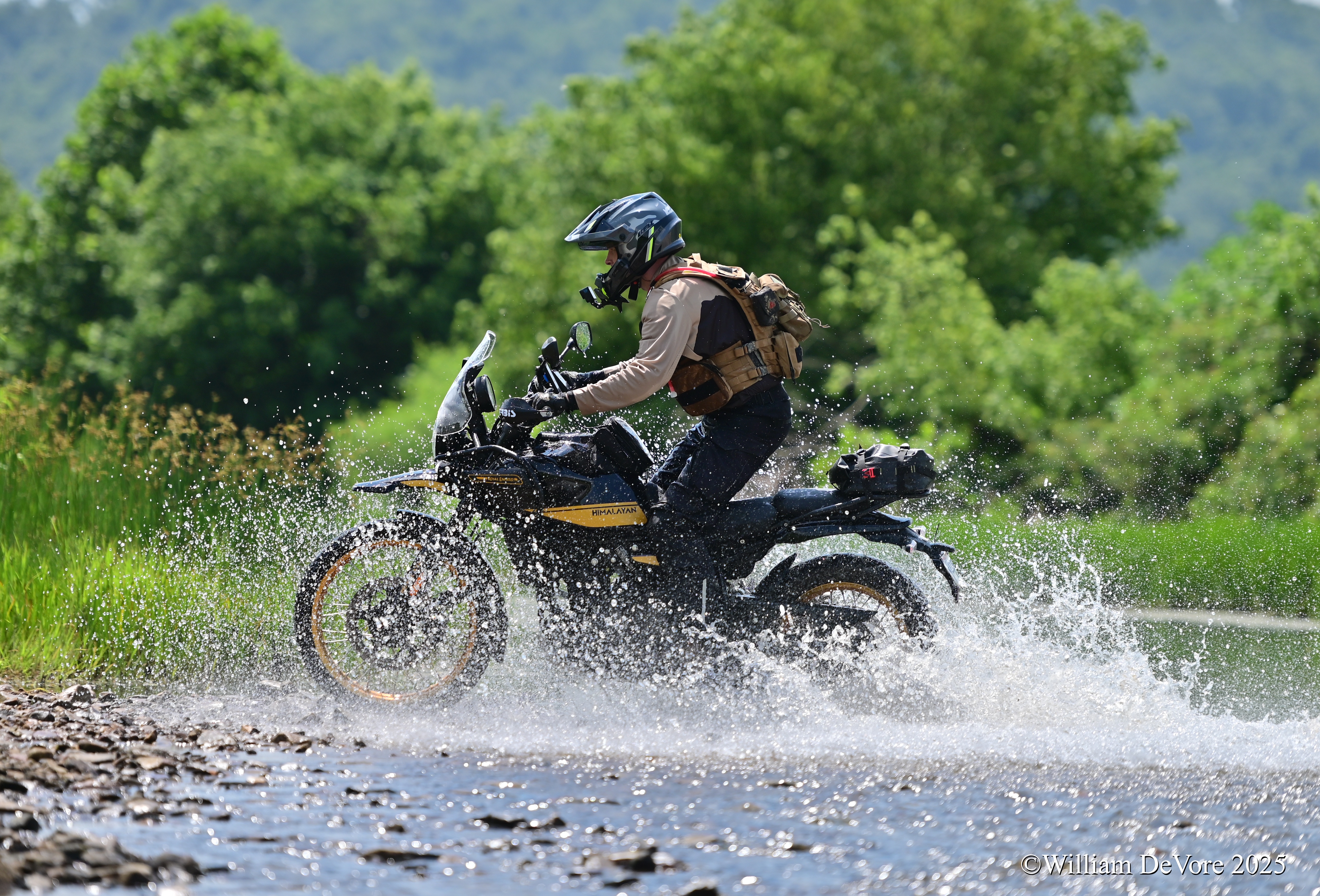
When the dirt roads got more rugged and the rock population increased, I was impressed to see the stock Himmy suspenders soak up the bumps. The suspension is plush, but compliant. I didn’t feel the bike was especially lazy, but folks looking to get especially aggressive will undoubtedly want to do some tuning. Having hosted an ADV rally for almost a decade now, I’m quite confident the stock suspension, while non-adjustable, is still more than sufficient for the kind of riding most adventure riders do. As with all bike suspension, you’ll want to have it sprung for your weight and typically bike loadout, but on road or off, from the Southern Ohio Adventure Loop (SOAL) to the Daniel Boone Backcountry Byway (DBBB), I had no complaints about how the bike handled terrain I threw at it.

One of the biggest assets the Himalayan 450 brings to the table off-road, is low center of gravity. Switching back and forth between the Himmy, my T7, and an Ibex 450 was very telling. Despite the scale claiming 432 pounds ready to ride, the new Enfield 450 carries its weight especially low. Having hare scrambled a Triumph twin and specializing in “big bike recovery” throughout the hollers of Kentucky, I felt more confident piloting the Himmy off-road with far less saddle time than any non-dirt bike I can recall. The stock bar position is ideal for sitting or standing, the front of the saddle is narrow for pinching tank with your knees, making it easy to steer with your feet. Per my comments above, the brake pedal is easy to find and offers good feedback to the rider. I can’t emphasize enough, for new adventure riders exploring this segment, the Himalayan 450 is incredibly confidence-inspiring when you first start leaving the predictability of pavement.
Turning Wrenches
As a guy who tends to own bikes for many years, evaluating a new bike always means thumbing through the owners manual to examine the maintenance schedule. Royal Enfield specifies fresh oil and filter changes for the 450 Himmy every 6250 miles (10km). Oil changes on the new Sherpa mill are extremely similar to dirt bike or CRF250L maintenance. A cartridge paper oil filter is behind a metal cover on the right side of the bike, with 2 screens inside drain plugs on the left side. Valve clearance checks are also specified every 6k-ish miles, which is a bit more than Japanese bike owners are accustomed to; however it’s an improvement over the outgoing model, and certainly a dramatic improvement over race schedule maintenance of most 450s on the market today (i.e. the CRF450RL). the Sherpa valve train is Dual-Overhead Cam (DOHC) with shim under bucket architecture. Anyone who’s worked on an off-road race bike of any kind will be very familiar with the process.

Air filter changes are also due with engine maintenance. ADV owners will probably be split on the issue as the tank must be removed to change the filter. While that’s “hassle”, it’s still pretty common in the ADV market; moreover, like my Scrambler, with some practice, removing the tank becomes a matter of muscle memory. Also, the advantage to the air filter under the tank is improved water crossing depths. Considering the number of swamped engines I see each year, water is arguably the most intimidating thing I encounter off-road in the holler, the Himmy’s elevated snorkel will definitely pay dividends for certain owners.
Changing tires on the Himalayan is smooth process considering the stock center stand. You’ll want to put something under the skid plate to keep the nose from diving while you wrestle the front tire loose, but it sure beats fussing with a jack. I change a lot of tires each season, so I also like the convenience of a front axle that threads into the far fork tube, it’s one less set of pinch bolts to tighten, and means only needing one wrench to re-install.
Pickable Nits
A reputable dealer will be sure to go through all the features and functions of the bike before you roll away. If I was smart, I would have asked for that before loading up the 450. Since I wasn’t, it did take some poking around the controls to understand how to reset trip odometers and whatnot. Considering other bikes I’ve seen, the RE dash isn’t overly complicated, it’s just a matter of practice.
Throttle-by-wire (TBW) is definitely growing in the ADV market. Anyone who wants rider modes and cruise control is accepting (perhaps demanding) throttle by wire at this point. Undoubtedly, I’m an analog dude, so there was an adjustment period to riding a throttle-by-wire bike. In the end, I can’t fault Enfield for any of the performance related to TBW; I still prefer cable, but know it’s a different experience if you’re an “old-school” buyer.
I think the Himalayan control surfaces are solid; pegs and pedals are where they should be and perfect off-road for my size 10 boot. That said, despite that solid brake pedal, I was surprised they didn’t offer a folding shift lever. You can get a $50 billet aluminum folding shift lever from Hitchcocks; I’ll debate aluminum vs steel in a different article, so at least it’s out there, it’s just an interesting choice considering how many other typically aftermarket parts are standard on this machine.
After 2,000 miles my only real complaint is the seat. Is it solid for a 3-hour ride? Yes, it is. Are stock motorcycle seats typically “left wanting”? Absolutely yes. To its credit, the Himmy seat is superior to my stock Tenere seat. Long-distance rides with delicate posteriors (like mine), save a few pennies for an aftermarket option. For folks who don’t ride more than 200 miles at a stretch, you’ll be fine with factory options.
Competition
Without hashing out a “what makes an adventure bike” debate, I see the CRF300L, KTM 390 Adventure, CF Moto Ibex 450, and the KLR 650 as the closest competitors to this bike. Drawing a bigger circle, you could throw in the Triumph Scrambler 400x, the Kawasaki Versys-X 300 , the Honda NX500, however all of those bikes have 19″ front wheels, indicating to me, they are at least one standard deviation closer to pavement preference (more than happy to discuss merit of these in the comments, I love them all).
When debating factory “Lightweight” adventure motorcycles, I see the CRF300L Rally as the most off-road capable machine in this class. Clearly with one foot in the dual sport realm considering its base model stablemate, the 300L Rally will come up short on interstate power, range and comfort, where the Himalayan will clearly shine. By contrast, the 300-Rally brings a lot more suspension, significantly less weight, longer maintenance intervals, and very robust chassis. Light ADV Shoppers looking to be on dirt more so than pavement will likely gravitate to the 300 if power is no object, however those still looking to carve more canyons will see the benefits of the Himmy.
CF Moto’s new Ibex 450 and KTM’s 390 Adventure are clearly very competitive light ADV options. Several shootouts have already been published on YouTube featuring these bikes alongside the Himmy. Having ridden the Ibex, it’s a logical comparison, albeit the target audiences are probably different. I suspect people looking for ADV aesthetics, more creature comforts, or a lighter alternative to the middleweight ADV segment will lean toward the Ibex or 390. However, the Himmy 450 brings an equally capable machine with more classic looks, affordability, and in my experience, significantly lower center of gravity, more pleasant throttle response and power delivery. Many will niggle on suspension and electronics, but like all things, it’s a matter of taste and use case.
How I would set up the bike
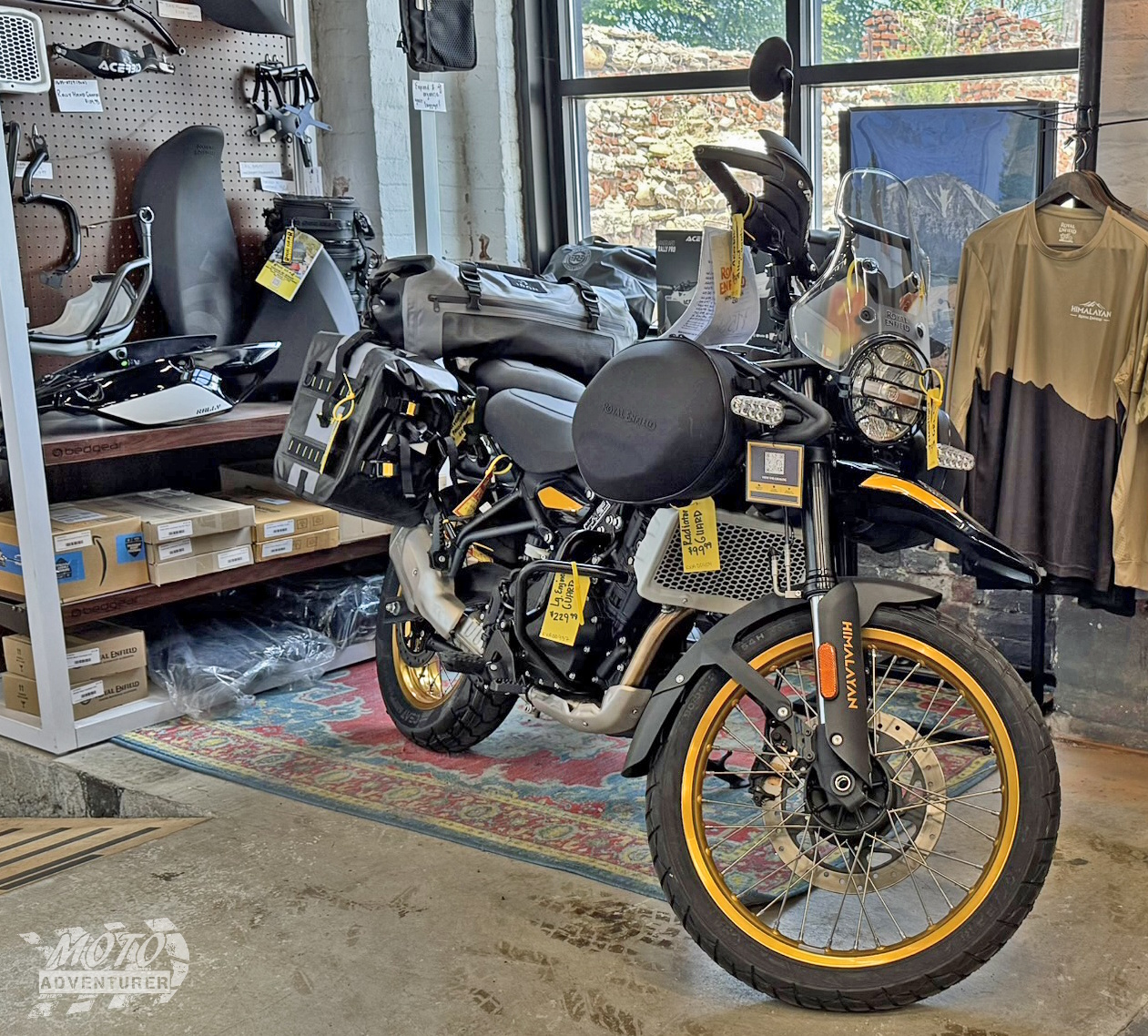
In the event I laid down my own cash and took home a new Himalayan 450, how would I set it up? Throttle Company already had the bike outfitted with the rally skid plate, rear luggage rack, hand guards, and tall windscreen. I would do the same, albeit I expect I would still use the factory short screen most of the time unless I’m going to spend hours on the interstate. Just like the demo bike, I would prefer standard tube type wheels. I would also spring for the factory rally “mud guard”, basically a cowling for the rear subframe to keep the seat more mud-free, essential equipment for exploring the holler. I also want a set of the front panniers, and possibly the rear pannier racks for soft luggage. The Himmy is a serious mule, and I want to take advantage of that capability. I like long-distance rides, so a new seat would absolutely be on the list, be it from RE or elsewhere. Per the comments above, the suspension impressed me out of the box. Like most factory adventure bikes, my riding taste and preferred terrain makes it possible to override the stock springy bits. I would probably spend $1500 on a higher-performance shock and fork cartridge inserts to get a little bit more out of an already capable machine. All in, these trinkets would add another $3200 to the price tag, but with a GPS and dual sport tires mounted, I’d feel ready to go anywhere.
Final thoughts

Exploring and Adventure has never been so attainable. The adventure space is rapidly filling up with flavors from across the globe (Kawasaki just unveiled the new KLE 500). Today there are luxury models, techy models, and a few analog models available for prospective buyers. With its latest iteration, it seems Enfield has tastefully included modern technology with more classic aesthetics and included heavy portions of practicality for the new Himalayan 450. With more money riders can purchase more creature comforts or more performance from other ADV models, however, as a seasoned adventure rider with staples from multiple motorcycle segments in my stable, I thoroughly enjoyed riding the Himmy in all conditions (including several gnarly thunderstorms) and never felt like it was “cheap” or I was desperately wanting more. Some would suggest the Himalayan 450 is an “entry-level” option for the ADV market, but I think that sells the bike short. The Himalayan is a solid choice for practical ADV riders, budget-conscious motorcyclists, and folks who appreciate the amalgamation of form and function that Royal Enfield offers. The Himmy comes with everything ADV riders need, a sprinkle of extra things they may not. The bike has character and charm, enough creature comforts to roam the interstates, while never complaining about being flogged down the muddy byways. Handing the keys back to Dylan, I looked forward to returning to the grunt and growl of my Tenere 700, but I know I will always look back and remember how easy the Himalayan 450 made everything… and for a lot less money.








 Moto Adventurer
would like to pick your brain about the pros/cons of a Triumph 400X Scrambler vs the 450 Himalayan as an all around bike for fire roads and street. Thanks.
Jonathan.
LikeLiked by 1 person
I’m here for it. I’ve ridden the 400x and like the engine. Something about the steering geometry was off on the test ride I took. It’s like the bar risers were too far forward. Hopefully that was a demo bike isolated problem. I’ve never ridden it offroad so I can only speculate based on my scrambler 865 ownership. With that, the Himmy has more suspension travel, more range, included accessories, better offroad wheel options (unless get a 400xc). I imagine the Triumph service intervals are likely a bit longer than the Himmy.
Fit and finish will be better on the Triumph, but the Himmy gets my nod for off-road capability. As a guy known to scrambling a scrambler in the worst conditions, I’m sure the 400X can do it, it’s merely a question of taste, challenge, and comfort preference.
LikeLike
I have the 400x with the stock tires and enjoy riding it almost more than my 1200 Bonneville on the street. Love taking it on fire and logging roads here in Southern Oregon. I’m sure with proper 50/50 shoes it would be more confident on the dirt or gravel. As a Triumph fan it suits me. I’m just not sure that it would fit the bill for BDR type trips which I’d like to do. I think the greater travel and bigger front tire of the Himmy would be noticeable. I’ve ridden a demo 450 on the street and liked its power and smooth transmission but never had the chance off-road. I did have a KLR which felt too tall.
LikeLike