On a recent episode of Moto Adventurer Unscripted, Mark and I did a deep dive into tool kits, including some obscure items. As it turns out, Mark and I both tend to be loaded for bear when we’re out adventure riding. Riding solo apparently carries a weight penalty. With that in mind, we like tools that can do multiple jobs, especially those that pack small and reduce weight.
Last spring Rolling Mavericks reached out to me and asked if I wanted to try out some of their products. I mentioned I wanted to lighten my tool kit, so they sent me a set of their Asahi Lightweight Trail Spanners. Considering my positive experience with them, and a few other items, I’m sharing this info with you today, no strings attached.
Lightweight Spanners
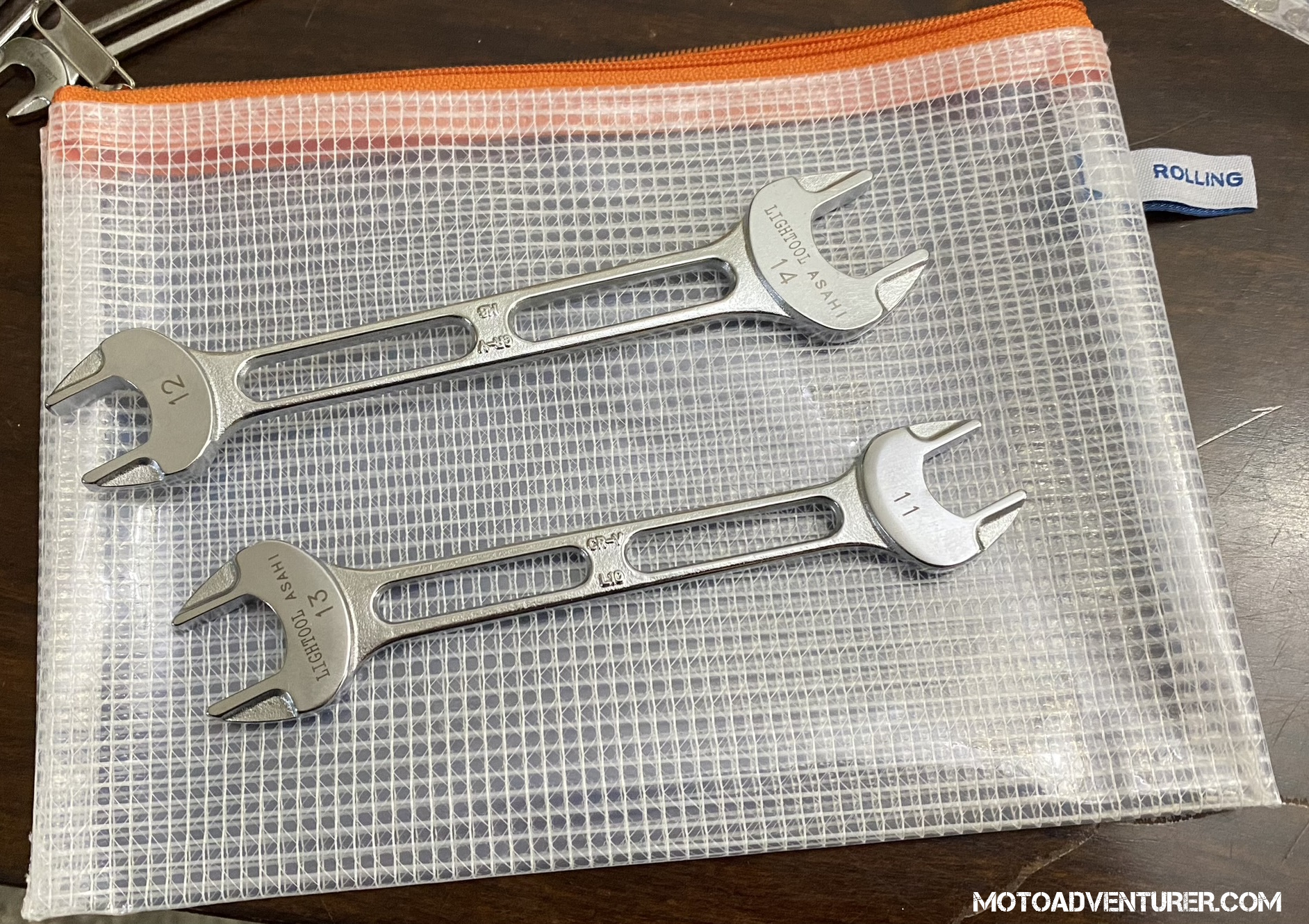
My advice on building a tool kit typically starts with basic wrenches and sockets. These tools become invaluable when a lever needs adjusted, or a handguard gets loose. In the past, I carried five wrenches to cover the sizes I needed on various metric bikes. The Asahi lightweight wrench set cut that down to 2; 3 if I wanted to pack a 13mm (KTM loves that 13mm, irony?). The Asahi wrenches are extremely lightweight, not titanium light, but reasonable, especially for steel. The open-end spanners don’t quite get the “grip” on smaller bolts when they’re especially tight, but it’s a sacrifice I was willing to make considering weight and typical torque ratings. The foursome of Lightool Trail spanners are available $27; you could shave a few more ounces with the high-end titanium options, but you’ll really pay for it.
Zippered Mesh Bags
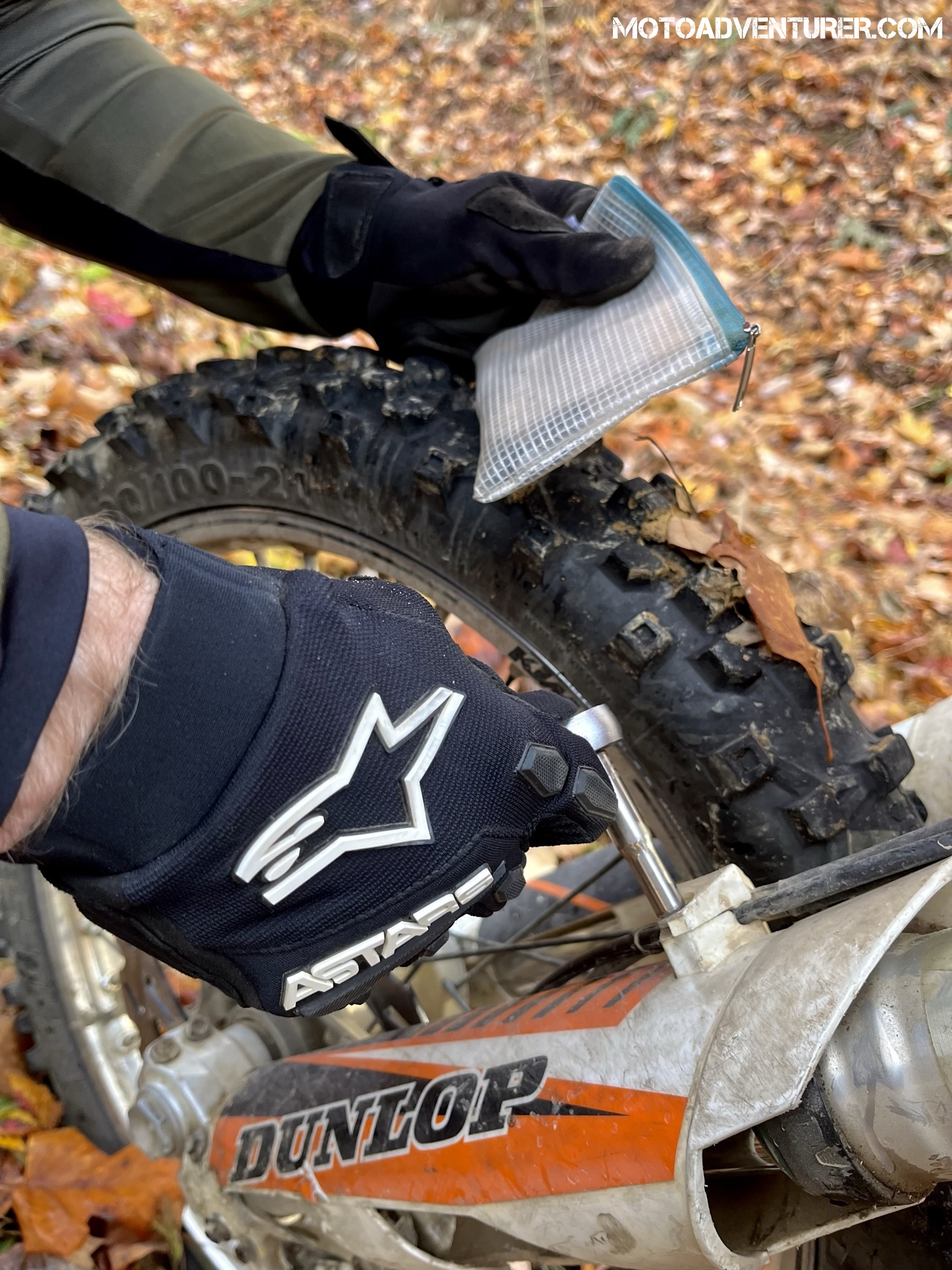
In the past, I carried spanners and mini-ratchet tools in a canvas shaving kit. Considering the impacts of off-road riding, said containers were typically shredded by sharp-edged tools. Unsolicited, Rolling Mavericks also included a collection of zippered mesh bags with the trail spanners. I’ve been pretty enamored with them since day one. The bags come in at least four different colors and a handful of sizes. The variety makes it convenient to separate tools based on type; when you’re thumbing through a pocket of your tool pouches, you see the color you need and grab it quickly without shuffling through loose chrome parts bouncing around in the bottom. After a season of riding the bags are still in good shape; worth the $11 for the assorted “trail pack”.
Asahi 72-tooth ratchet
This entire conversation began with the endeavor to lighten the tool kit, but ironically a toolbox addition stole the show. In addition to the above items, Rolling Mavericks sent me an Asahi Lightool 3/8″ ratchet. From the moment I could walk, I was tinkering with my dad’s Craftsman tools. Certainly, we can debate Craftsman quality in 2025, but until now, that was more or less the standard in my toolbox. By complete accident, that has completely changed; when I’m enjoying a late-night wrench session in the garage, I now reach for the Asahi 72-tooth ratchet. The Asahi ratchet is lighter in the hand (nearly half the weight), smoother to the touch, and feels dramatically more precise; no slop in the ratcheting mechanism, and many more “clicks” in the action compared to the domestic hardware store alternatives. It’s about a $50 investment; a few more bucks than Craftsman, but if you’re a fellow tool snob, it’s still a savings against Snap-On fare.
As mentioned on the podcast, if you’re building a tool kit, you can save a few bucks by going to garage sales. However, if you’re looking to shave ounces, you need to spend a few dollars. I’ve been impressed with these offerings from Asahi over the last year. I suspect I’ll be doing some shopping with Rolling Mavericks in the near future for a few other handy items that will save me some frustration on the trail later.
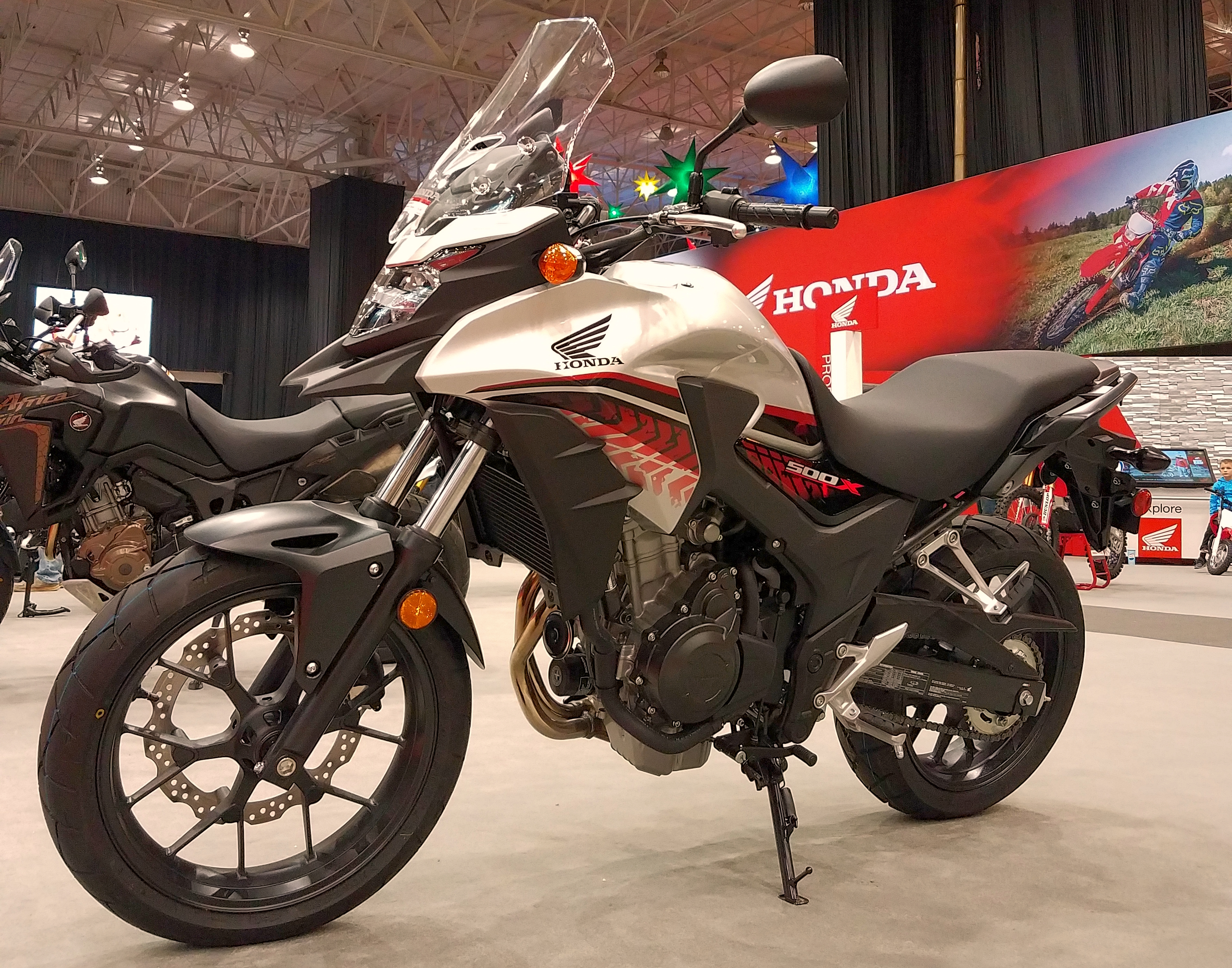
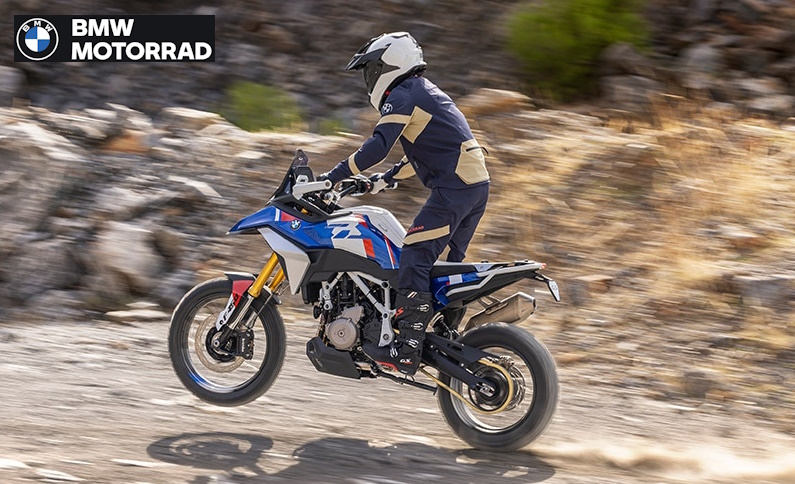
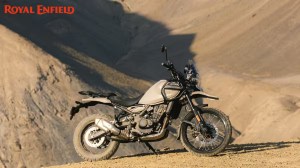
Way back in the early days of 2017, I went to the International Motorcycle Show to see the new Royal Enfield Himalayan in the flesh. The Himalayan premiered internationally in 2016 but wasn’t available in the U.S. until 2018. On the heels of the global Himalayan reveal, BMW and Honda both brought new lightweight adventure models to the EICMA show in Milan, Italy; the 310GS and CRF250L Rally respectively. Kawasaki also came on the scene with the new 300 Versys-X that same year. Honda was offering the CB500X in an “adventure touring” trim with dual 17-inch wheels at the time, but apparently got the message in 2019, deciding to install a 19-inch hoop on the front instead.
The second wave
In 2020 KTM launched the 390 Adventure based on their 390 Duke. With cast wheels (until just recently) and a few more El Bees, some made the argument you could do the same kind of riding on the Duke and save a few pennies. I saw a few 390s in the wild, but from my vantage point, it seemed most of these bikes were pavement-locked and were beginning to accumulate on the used market last year.
Honda saw fit to bump their 250 engine to 300 in 2021 (286cc), gaining parts from the CBR300R that got that treatment back in 2015. However, aside from the Himalayan getting a minor refresh in ’21 this segment remained mostly unchanged. “Global affairs” of the time undoubtedly stalling progress.
Giving the people what they want
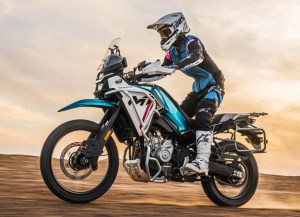
When the Himmy first landed in the U.S., many critics said it had 400cc displacement with 250 power. In 2024 Royal Enfield fired back with an all-new liquid-cooled 450 Himalayan. CF Moto launched the new twin-cylinder Ibex 450, and Kove released the new street-legal 450 Rally the same year (both available in the U.S. today). Last week, KTM announced official pricing for the all-new 390 Enduro, Adventure X, and Adventure R models, boasting less weight, lower price, and better off-road chops. In the twenty-teens adventure aficionados bemoaned high weights and low power; it seems today much more capable machines are landing on U.S. shores.
Forces of Evolution
Long-time readers know I have a soft spot for the Himalayan 410. Had it, or the 450 for that matter, landed a year earlier, I could easily have had either in my garage today. As a 5’10”-175 lb. American, the Himmy 410 ergo’s are the most comfortable ADV bike I’ve ever sat on. At $4500 the Himmy was a steal in 2018, however, it received accurate criticism regarding quality and performance. KTM’s first generation 390 Adventure faced similar dissatisfaction, especially in the shadow of the Tenere 700, a better bike in almost every way for $2500 more.
Some would suggest that this was the trickle-down effect of emerging technology, both in terms of cost and features. With that, others would suggest this is simply the fleshing out of the segment from the brands. While I certainly believe that is true, I think it’s worth pointing out additional market forces. Riders like Pol Tarres have unquestionably proven the capability of adventure motorcycles. The off-road allure is catching the eye of more and more East Coast riders; a place that requires more pavement riding between forgotten trails and county roads. Younger riders are anxious to dip their toe in the ADV pool, but middleweight prices are moving out of reach.
At the same time, more and more Boomers are reaching their final bike purchase; coincidentally recognizing these adventure bikes are heavy. Older riders want to stay in the segment but recognize their limitations. The marketing and generational forces are likely facing significant pricing headwinds due to economic contraction and more stringent borrowing conditions. Recent news of KTM is a stark reminder of this truth. Unquestionably they’ve made bad decisions, but I’ll wager this is the symptom of the overall problem, not just an outlier.
The causes of these circumstances will be speculated for many years. Ultimately it’s evident that there is now sufficient demand for sub 400-pound, lower displacement motorcycles, with adventure creature comforts, upspec suspension, and dirtworthy wheels at an affordable price.
What does the future hold?
Last week a digital rendering of a Hero Motorcycles “Xpulse 421” circulated around the moto news outlets. As I’ve mentioned, considering Royal Enfield’s growing presence and Bajaj’s cooperation with KTM, I expect to see more evolution emerging from India. This tease from Hero, on the heels of the 2023 Dakar victory, is more evidence to that point.
Looking at more established brands, BMW pulled the cover off an extremely fleshed-out and apparently capable 450 GS concept last fall. Kawasaki teased a new addition to the adventure space at EICMA; showing mostly forks and a 21-inch wheel, just enough engine poked through the display to reveal twin exhausts. The teaser also included the words “Life’s a Rally. Ride it. KLE Est. 1991”. Is the Green Monster hearkening back to the KLE500 or is this a Rally-ized new Versys 650?
I’d be remiss not to point out Triumph’s diminishing presence in the dirt-worthy ADV space. This year Triumph cut the Tiger 900 “Rally” back to a single offering; the sub-1000cc Tigers are now offered in mostly “ADV-Touring” trims. Considering the new success of the Scrambler 400, I have a strong suspicion we’ll see more sub-700 offerings from the Brits; hopefully a Tiger Cub among them.
In the last ten years, we’ve seen significant evolution in weight reduction, technology, and capability in the middleweight ADV space. It seems the lightweight class is receiving similar treatment. Meanwhile, I suspect we’ll see more conservative tech, and significant outsourcing in the interest of offering affordable pricing. If true, the most aggressive off-road adventurers and the most budget-conscious buyers both win.
News broke last week that Stark Future is releasing an “enduro” electric motorcycle based on its Varg motocross (MX) variant. The new Varg “EX” is supposed to be street legal, carry a charge for about 6 hours of ride time, weigh 264 pounds, pulls with 60 ponies, and sets the buyer back $12,900 ($13,900 gets you 80HP).
Stark has thus far capitalized where Alta seemed to fall flat. A close friend of mine recently sold his 300 two-stroke woods bike and bought a Stark; telling me it’s one of the most impressive bikes he’s ever owned. That’s high praise considering over 100 motorcycles have passed through his hands.
After years of empty promises from EV companies, I’m highly doubtful of range numbers considering the complex myriad of factors that dictate the real-world outcomes. I will say that I’m skeptically optimistic, if this new Enduro bike can pull 4 or more hours of “dual-sport” riding in eastern Kentucky, I’ll be the first to sing its praises. That said, beyond skepticism, my biggest concern with EV motorcycles is that up until now the industry’s marketing people seem to have missed the plot. Electric is not, and will not, be a direct replacement for internal combustion. EV is an alternative flavor of “fun”, with its own pros and cons.
Stop pretending
Bookmark this post, as I hope I’m wrong. Considering that electric cars date back to 1888 (the Flocken Elektrowagen), if not before, the narrative of “once battery technology advances” rings hollow. Gasoline is 13 times more energy dense than batteries by volume; hence the whole range problem; more batteries for more range is more weight which requires more batteries, reaching a point of diminishing returns. Expecting a more efficient, yet profoundly less energy-dense locomotive solution to be a direct replacement to an existing infrastructure isn’t impossible, but highly improbable considering the hurdles of chemistry and physics.
That said, electric has massive torque, emissions, and sound pollution advantages over internal combustion engines (ICE). Marketing folks should playing to those strengths instead of trying to beat ICE motorcycles at their own game. Electric vehicles have massive potential to penetrate areas that have recently closed or are off-limits to ICE vehicles; indoor and urban locations immediately come to mind. Inflating the range numbers based on the most ideal use-case is a losing battle; it’s time to focus on where electric clearly wins.
Silence is golden
Not long ago, I published a review of the SUPER73 R-Brooklyn. That review covers lots of the advantages of the e-bike “hybrid” powersports space; a years later, that segment has become more popular with the likes of the Talaria MX5, Surron Storm bee, Zero XB, and now the Varg EX. Understandably, there’s a heap of regulatory red tape that e-bikes must to overcome, however, it doesn’t change the fact that the door is now open for e-powersports in noise-ordnance-riddled urban spaces that have long since policed motorized activities out of town. Dayton currently has a significant number of abandoned public parks and golf courses. These areas, and certainly more around the country, are prime locations to rebuild a motorsports community in more population-dense areas, without offending the neighbors (Look up “Electrek Valley Bike Park”).
Now, if you engage in an online discussion about a new e-bike, without fail, you’ll hear the proverbial shout from the back, “I can’t live without the SOUND of a motorcycle”. That’s fine, we’ll always have those people, however, it’s undeniable that silence is a massive selling point for electric bikes. The ability to “hear traction” and get up close and personal with nature is something I want with a dedicated woods machine. I’ve endured countless negative dog and deer encounters thanks to my two-stroke; I’d much rather be in a position where I have the element of surprise for once. Blending in with nature, whilst hearing the front tire letting loose before a low-side crash is a superpower.
Horsepower is impossible without torque
…and electric has buckets of both. Near instantaneous torque is what makes electric so addicting; dank nooners and effortless climbs, electric motors put power to the back wheel, right bloody now. That’s the whole purpose of motor controllers, to smooth the power delivery output of the motor so that it’s usable. Personally, I’d like to see most of these bikes with a hand-operated rheostat… er “clutch”, but we’ll save that argument for a different article. The point is, electric bikes have the potential to excel in the most difficult terrain (like trials), and especially in artificial man-made terrain indoors, offering more access to more riders. Simultaneously, there’s an argument to be made about electric bikes being “cleaner” when confronting the gnarliest of outdoor natural terrain. If the industry is serious about being a force of change, we need more people like Taddy Blazuzuak competing in the gnarly races on an E-moto.
The headwinds
At the risk of being the economic doom-dealer, recession is on the horizon, if not already here. KTM’s trouble isn’t the disease, it’s a symptom. Thanks to the events of 2020, we’ve had a euphoric “boom” in the moto industry. The bust is waiting in the wings; it’s a matter of when. This week I saw a brand new ’24 GasGas 250 two-stroke enduro on sale for $6,800. That bike retails over $10k. I made a profit on my enduro 2-stroke when I sold it in 2022, today I could almost buy a brand new one with those proceeds. Stark is asking double that price for a new Varg EX. Surron wants $4,400 for a “light bee” (hybrid e-bike), and $8500 for their new Storm Bee (E-motocrosser). OEMs dealing in petrol-powered toys are slashing prices to move inventory, and but EV is asking a premium for their new technology. The good news is that considering the limited supply from companies like Stark, they’ll probably get it. However, depending on how deep the consumer gets cut over the next 2-5 years, they may not.
The internet is covered with articles about the failure of Brammo, Alta, Cake, Fuell, and Energica. Many of these companies failed in “good times”, how will electric motorcycle companies fare in hard times? I reiterate, these companies must stop trying to compete in the range department, but illustrate how electric is different, and where electric is clearly better. Moreover, by orders of magnitude, motorcycles sell on sex appeal, not their stat sheet. Simultaneously, if you can get the same number of smiles per hour, at half the price for new, and even less for used, these premium electric bikes have a tall mountain to climb. This may not matter in “good times”, but economic winter is most certainly coming.
I think Stark “has the stuff”; thus far they’ve continued to impress on all fronts. Ideally, the owners are personally invested and will weather the storm. To my surprise, Zero has held on the longest thus far, more impressive considering sex appeal is not remotely their strength. Their new XB fits exactly into my playbook (although it looks oddly familiar to a Surron…), so hopefully they’re re-baking the formula to play to EV’s strength, while the off-road segment is still growing.
Do think the electric motorcycle segment has the bright future the marketing people claim or is it just the newest thing when folks have cash to spend?
At this point I assume everyone in the ADV space has heard the news, Pierer Mobility Group, KTM’s parent company, is struggling. There are a number of factors at play here, economic compression, growing inventory, questionable camshaft reliability, and the part I want to address, brand identity.
The logistics and financial situations are a constant battle; companies must ride the waves of the economic cycle. Certainly, the company should be making wiser decisions, like creating more realistic manufacturing targets, and tighter quality controls. Still, to right the ship, most of Pierer’s issues stem from lack of differentiation between the brands; there are simply too many roosters in the hen house.
Pierer bought the Husqvarna moniker in 2013 and then went on to purchase the GasGas label in 2019. If you walk into a dealer under Pierer’s umbrella today, you may see all three of these brands in the same showroom. For the casual buyer, you might say that you can now buy a KTM in orange, white, or red plastics. The previous statement is technically untrue, there are nuanced differences between each brand, especially when looking at the street legal options, but the premise is the same. If you’re an amateur rider looking for a dirt bike, the flavors aren’t that diverse across brands. As it stands today, KTM offers over 17 different off-road-only models aimed at adult riders, when you expand these offerings to 2 other brands, that’s an incredible amount of duplicate inventory to maintain.
Based on what I’ve heard from my local dealers, Pieier is attempting to utilize KTM as the staple performance machine, Husqvarna as their “premium” offering, and “GasGas” as their most “fun and accessible” motorcycle. I understand the marketing lingo behind these strategies, and I agree with them. Unfortunately, I think engineers, accountants, and marketing managers have failed to make these differentiations a reality. If I may, I’d like to suggest some changes.
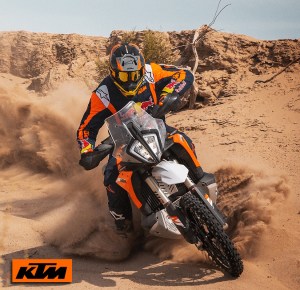
KTM: Race Heritage
KTM has been serving up orange victory Koolaid in the Dakar Rally since 2001, and finally clinching a Motorcross 450 Championship in 2012. Today KTM is a staple in every off-road segment and is arguably the reason we can still buy a 2-stroke motorcycle in the U.S. & Europe.
KTM’s focus should be thoroughbred off-road machines, with some performance adventure machines in the mix. Today’s flavor of motocross and hare scramble machines are exactly where they should be, along with the KTM 890 Adventure, and 890 Adventure Rally bikes. The early news about the revised KTM 390 Adventure also fits well into this new vision. Ultimately the message should be, riders that want a “woods or track weapon”, buy KTM.
KTM target customer
Motocross racing
Cross-country racing
Performance off-road Adventure
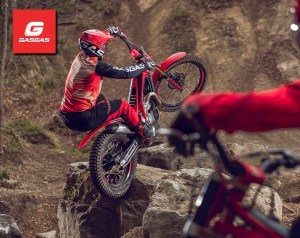
GasGas: Rugged Off-road for everyone
For folks unfamiliar, GasGas originated in Spain. Trials has been the bread and butter for GasGas since the 90s, while their victories also include Enduro championships in the same era. GasGas’s heritage has been about tackling tough terrain, not so much about speed or winning on tracks. That experience, combined with affordability and ease of ownership should be the GasGas benchmark. If riders are interested in riding trials, enduro or hard enduro, they should be browsing the red bikes. Considering that “rugged” is the spirit of GasGas, I also think they should be offering trail bikes and dual-sport machines for prospective buyers; reliable bikes that are meant to take incredible punishment, even if (perhaps especially if) they’re in novice hands. If orange bikes are the thoroughbred race horses, the red bikes are mules meant to go anywhere.
GasGas target customer
Trials
Enduro
Hard Enduro
Rugged Trail Bikes
Dual-Sport
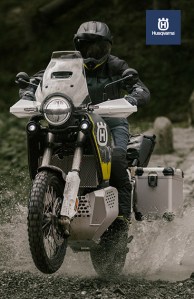
Husqvarna: Premium Technology, comfort, and performance
Husqvarna was originally a Swedish company, and interestingly enough, has roots in grand prix racing that dates back to the 30s. Considering Pierer’s current model of “Premium”, and the fact that Husqvarna actually has the longest heritage of all three brands, it seems fitting that Husqvarna should be the bread-winner with respect to emerging technology, premium components, and rider creature comforts. In line with the new Norden 901 Expedition, I think Husky should take over the responsibility of the new 1300 adventure platform from KTM. While not to belittle Husqvarna’s race pedigree, it unfortunately hallows in comparison to KTMs more recent victories, and makes more sense for KTM to keep the hard adventure segment, while leaving the premium “touring” buyers to chase after the white horses. That said, I do think it’s worth putting “special edition” models under the Husky logo; accounting for Graham Jarvis and Billy Bolt’s exploits, special edition Erzberg and 6-days Husqvarnas make sense (I know, Mani is still a beast).
Lastly, Husky should be the street bike brand. Husky re-emerged from Pierer with the Svartpilen and Vitpilen, and should continue on that journey, unchained from the styling and engineering choices dominated by off-road industry. KTM was known for its dirt bikes for a long time. Considering current damage to brand reputation, and the fact that others have suggested “KTM is a dirt bike brand with a street bike problem”, let Husky usurp KTM and offer premium road bikes in a demographic that is unquestionably distinct from the off-road community. I’m not exactly sure how to handle it in MotoGP, but it seems more applicable to put the “Motorcycle Grand Prix” brand back into premier class MotoGP rather than KTM. I’ll take that further, that is may even make more sense for Pierer to jettison MotoGP, and focus on World Superbike; albeit, that’s well outside of my wheelhouse of expertise.
Husqvarna target customer
Road Racing
Touring
Adventure Touring
Street
Special Editions
Without a doubt, these changes cost money; money that Pierer is already saying it needs to stay solvent. Assuming they can stop the bleeding, I still believe these changes are necessary to keep all three brands afloat. Circa 2008, General Motors was fighting this same battle. Pontiac was among the brands that didn’t survive the war. I have every reason to expect MV Agusta to be sold from under Pierer’s umbrella, but then again, I can also see the other red brand getting the axe first. Time will tell.
Assuming they stay solvent, do you think my plan will work? What changes would you propose?
Vague front-end feel, crappy handling, the dreaded sound of hissing air, or just the “flop-flop-flop” of a tire desperately trying to find its way off the rim. A flat tire isn’t the end of the world, but it’s a significant obstacle if you don’t have an easy means to remove a wheel in order to patch or swap an inner tube. For experienced woods riders, a solution is merely a stick or a log away… but for the dual-sport and adventure crowd, sometimes finding a feasible solution to prop up the bike in a gas station parking lot is a challenge; at least not without offending the proprietor. Fortunately, Tirox has been working on a solution to this problem for several years, and the new Snapjack X-trail motorcycle trail stand is now available.
In the interest of transparency, I’ve had a standing relationship with Tirox for many years now. When the owner of Tirox was working on this new stand, we had several conversations regarding the design, so to some degree I may have had a (very) minor influence on the final product. All this to say, I have received a free X-trail stand to test. Albeit, I’ve been testing and helping to develop this product for a couple years now, I believe in the product, but I also recognize I have a bias. That said, I think the results speak for themselves.
How does a trail stand work?
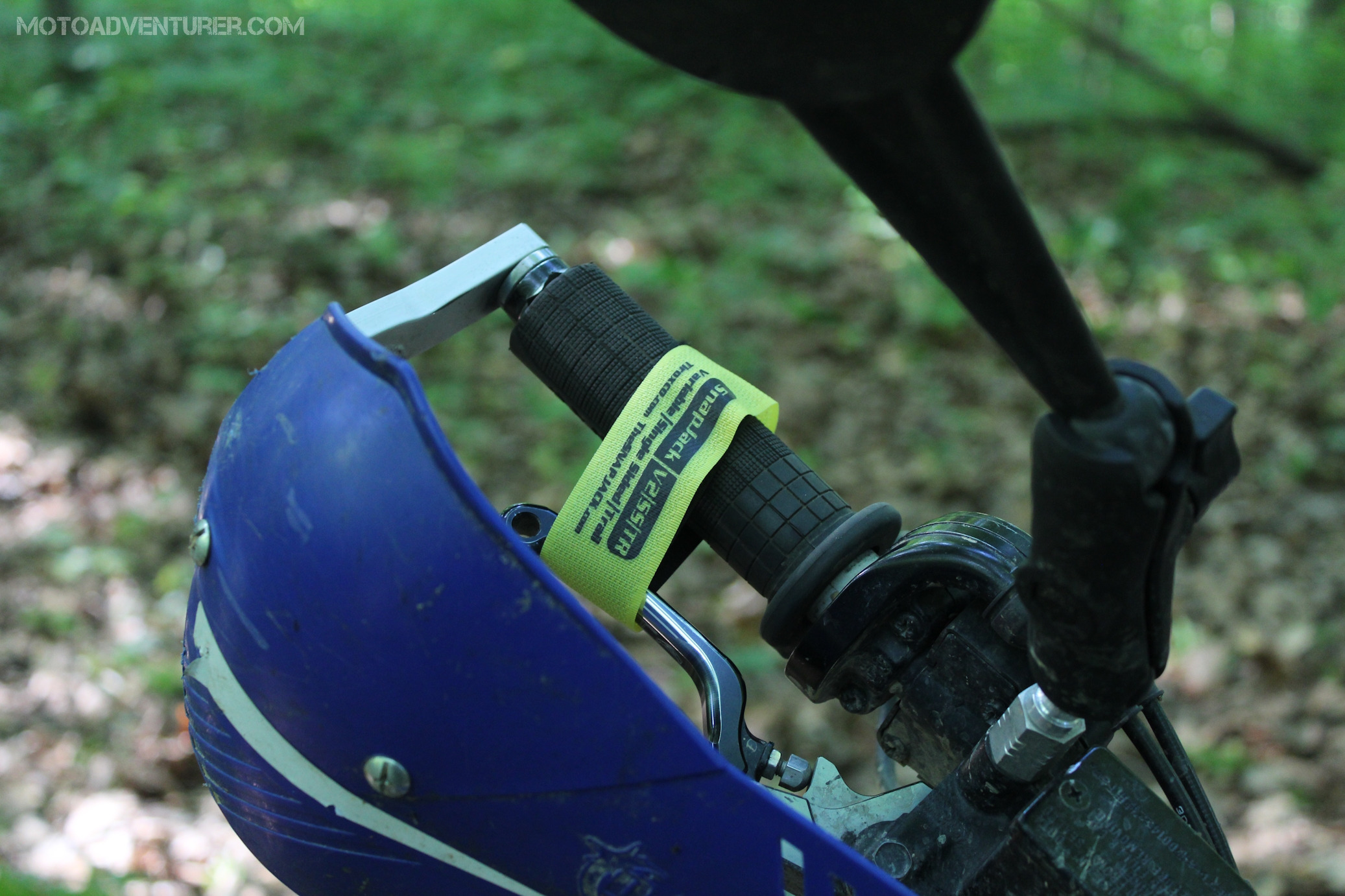
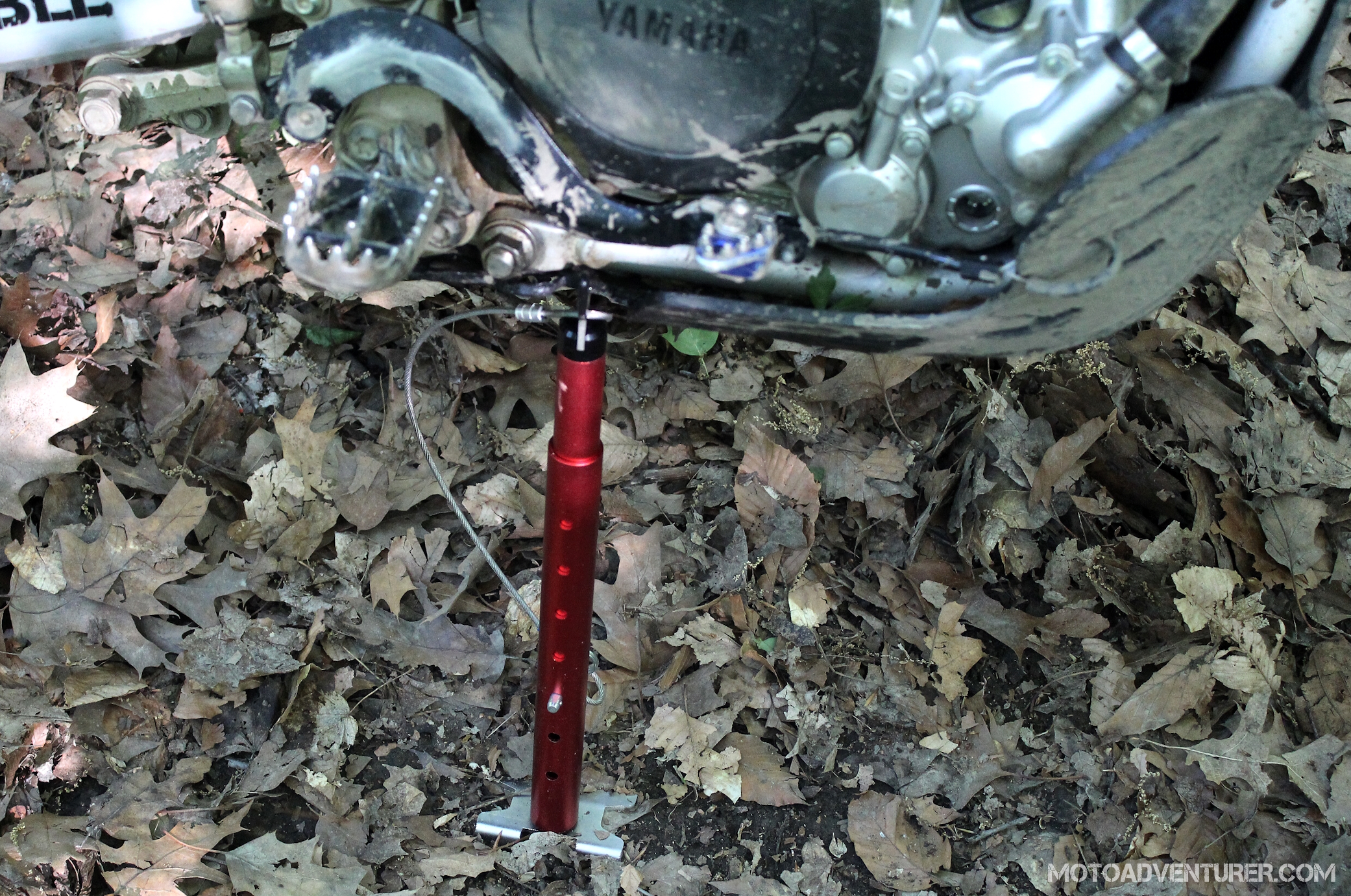
In the absence of a lift, “paddock” or “pit” stand, the Xtrail works like a secondary kickstand as a way to lift a wheel off the ground to clean a chain or remove a wheel. If removing the rear wheel, a strap is used to lock the front brake, with the kickstand down, the rider pushes the bike over slightly on the kickstand, lifting the right side of the motorcycle, and placing the trail stand under the bike in a secure location. Ultimately, a trail stand makes use of a single wheel and the kick-stand to form a stable “tri-pod”.
Why do I need a trail stand?
Per the comments above, tossing your bike over a log and finding a hardy stick is a feasible solution for removing a wheel on the trail. However, it’s more convenient to pull off a wheel and change a tire, wherever you want to. The X-trail packs easily in a pannier or a tool tube that can be fitted to your bike, behind your pannier rack, or even on your gear. The X-trail also includes a reliable means of locking the front wheel and even a reusable zip tie to hold the stand to the bike if needed. Unlike a “stick” the intent of the X-trail is to hold the bike stable so you can do the work to the bike with less fear of it toppling over.
What makes the X-Trail special
Trail stands aren’t exactly new. There are threads on ADV Rider where folks have disassembled a crutch and packed the telescopic part in the pannier bag. At this point, there are multiple aftermarket trail stands available for dual-sport bikes. That said, the X-trail is specifically designed to focus on strength, stability, and flexibility. A stick or a crutch will pivot and rotate if the bike moves. If the front tire isn’t planted, if the soil shifts, or if you rock the bike too much when wiggling the wheel out, the “third leg” of the tripod pivots, and if you’re lucky, the bike just gets “lower” and you’re not wearing it. The X-Trail’s foot is a serrated fixed platform, intended to keep the bike in a fixed position, despite standing in sand or mud. The X-Trail’s “hook” is also designed to be used in multiple positions, offering solutions for removing either the front or the back wheel, and also being useful on a wider range of motorcycles.
What’s my experience with the X-trail?
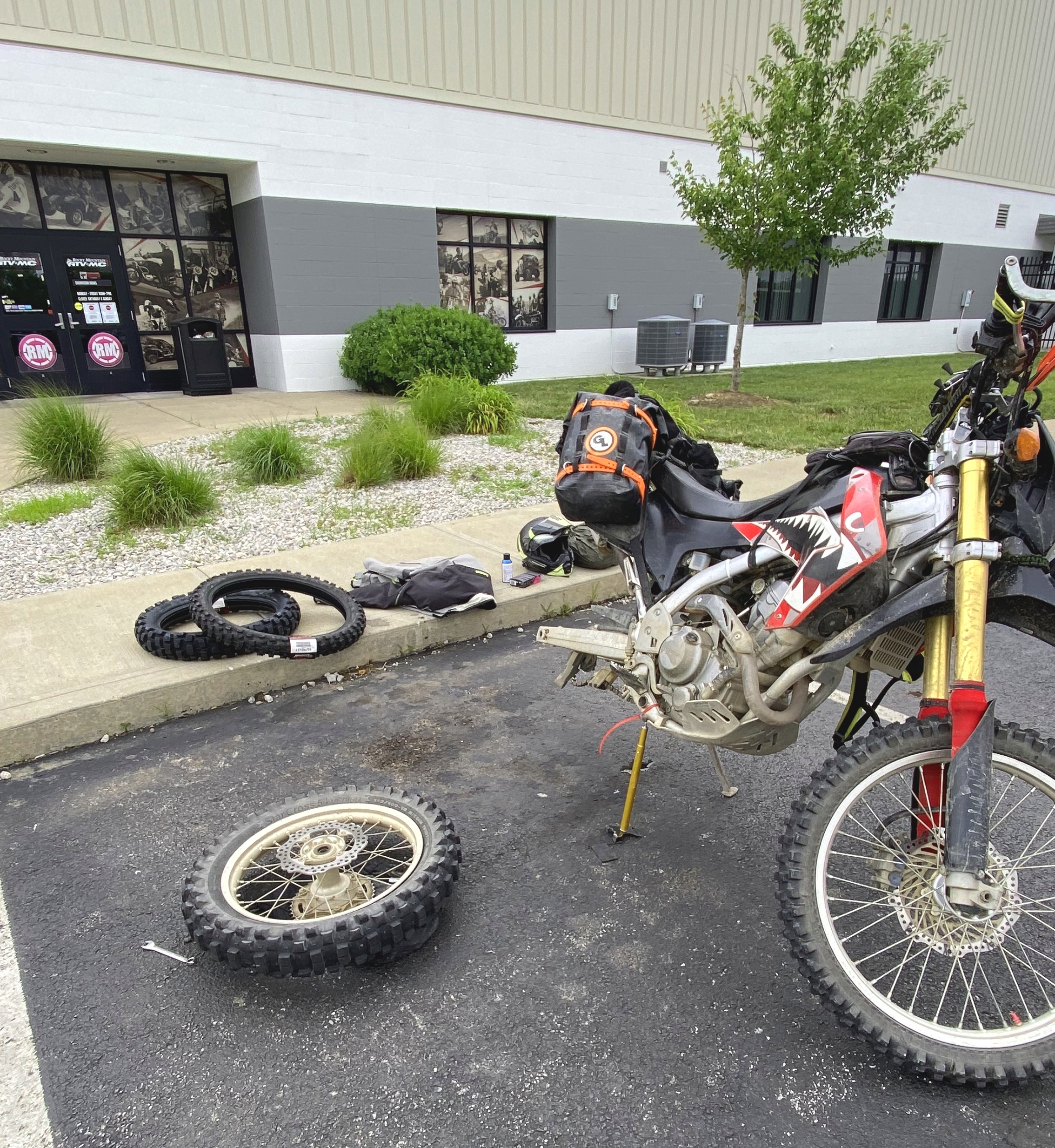
I easily spend 50% of my time riding solo, including dual-sport and even strict dirt riding. Self-reliance and redundancy tend to be priorities when riding solo. The X-trail is small enough that it could feasibly be attached directly to the bike to save space, but in my case, a tool tube is the preferred solution for transportation. Along with the X-trail, I also pack a patch kit, zip-ties, spare wire, and some fuses in the tool tube, then leave them on the bike all the time. In 2021 I spent a week living off the back of my CRF250L; during that week I realized I needed to make a tire change. I stopped at Rocky Mountain ATV one afternoon and changed both tires in the parking lot using the X-trail. It’s also been invaluable on a handful trail rides, making a trailside flat repair a minor event. There are other solutions available, including “free ones” in nature, but it’s a cheap insurance policy that works about anywhere.
Where can I get an Xtrail?
The Tirox X-Trail is available from a number of online retailers, comes with a lifetime warranty, and will set you back around $60. You can also find out more at TiroxProducts.com.
I caught this news headline a while back, “Construction zone along I-75 facing changes after 2 fatal crashes within weeks”. I-75 has been under construction for 2 decades here in Dayton, and unfortunately the situation has finally come to a head. After a long summer of major traffic incidents, including fatalities, the state has decided to close the interstate through Dayton. When confronted by the decision, the governor responded with:
“Excessive speed, texting, and otherwise distracted driving has reluctantly led us to an unfortunate decision. Despite our best efforts, our State troopers and local law enforcement have simply been unsuccessful at thwarting the guilty offenders. Our public servants are simply understaffed, and despite federal aid, we cannot front the necessary resources to keep Ohioans safe. Regrettably, we must close the interstate until further notice. Once the necessary infrastructure repairs have been completed, the transportation department will reassess the possibility of reopening the thoroughfare.”
That’s ridiculous you say? Indeed, the carnage taking place on public roads in Dayton is very much true, however I crafted the fictitious response above. “There’s no way they would close the interstate!” you say. Agreed, under the circumstances I have described, they wouldn’t; it’s not culturally acceptable. However, unpaved public roads are closed under similarly described circumstances, with great frequency.
What do you mean culturally acceptable?
While I’ve been unable to find the exact ordinance, multiple sources suggest that in Cleveland, women are strictly forbidden from wearing patent leather shoes. Imagine if you will, a law enforcement officer arresting a woman outside the theatre, because of her flashy footwear. Preposterous, but in the event an officer of the city sees a woman in patent leather shoes, that officer is choosing to let a person willfully disobey the law. How does this happen? In today’s world, It’s no longer culturally acceptable to arrest someone over their choice of shoes. Politicians know full well, demonstrations would be held in front of the county courthouse the moment that took place. Our culture won’t stand for it.
Inversely, if you want to spend twenty-geez on a side-by-side UTV, load it down with beer, and then hold the accelerator to the floor in every mud puddle you find, the locals will let you get away with it… Until they don’t. Eventually, enough complaining from residents will have the sheriff, if not federal authorities, install a gate; closing access to what was once seen as public property. Equestrians, bicyclists, hikers and bird watchers will likely retain access, moreover they’re bound to promote the wisdom of closing the byway to motorized traffic. It is culturally unacceptable to hoon around on a powersports vehicle, litter, and excessively wear public routes (especially after sundown). It is quite evident however, that it is culturally acceptable to punish the innocent by limiting access, or even outright closing areas to the public, under the guise of safety or preservation. In the end, the pedestrians outnumber the off-road community by a wide margin. In Red River Gorge, this was The Narrows Road, recently miles of trails were closed in Moab, Utah, and just last week, Flatlands Road near Suches Creek was closed in Georgia.
It’s time for a culture change
Folks aren’t going to like these terms, but this is the tyranny of the majority to quell the poor decisions of individuals while lumping them with a minority. Government funding for maintenance and law enforcement for these backcountry areas is limited. In the end, closing these areas means municipalities, counties, and park services can stop fighting a complex problem and spend that money on something that appeals more to voters. While I would love to promote a massive demonstration of off-roaders parked out front of various government buildings to protest the mass punishment of the innocent, I suspect it will be received like the “Freedom Convoy”. Our movement to keep public access unfortunately means improving our very underserved image, building relationships, offering alternatives to the rowdy crowd, and policing our own.
Seeing is believing
Gandhi said, “Be the change you wish to see in the world.” I’d love to wait around for our great off-road freedom fighter to show up and whip these authoritarians into shape, but that savior isn’t coming. Virtually no one is going to go toe-to-toe with “city hall”, if we want maintain the riding access to public roads we have, we have to be perceived as a force for good. I type this, reluctantly, because I’m the last person to adorn my helmet with a halo and promote a message of “set a good example” for the public. Unfortunately, we have no other choice. We’re swimming up stream against climate activists, government budget shortfalls, and generations of Americans that have no idea why anyone would ever engage in a risky behavior like motorcycles. If we want to hold the line, we must band together to present a brand that non-riders want to associate with.
Off the top of my head, the first, best method is the formation (or reinvestment) of clubs with focus on supporting the local communities and the highways and byways we ride. The Daniel Boone Backcountry Byway hosts two annual events called “back the byway” where Jeepers get together to fundraise for trail repairs and pick up trash along the routes. If the local trails are littered with beer cans and candy wrappers, some folks feel less guilty adding to the squalor. If a band of motorcyclists is keeping the byways tidy, the casual passerby feels at least marginally delinquent about throwing trash on the ground, let alone how the locals perceive the club when they’re hauling bags of garbage to the dump. I recognize this is tall order; motorcyclists are typically “rugged individualists”. Unfortunately we can individually lament the loss of public access, or band together in attempt to thwart it.
Building relationships
Getting motorcyclists to join a club for a cause is one ask, having that club establish relationships with the locals, especially the authorities is another level. In most cases, the sheriff, the Park Ranger, and the locals couldn’t care less about disappointing some out-of-towner when they close a trail. That discussion becomes much more painful when they have to look a familiar face in the eye. As clubs and individuals, we have to go out of our way to meet local residents and authorities and leave a positive impression. For Adventure riders, this should be easy. If you’re grabbing a sunrise breakfast at the local diner, when you spot the sheriff, tell them to have a great day (bonus points for buying their coffee). Meeting the local park service folks may be a bit more difficult, but if you’re passing through those areas, opportunities arise, and in the interest of volunteering, have your club make some shirts, and show up to hiking trail clean up days. You’ll meet the locals, the trail support people, and maybe even some activists; subsequently you’ll get the opportunity to put a name to an otherwise faceless stranger that has been demonized as a trail destroying force. Taking this a step further is networking with the 4-wheeled organizations; they’re a larger part of the overall population and like it or not, they’re in the same boat with us. If you’re really motivated, it would be wise to befriend the mountain bikers. They will undoubtedly be less likely to understand our plight, but you’ll have your foot in the door with the pedestrian community, and while they don’t see it coming, parts of the hiker community will gladly kick bicycles off the trail when they’re done with us.
I get it, this is work. It’s much easier however to keep a trail open, than it is reopening a trail that’s been closed.
Ride rowdy
All of us have that one friend. If you don’t, it’s probably you. Wheelies in the parking lot, every incline turns into a hill climb contest, holding the throttle open and praying is easier than finding skills and talent… I can go on. These folks are apart of the community, and they’re not going away. Motorcycles attract extreme personalities; ultimately folks need opportunities to ride the way they like to ride. The first answer to this is private property. There are various motocross and enduro clubs around the country. We need to network with these organizations to get new members to the clubs that are accepting, and ideally set up public events at these spaces that offer the kind of riding the ornery folks enjoy. Events like these become maintenance and improvement fundraisers for the clubs and a networking opportunity for everyone. A similar situation can be offered by public organizations, but needless to say, most of them will balk at the possible “trail damage” caused by competition events. I want to reiterate, I’m not trying to push the rowdy riders off as someone else’s problem, to some degree these folks are simply missing the outlet they’re looking for, at the price they’re prepared to pay to engage in it.
Policing our own
When folks can show up and pay nothing to hoon around, they’re going to. Unfortunately there will be those among us that refuse to play nice with public riding areas; be it nihilism, narcissism, laziness, or deviance. Unfortunately, counter culture is as much part of the motorcycle culture as “live and let live”. Again, as individualists, I’m asking that we evolve to something beyond our station. When we see one of our own behaving in ways that will likely come at a cost to us all later, we have to say something. It’s uncomfortable and very much against my nature. Unfortunately until we build a massive off-road paradise, we’re stuck dealing with trigger happy authorities that are simply looking for an excuse to close access to off-roaders. We have to guard our brethren and prevent them from becoming said example, if we can.
Talk is cheap
Closing a road, installing a gate, passing a law, issuing citations, and publishing editorials (like this one) are easy solutions. You know what’s hard? Leading by example. In the last 3 years we’ve seen globally that telling other people what to do is easy. Proving that your actions lead to better outcomes takes effort. It’s human nature unfortunately. Doing the same thing expecting a different result is insane. If we want to strengthen our community and keep trails open, we have to do something different. We have to make the hard choices and evolve. I pray that writing this article is the first step for me personally. I hope to find at least some of you on the same “proverbial” trail in the future, headed in the same direction.
It’s winter in Ohio, and for many of us, that means the beginning stages of Parked Motorcycle Syndrome. Fortunately, the New Year opens with another edition of the Dakar Rally. For 2024, the Dakar rally will be a 14 day, 12 stage, ~5,000 mile adventurous rally race across the Saudi Arabian desert.
What is Dakar?
Originally the named the “Paris to Dakar” rally, the Dakar is a “rally raid” event and brainchild of Thierry Sabine. In 1975, Sabine was competing in the “Cote-Cote” rally where he was subsequently lost in the Tenere desert for 3 days. After which, Theirry decided that the desert would be an ideal location to host an annual rally. In 1978 the first rally was held, leaving Paris, France and ending in Dakar, Senegal. 182 vehicles showed for the first iteration of the grueling event, with only 74 finishing the 6,200 mile test of endurance. For 2024, the Dakar Rally expects to host over 750 competitors, including 137 motorcycles.
What’s a Rally Raid?
“Rally Raid” or cross-country rallying is a type of off-road racing that typically takes place on an unmarked course where the participants race from start to finish, never traversing the same terrain twice. Navigation is typically the defining factor of rallying, since the course is not marked, the racers must ride as fast as they can, while still reading their road books or following their GPS depending on the event. Dakar in particular has been known for its road book navigation, which has changed dramatically in recent years. In addition, rally races often use portions of public roads to connect offroad sections. Rallies like Dakar may be 5,000 miles, but only portions of that distance are off-road. Road sections are often called “liaison” sections, where riders must arrive at the start point for the off-road “special” at a certain time, but while on the liaison sections riders are not timed to avoid problems with local traffic and speeding.
What’s a Road Book?
Road books, “roll charts”, or “scrolls” are paper maps, often “rolled” through a roadbook holder that shows the rider navigation information, one block at a time. The roll chart contains blocks of information that show distance, direction, hazards, intersections, and indication of the course direction based on this information. Riders progress the road book as they pass various milestones by rolling up to the next navigation note. You can buy a simple manual roll chart holder for your dirt bike, but pro rally racers usually have a “rally tower” on the front of their bikes that hold the roadbook (along with various other navigation and safety equipment) and progress the roll chart by pressing a button the handlebars.
What makes Dakar special?
There are a number of prestigious and well-established rally races around the world, but most competitors recognize the Dakar rally as the most challenging. Most years, the Dakar rally has no less than 10 days of racing; often with a single “rest” day in the middle. Riders and their teams must prepare their machines & themselves to compete at the highest level, traversing off-road timed-special sections in excess of 200 miles each day, for nearly two-weeks. In Dakar there are time penalties for speeding, engine swaps, missing waypoints, among others, meaning that precision and efficiency are every bit as important as speed. In recent years, Dakar also includes a two-day “Marathon” stage, where riders are responsible for all routine maintenance on their machines. They may receive assistance from other competitors, but their team and mechanics are barred from helping the riders fix anything broken or in need of service on their bikes.
Most of the front runners are sponsored riders by factory teams like Honda and KTM, but the Dakar has a special class they call “Malle Moto” that harkens back to the roots of the rally. “Malle” is French word for “case”, essentially a tote of personal belongings, tools, and spare parts, which is all the Malle Moto riders get besides a tent and their bike. Malle Moto riders are the hardest of competitors, racing hundreds of mile each day, working on their bike all evening, then getting as much sleep as possible before the process begins the next day. Many Malle Moto competitors only get around 4 hours of rest each night aside from the rest day. Sleep deprivation is a big deal for all competitors during the two week event, and especially for these unsupported competitors.
I would be remiss to mention, race direction works very hard to make the even safer each year. Unfortunately, multiple competitors are injured each year at Dakar, and more regrettably, the rally has claimed the lives of various competitors over the years. Unknown rugged terrain, sleep deprivation, marathon stages and more make for the ultimate endurance challenge.
How do I fallow the Dakar?
The Dakar rally is returning to Saudi Arabia again in 2024, which means that the race is 8 hours ahead of Eastern Standard Time in the U.S. Most days the special sections are wrapping up by the time the sun rises on the east coast, so you can typically check the results on Dakar.com in the morning to see how the day went. Dakar also has an app you can download on your phone if you prefer mobile. The Dakar YouTube channel will feature recaps and highlight reels almost every evening. The sports networks may drop the occasional update video, but if you want to see some of the best coverage, download Red Bull TV on your smart TV or cell phone. Red Bull’s “Dakar Daily” as they call it, is ~20 minute recap of each day’s racing, featuring epic video of the action and scenery, along with racer interviews as they paint the best picture possible of what it’s like to be at the rally. There are also a couplePodcasts out there that do a great job of covering the action each day, occasionally getting interviews directly from the competitors.
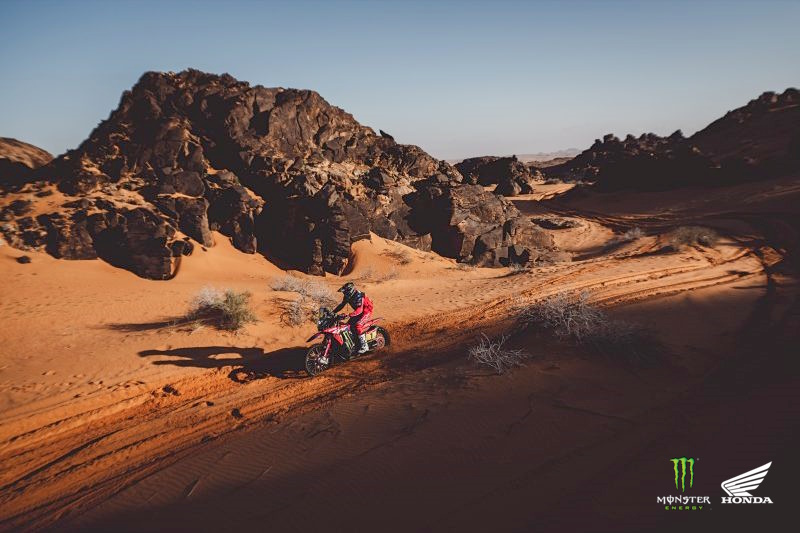
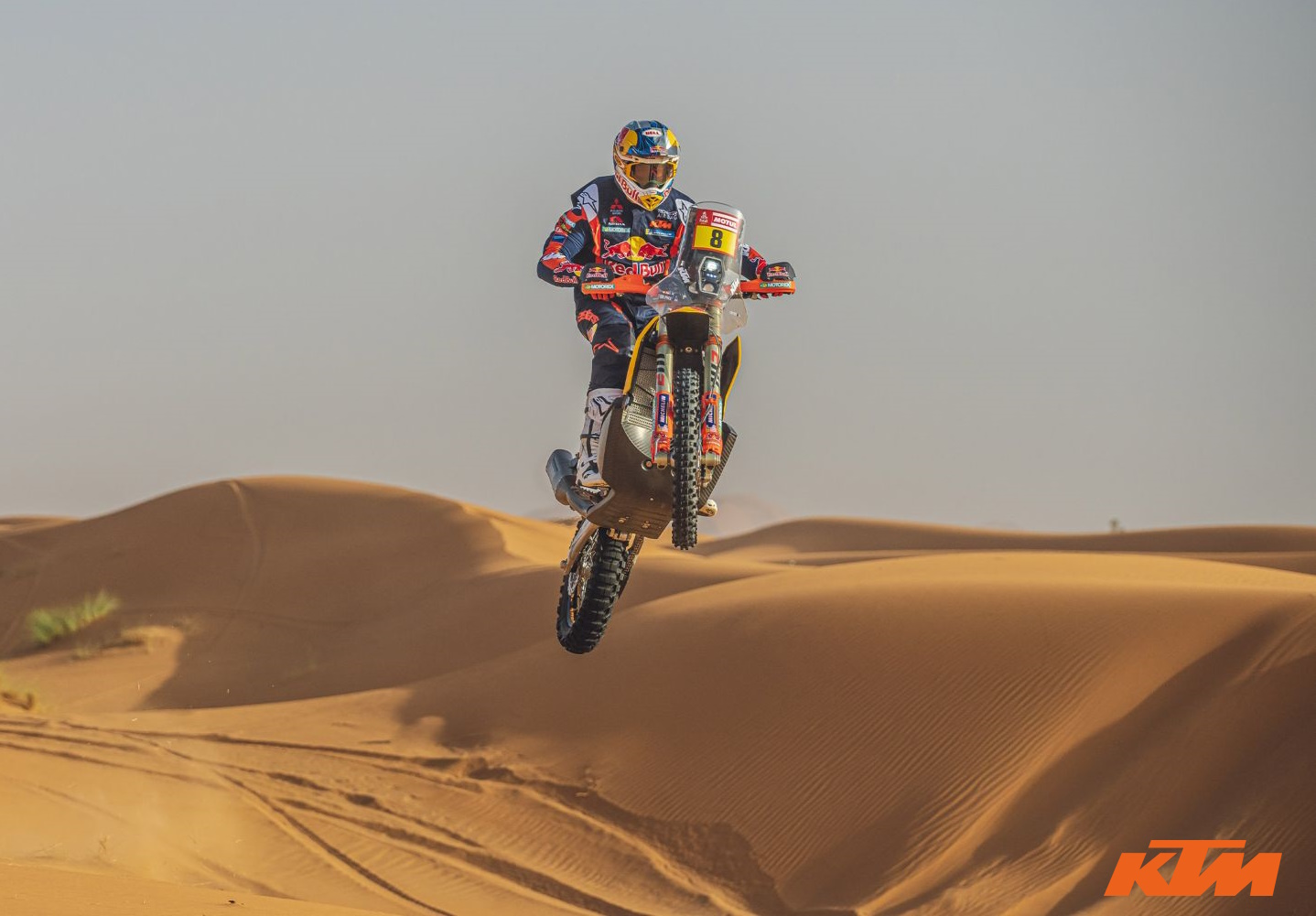
This year Americans Ricky Brabec and Skyler Howes will be racing for Monster Energy Honda likely near the front of that pack, but be sure to keep an eye on Aussie Toby Price and German Matias Walkner racing for KTM, along with Brit Sam Sunderland and his Aussie partner Daniel Sanders on the GasGas rally bikes, with last year’s winner, Argentinian Luciano Benavides is riding for Husqvarna. Also be sure to keep an eye out for for announcements from the American Rally Original team if you’re looking to follow more U.S. competitors in this year’s event.
This year’s Dakar Rally starts Friday, January 5th. If you’ve not tuned in to follow the rally in the past, here’s your next chance.
In 2019, no shortage of press was dedicated to the impending demise of Harley-Davidson as a consequence of boomers aging out of the hobby. Social media and the comment section of such articles were loaded with remarks about “grey beards” being out of touch, killing the brand, and so on. Ironically, what has not been discussed, is how a related demographical shift may likely have a larger impact on our motorcycle community and even the bikes themselves… globally.
Aging demographics
Demographics is less than an exciting topic on a motorcycle website, but hang with me, it’s relevant. Back in the 80s, folks in Japan realized they were on the cusp of population decline. Quietly, the Japanese began moving their factories from the mother island to the United States; utilizing the booming American workforce as a means to filter profit back to their homeland where labor was becoming scarce. As a result, today Honda’s are arguably the most “American made” automobile in the U.S., and Japanese companies like Toyota are the most in-demand vehicles on dealer floors. Meanwhile, Japan’s population is shrinking at a rate of about 800,000 people a year.
While Japan is the most notable example of population decline and economic-demographical shifts, there are other major regions headed this direction. Russia has been in (birthrate) population decline since the 90’s, but more concerning on the motorcycle front is Europe, and especially China. Some demographers believe that China’s population may have actually peaked in 2021. Germany, the 4th largest economy in the world (after the USA, China, & Japan), is struggling with a birthrate of 1.5, but is still managing to sustain its population through immigration; experts question if this is sustainable. Italy’s population has been in decline since the mid-2000s, while much of Eastern Europe is in far worse shape with extremely low birth rates and a rapidly aging population. As of now, western Europe, especially France and the UK are maintaining, however, most of the first world, the United States included, have birth rates lagging behind the replacement rate; presently hovering around 1.6.
Inversely, today much of Sub-Saharan Africa is leading the world in population growth (Niger’s birthrate is 7.2). As motorcyclists however, we would be wise to notice that as of this year, India has surpassed China as the most populated nation on earth, and unlike much of the first world we know, India is still holding up a birth rate above 2. For folks unfamiliar, India is the home of Bajaj, Hero, and Royal Enfield. Royal Enfield likely needs no introduction, but domestically, Hero and Bajaj are less than household names. Based in New Delhi, Hero MotoCorp began as a joint venture between Hero Cycles and Honda in the 80s but evolved into an independent company around 2012. Dakar fans will undoubtedly recognize Hero as they’ve been competing in the endurance rally since 2016. Bajaj on the other hand has made lots of headlines in recent years from its partnerships with premium brands like KTM and Triumph. The Bajaj Group currently manufactures KTM’s single-cylinder Duke models, along with the powerplant (if not more) of the new Triumph Scrambler 400.
Unanticipated consequences
While I see Yamaha as an exception, the Japanese monikers have become stale. Honda and Suzuki have both launched new powerplants in recent months, unfortunately, both companies continue to “play it safe” with offerings that aim center mass at target customer use-case while offering the sex appeal of the Sears catalog. Suzuki is said to have one foot in the grave for years now, but regarding Big Red, I want to be excited for the new TransAlp. Unfortunately, I continue to scratch my head when I consider Honda’s approach to the ADV market. The heavier, more displacement, or higher priced the model, the more off-road it leans; seems inverted to me. All 4 Japanese companies formerly dominated off-road but now seem to be ignoring the growth of hard enduro, while softly conceding an 18-inch rear wheel, and if you’re lucky, a 6th gear for hare scrambles. Again, Yamaha has kept their sole two-stroke mill on life support, but it’s tough to be optimistic considering Japan’s almost sole focus on track racing, be it on or off-road. Certainly, I welcome views to the contrary, regrettably, I believe these behaviors are indicative of the cause. It’s a dramatically aging population, with a shrinking workforce. Combined with cultural risk aversion, this has led to slow to no innovation and development in our niche (hobbyist) industry.
Europe is still selling smoking hot bikes, but outsourcing is growing in popularity. It’s interesting to think that the Bavarian company (known for boxer twins) offers its middleweight adventure motorcycle fitted with a Chinese powerplant. That’s not an insult, simply an observation to draw attention to the stark contrast from its former nationalism; combined with an interesting partnership of contrasting (perceived) stereotypes regarding quality & precision. The other German-speaking brand, KTM follows suit, including their 790 Adventure arriving on U.S. Shores in 2024. While I don’t see BMW nor KTM being damaged by outsourcing, in fact, quite the contrary, I mention these two examples because I believe it’s a hint of the future. Intellectual property is likely to be driven from the countries of corporate origin, however, manufacturing is likely outsourced to “younger” demographics that can more affordably assemble the products.
I hate to say it, but I fear China is a flash in the pan. I took a ride on the CF Moto Ibex 800 last September. Probably one of the best test rides I’ve had since I can remember; that bike was bonkers and even better on my favorite “roads”. With that, I’m extremely excited to see a new 450 twin adventure bike on the market. That said, as best as we can tell, much of what is coming out of China is a result of a partnership, not invention. Historically Chinese companies have had a reputation for intellectual property theft. As stated above, we know that designs making the headlines have originated in Europe but are built in China and then licensed for alternative applications. As I see it, we’re on the cusp of a Japanese invasion-like moment akin to the 1970s with regard to China. However, China’s population, culture, and politics are dramatically different than that of Japan circa 1980. Unfortunately, I fear that by the time Chinese companies perfect design and innovation on par with name brands, it may be too late for Chinese manufacturing and infrastructure. Even with a reliable outsourcing model, China has some steep hurdles ahead as the shadow of the “one-child policy” looms over the labor force.
India however, is just hitting its stride. Royal Enfield (RE) is the easy example here. The longest continuously operating motorcycle manufacturer in the world; there’s a caveat of course, because RE made the exact same bike for decades. However, they have a whole new plant, with all new models; innovation is increasing, as is the national population. India, and the motorcycle companies based there, are hitting the sweet spot as industrialization is offering locals the opportunity to specialize. Intellectual property is being generated under the same (proverbial) roof as manufacturing, which avoids the consequences of outsourcing. And as of now, labor costs are lower, relative to the consumer. Bajaj of course is benefiting from European development, however, India is not fighting the same headwinds of political and demographic struggle facing the Chinese. As Triumph, KTM, and others bolster single-cylinder offerings in their lineups, it will be interesting to see what new innovations may emerge from India in the future.
History is littered with false prophecies
I want to reiterate, this is speculation on my part. Moreover, I don’t wish ill will on any person, company, or nation. I read the news, I watch behavior, and draw conclusions. Conclusions that could be blatantly false. The demographics aren’t exactly fixed, but for many, the die has been cast. Outside of Japan, much of the industrialized world only knows a “system” of continuous growth. As more and more citizens shift to fixed income, and fewer and fewer young people enter engineering and tool trades, economic contraction stunts industries, and exports will change. I work in engineering and automation; perhaps the future will be similar output with fewer humans and more robots. Plausible solution, assuming we can maintain the customer base and investment capital. Nonetheless, demographics are undoubtedly going to shape the motorcycle offerings of the next decade.
A thousand words have been dedicated to my theory. How do you see this playing out?
After another summer of riding and racing, the Unscripted Podcast is back on the air. My apologies as life took a firm hand on the wheel last spring, but we’ve got a solid list of guests lined up this winter.
Episoside 54: Matt Kelley
Matt Kelley is a motocross, cross country, and trials rider. a seasoned adventure rider, big-bike enthusiast, in 2018, Matt Kelley was part of Team USA competing in the BMW GS Trophy event in Mongolia. Matt tells us about his upbringing in motorcycles, the various toys hiding in his garage, and how he enjoys the challenge of riding adventure motorcycles off-road. Matt gives us all the details about what it’s like to participate in the GS Trophy challenge.
Episode 55: Jeff Pierce
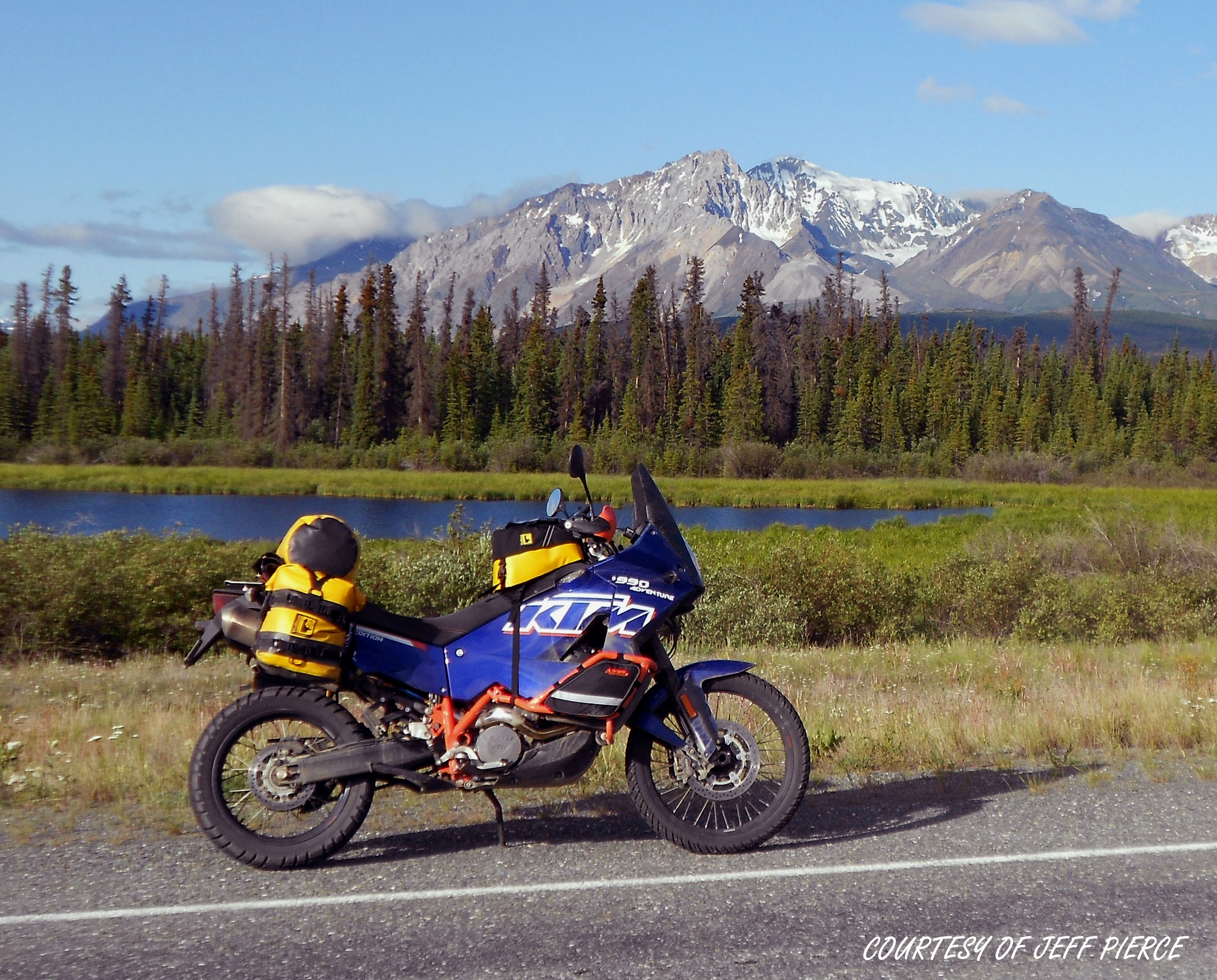
Jeff Pierce is a long-time friend Navy veteran, and Red River Scramble volunteer. I helped Jeff build his Harley Dirtster back in 2018. Before we met, Jeff purchased a new KTM 990 Adventure and rode from Ohio to Alaska and home. Jeff and I get into all the details about what it takes to ride to Alaska, how to pack, what to expect, and every rabbit hole along the way.
Episode 56: Kane Wager
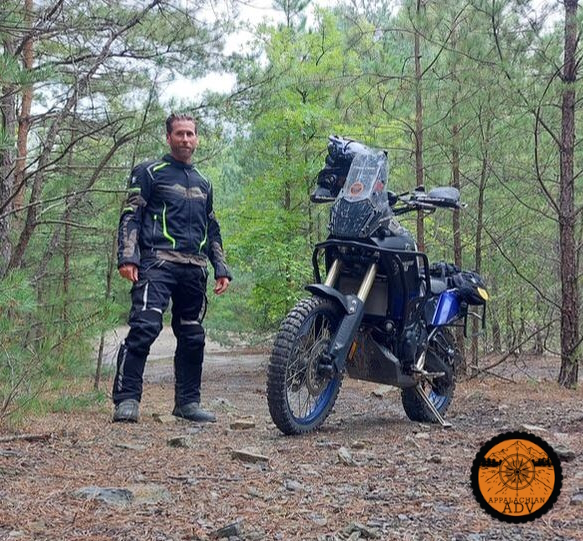
Kane Wagner is an Air Force veteran and the owner-operator of Appalachian ADV adventure touring and training company. Through his company, Kane hosts a series of adventure riding events in eastern Ohio and central Pennsyvnia along with and rider training clinics. Kane and I talk about what to expect when attending one of their events, what kind of terrain to expect, and so much more.
Episode 57: Drew Faulkner
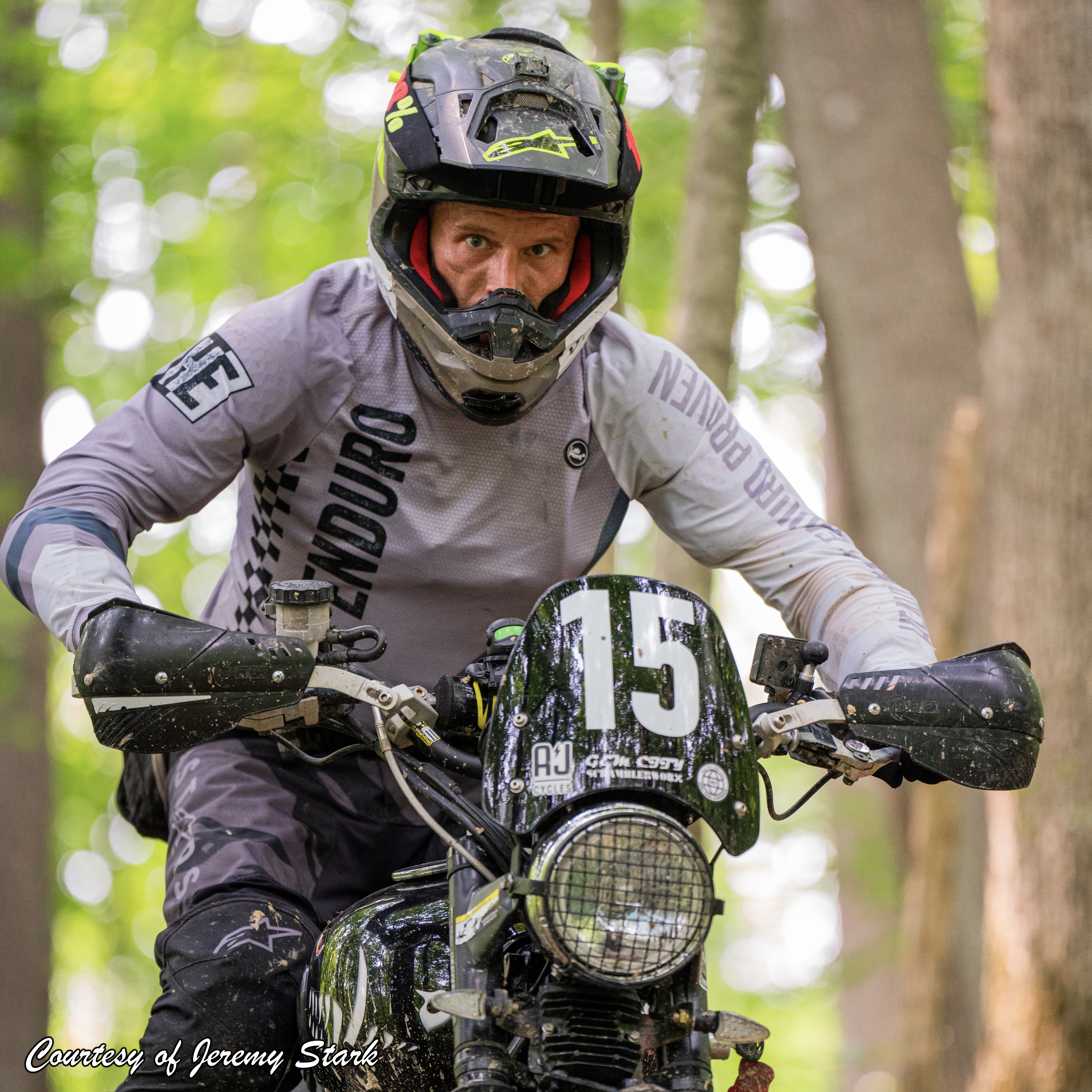
A flip of the script, my buddy Mark Scherrens decided to put me in the hot seat for 2 hours. We talk about what its like to not only race a hare scramble, but what it’s like to race an adventure bike in Kentucky. We talk about how I first got into racing in KXCR back in 2020, how the series first launched the ADV class, and what riders should expect on the courses. We cover preparing a big bike to race a hare scramble, how to prepare yourself, what kind of gear to wear, more blurbs about adventurizing a Triumph scrambler and more.
Episode 58: Dana Brown
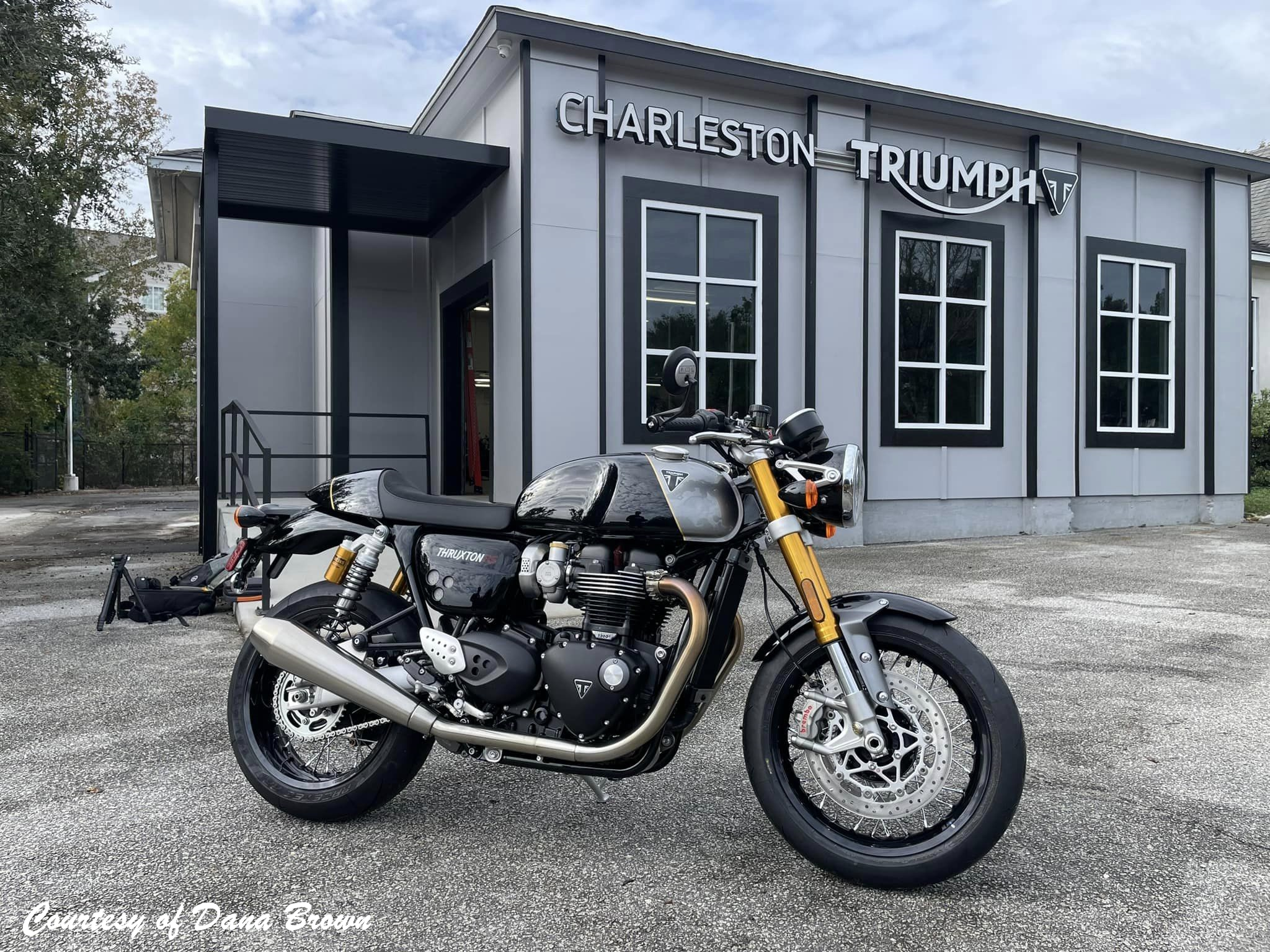
A returning guest to the show, Dana Brown and I talk about his recent motorcycle accident and then making a career change as a motorcycle saleman. We talk about sales trends and the changing motorcycle market in his district around Charleston, South Carolina.
Episode 59: Brian Ballard
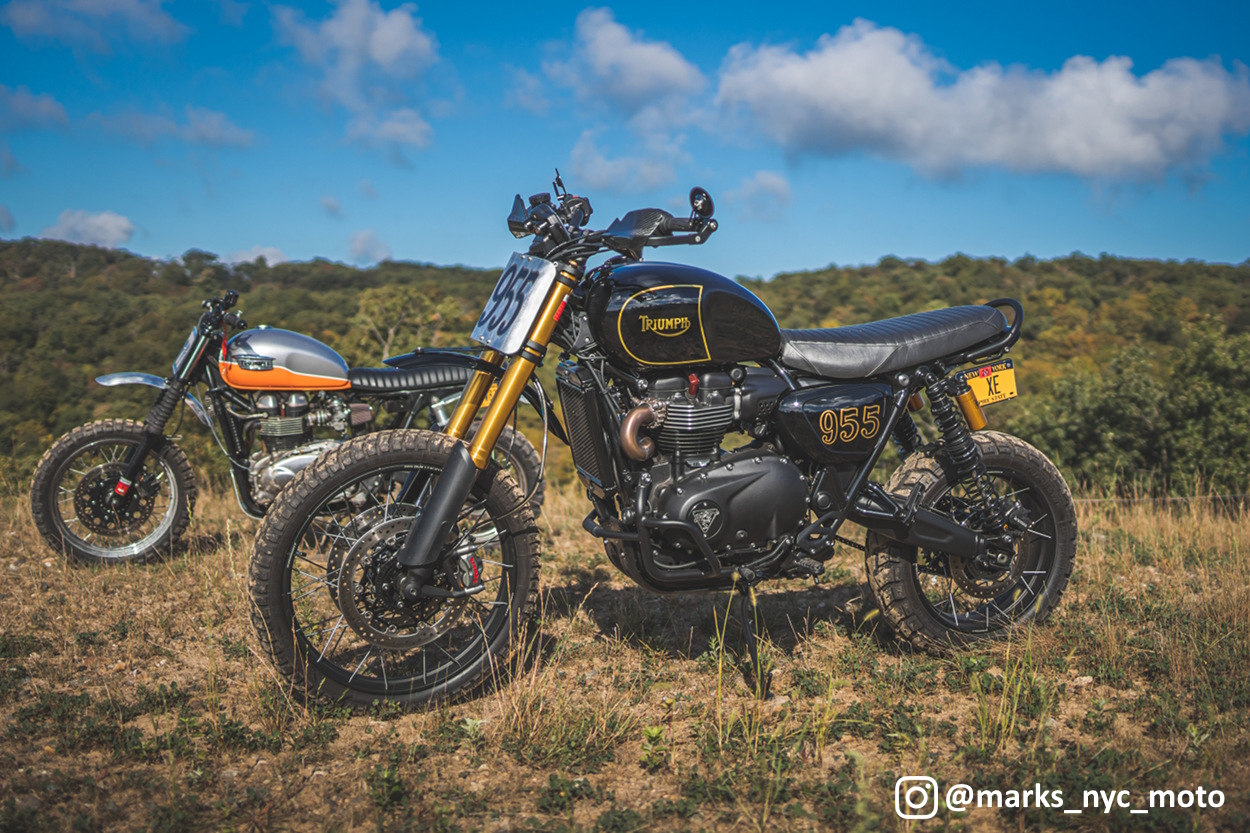
Brian Ballard is the owner of A&J Cycles in New York. A&J specializes in helping customers customize their bikes with high-quality aftermarket parts, from headlights to suspension. Brian and A&J Cycles also sponsors a flat track race team that competes across the country. Brian and I talk about his love for Triumph twins, customizing bikes through the winter, and the amazing family that is the off-road racing community.
This is just a preview of what we have on tap this winter. If you’ve not tuned into the Podcast before, check out Unscripted on Spotify, Apple Podcast, Google Podcasts, and more.
At this stage, I shouldn’t need to convince anyone that putting an MT-07 engine into an adventure frame and launching an all new 700 adventure bike is a good idea. That idea was so good, I think Yamaha should take it further. Please revise the R3’s twin cylinder engine to 350cc and place it into a bespoke adventure frame, and launch an all new T3 for the ADV crowd that is clamoring for more Light adventure motorcycles. This new rally-esque machine can take cues from it’s larger sister, while offering a superior choice over Honda’s 300L Rally or Kawasaki’s Versys-X 300. This new T3 would need to bring at least 3.5 gallons of gas to the party, be equipped with at least 10-inches of suspension travel, wear a 21/18-inch wheel set, and weigh in close to 350 pounds. It’s understandable that beating the 300L Rally’s weight of 330 pounds may prove difficult for a twin engine, but as long as this new T3 tips scales under the Versys-X, KTM 390 Adventure, & the new CF Moto MT450 Adventure, and brings 37 ponies to the party, it’s a winning formula.
The SCR350
Honda has decided to revisit the classic CL models by launching a new 500cc scrambler using its existing 500 twin engine. Triumph has just dropped a new set of 400cc Scramblers (standards). It’s evident, that despite some grumblings from moto-journalists, the Scrambler craze is here to stay. Wedged somewhere between the MT03 and the new T3 described above, there’s an opportunity here to ruggedize an XSR300-esque machine to offer a true scrambler from the Blu-Cru. While I recognize that this is mostly “a styling exercise” when street bikes get round headlights and high-pipes to capitalize on nostalgia, building a 350-twin based on an existing ADV machine offers the opportunity to recruit new riders that want to dip their toe into the ADV world, but aren’t ready for full commitment and don’t want all the farkles & wiz-bang. Simultaneously, it offers a true standard motorcycle with marginally more suspension travel to tackle the deteriorating road conditions of America’s urban centers. While Honda’s SCL500 is a stylized Rebel 500, I think it wiser for Yamaha to take a page from Triumph’s book and offer a mono-shock machine with 6-speed gearbox, 19/17-inch wheel combo, 6-inches of suspension travel, and tipping the scales under 400-pounds.
The WR350R
The hole left by the WR250R is palpable. In the absence of the Dubya-Ar-Ar, Honda and Kawasaki have both bumped the displacement of their quarter-liter dual-sports to three hundred. These new 300s are better suited to short interstate trips than ever before, but still lack the gusto offered by many of the European street & trail alternatives. There was never a better time to dust off the blueprints of the mighty 250R, and bump the displacement to 350. As WR owner myself, I’ll gladly concede, a new 350cc engine in the legacy WR250R chassis would already be a massive improvement over the competition; both Honda and Kawasaki’s options are tipping the scales over 300 pounds, while the classic WR stood a svelte 5 pounds lighter. 11-inches of suspension travel is still best in class, but I believe there’s an opportunity to offer an “extreme” package for the most aggressive dual sport riders that offers 12-plus inches of suspension travel akin to the WR250F. This idea is twofold. First, fools like myself enjoy riding from driveway to trail and home, with zero compromise off-road. Second, considering that Honda’s CRF450RL tips the scale at 289 pounds, a WR350R-x could be a direct competitor in terms of performance, but still extremely approachable with regard to price and serviceability.



















 Moto Adventurer