On the heels of EICMA1, there’s undoubtedly a lot of new blood emerging in the adventure motorcycle segment, especially at the bottom end of the displacement range. As more and more models are being released out of Southeast Asia, I’m getting T7 teaser vibes circa 2017. Coincidentally, I get the distinct feeling there are eerie similarities between today’s economic conditions and the shifting motorcycle market in the 80’s. I’ve been asking for some time, what motorcycles will replace the big 650 thumpers, and I believe we’re about to have the answer.
Big moves out of China
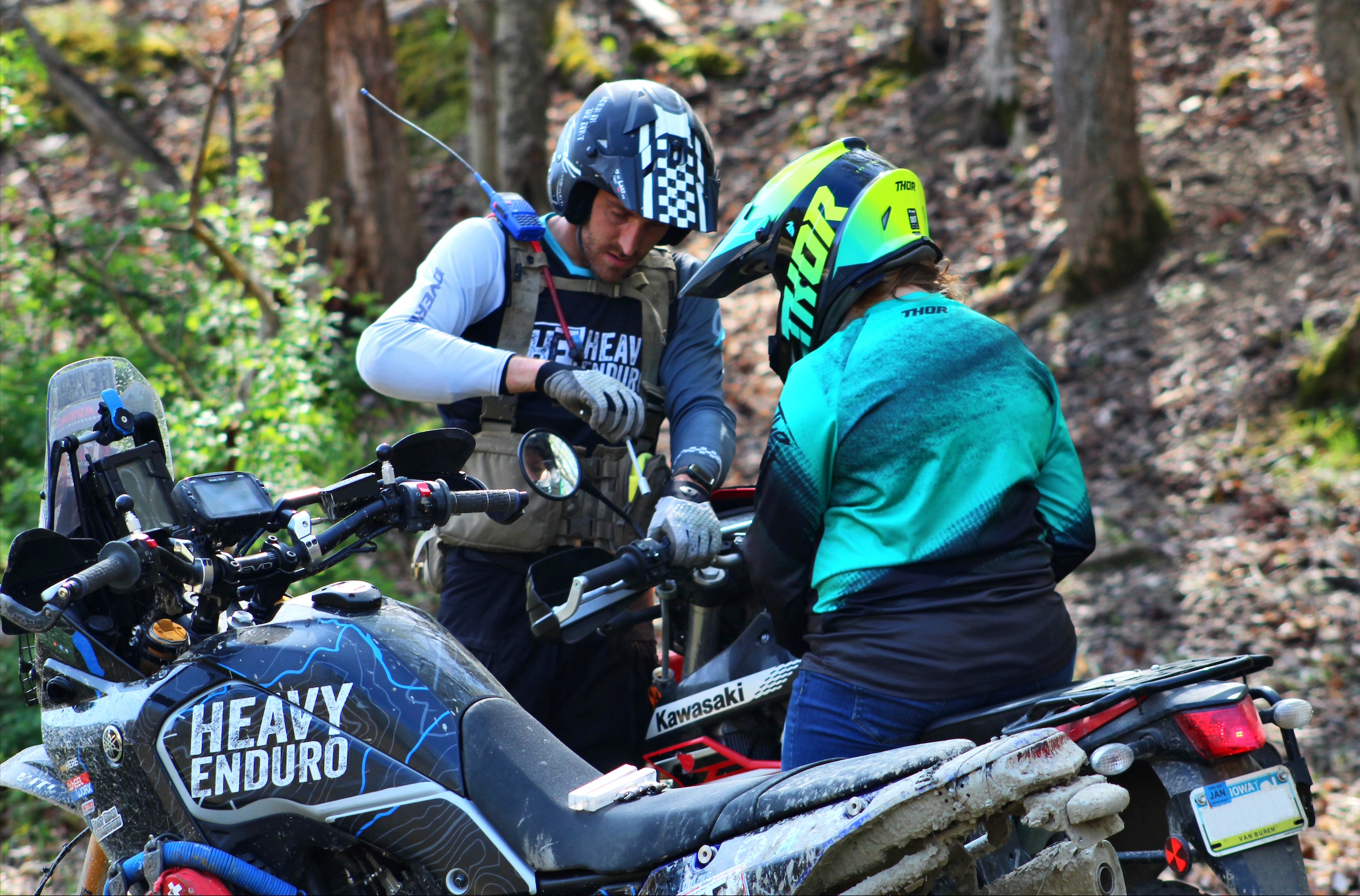
Kove burst on the scene last year with their 450 Rally. In January of this year, the Chinese company entered 3 of these bikes in the Dakar Rally, all of which finished. We can have an argument about competitiveness, but for a brand new rally team, from an unknown manufacturer, it’s a hell of a testament to reliability to finish what is arguably the most strenuous test of man and motorcycle. The latest news is that American Mason Klien has been recruited to race for Kove next year, so it will be interesting to watch those bikes perform in Dakar ’24 with someone of Klien’s caliber at the helm. The first retail Kove 450’s have already arrived2 here in the U.S. Their rally-ready race bikes are available for around 13 grand, but for the rest of us dirt-Gumbys, we can get street-legal 450 “adventure” bikes for around $9,000 (not including tax freight and fees).
While I fancy the idea of riding from driveway to hare scramble and home on something like a Kove 450 rally, I admit I’m most excited about CF Moto’s new 450 MT Adventure. For dirt bike and dual-sport folks, “450” is a ubiquitous term, and if you’re looking for a deal, there are endless listings of WR450s for sale on various marketplaces. CF Moto, however, is launching a 450 twin-cylinder engine in this new adventure platform. Unlike Kove, CF Moto is a Chinese company that already has established ties to big name brands; CF Moto builds the 790 engine for KTM, which it has also licensed for their Ibex 800 adventure platform (which I’ve ridden, it’s excellent). Considering Honda’s reluctance to “harden” the CB500X for more rugged off-road conditions, CF Moto seems to be pressing the envelope in the “lighter” direction; with all the adventure accoutrements we have come to expect.
The oldest continuously operating motorcycle brand
Royal Enfield was once a nostalgic moniker or a bad joke in motorcycle circles depending on who you were talking to. Since 2013, Royal Enfield has been on a path to expand its footprint and improve its product lines (it now sells more motorcycles globally than Harley-Davidson). I distinctly remember the launch of the Himalayan in 2016, since then RE has launched new 350 & 500 singles along with 650 cc twins. Last month Enfield officially pulled the cover off the completely new 450 Himalayan we’ve seen so many spot shots of. While less revolutionary than a 450 twin (by modern standards), this new Himalayan dual-over-head-cam thumper is pumping out more ponies, boasts upside-down front forks, longer travel suspension, and with electronic rider aids is a completely new animal compared to its 410 predecessor. The Himalayan of yore was undoubtedly capable, but lacked the performance that many ADV buyers prefer; depending on price, this new 450 is yet another capable adventure offering on the bottom end of the displacement scale.
Lighter is… cheaper?
2020 raised a whole new crop of off-road and adventure enthusiasts; dealership floors were picked clean, and part sourcing became challenging. While the latter may linger, the former are now unquestionably inverted. Less devout motorcyclists are shedding their toys and the dealership floors are flush with new models. All of which signals to me, we’re on the cusp of change. While Europe and Japan seem to be keen on offering performance, comprehensive electronics, and premium pricing whilst bumping displacement in the emissions fight, smaller more affordable offerings seem to be blooming elsewhere. The middleweight class continues to expand and become popularized as more adventure bikes tackle hard enduro and hare scrambles. Meanwhile us mortals realize that while the bike is capable, we lack the saddle time; but with a little less weight and manageable power, we’ll feel less intimidated by more rugged terrain, while still enjoying our creature comforts on the pavement. If continued economic pressure keeps new motorcycles on this path of unaffordability, I believe we’ll see increased expansion in this space. Perhaps then, I can finally convince Honda to put some real suspension and a 21” wheel on that 500 of theirs…
EICMA, the “Esposizione Internazionale Ciclo Motociclo e Accessori”, is an annual motorcycle trade show in Milan, Italy.
Special thanks to Jaden Russell for the Kove 450 Rally photo, follow him on Instagram @Rally_Russ
The answer to this question is as unique and diverse as the motorcycles said tool kit will be servicing. That said, at some point a rider is planning a long trip, is nursing an aging machine, or is preparing for a race and it becomes evident that some sort of tools will be needed to service the bike in the field. But how does one get started?
Factory tool kit
Want to hear a good joke? “Factory tool kit”, get it? Before I got into motorcycles I’m told many bikes were shipped with basic tools from the factory. That’s all but evaporated for most street bikes, however there are marked exceptions. KTM and Ural both provide excellent tool kits with their motorcycles. If you’re outside of the U.S., the CRF300L is shipped with a tool kit in the lockable side case. KTM’s adventure bike tool kit typically includes axle wrenches, spark plug wrench, necessary hex keys or Torx bits, small spanners and more. In most cases, the factory tool kits won’t be the most comfortable tools to use, but they’re compact and typically the bare minimum tools to fix most basic trailside calamities as long as you have a spare tube, some tape and a little know-how.
While not “factory”, several brands also make aftermarket tool kits that are available from various retail outlets. Unlike the factory kits, these kits try to cover the range of commonly needed tools without size or shape specific items. Most of these kits are an assortment of sockets, spanners, pliers, and ratchets. Unfortunately when it comes to axle wrenches, most of these kits will be lacking the larger hex sizes, so it will still be necessary to source these items, which are also less likely to fit in the kit, and find a place to put them so they don’t get lost.
How do I build a bike specific tool kit?
If your starting point is a factory kit or an aftermarket solution, in almost every circumstance, you’ll find yourself looking for additional tools to put in your kit, “just in case”. Similar to “risk acceptance”, one’s comfort level with “preparedness” varies wildly, which undoubtedly shapes the capacity and capability of a given tool kit. Thus, regardless of your parameters, I recommend going over your motorcycle for the following activities, and writing down the type and sizes of the tools you use.
Minor adjustments
On any given track day or trail ride, you may need to adjust levers, handle bars, fix hand guards, adjust a carburetor, suspension, and tighten loose fasteners. On metric bikes this typically means 8, 10, & 12mm spanners or “box end wrenches” for hex-head bolts. Depending on the bike, you’ll need to decide if simple spanners can do the job, or if a socket and extension bar is necessary to reach bolts or screws. Sockets with a ratchet are almost always faster and more comfortable, but it means having a container that holds the sockets or lord help you if you drop one in the woods. On the other hand you can typically pick up spanners cheap at a garage sale and most tool kits have elastic slots for wrenches, and if you’re spendy, you can even find titanium wrenches to save weight. A combination screw driver with flathead and Philips are almost always needed, bonus points if you can put Torx bits on the end. Hex keys or “Allen” wrenches are almost always needed, and if you own an Austrian machine, Torx or “star” bolts are extremely popular. Make sure you take the time to check the sizes required; I’ve taken shortcuts in the past and realized I didn’t pack a larger Allen wrench needed to tighten my hand guards after a crash. Fortunately a zip tie held the parts in place, but I had to replace that bolt that backed-out on the trail later.
Fix a flat
After the most basic items, fixing a trailside flat is likely the next order of business, especially for off-roaders. To be prepared for a flat, you’ll need tools to remove the wheels, which includes wrenches for the axle, hex keys or wrenches to loosen pinch bolts, and sometimes, special tools to remove “inverted” hexes up to 18 – 22 mm. To remove the tire you’ll need tire irons or “spoons”. Some folks like to pack a “bead buddy” to hold one side of tire while they spoon on the other side (I just use an iron and my knee). Depending on space and expertise, you’ll need a patch or plug kit, a spare tube, and a valve core removal tool (they also sell valve stem covers with valve core removers). To save on elbow grease, I recommend a valve stem “puller” and a travel bottle of shampoo. Getting the valve stem to poke through the rim when you’re stuffing it into a muddy tire is a pain, so the valve stem puller makes that a bit faster and a little water from your hydration pack and some soap helps the bead slip over the rim. If you’re deep in the woods it’s not tough to find a tree or a log to rest your bike on to pull off a wheel, but if you’re out in the open, a trail stand like the Tirox Snapjack or X-trail is a good investment if you have the space to carry it.
Field fixes and attachments
Fouled plugs are less common these days, but lord help you if you drown your bike in the creek. Fixing a swamped bike sucks, but it happens. In that instance you’ll likely need a spark plug wrench for most singles. You may or may not need to remove the tank to access it, so you may need wrenches for that. Sometimes oil sump drain bolts are an odd size, so be sure to check that so you can change the oil in the auto parts store parking lot later that evening.
After Ergos, tires, and plugs, it’s wise to pack items like zip-ties (of various sizes), electrical tape, a length of electrical wire (I recommend 10-12 gauge), side cutters or “dikes”. Some electrical issues are simple and can be fixed by swapping a fuse or twisting some wires together, but for maximum preparedness, you’ll want a multi-meter. A wise adventurer packs JB Weld (two-part epoxy), which will typically repair a small puncture in an engine case or attach something important that cracked or fell off the bike. Lastly, while it does everything but is good at nothing, having a multi-tool or pocket knife is almost never a bad idea. Sometimes a mini-saw will remove a precarious tree limb or you need to cut the shielding off some wire or cut paracord for a tow strap. Speaking of which, I’ve used tow straps on more occasions than I care to admit.
Where do I put all these tools?
The trusty “tool roll” has been around for a very long time. Many a Harley are still rolling around today with a leather tool roll attached to the fork yokes. Lots of the luggage brands make canvas, tarpaulin, or textile tool rolls with zipper pockets and elastic slots for various tools. The hardware store often sells water-resistant zip-top canvas bags, and the before mentioned aftermarket tool kits almost always come with a nice storage case. For most of these solutions, packing a tool roll or bag usually means attaching it to the bike, storing it in a pannier or fender bag.
For racers and off-roaders that are concerned about poorly placed weight on the motorcycle, some folks choose to “wear” their tools. Several major brands make waist belts and hydration packs with tool compartments. I raced for two seasons with a waist pack and was a big fan, other than the redundancy of having to slug on a tool belt and then a full hydration pack before each race. WLF Enduro now sells a “Pack Vest”, akin to the tactical vest modern soldiers wear. Said Pack Vest has since replaced my previous setup and I have no intentions of going back.
Prepared for anything
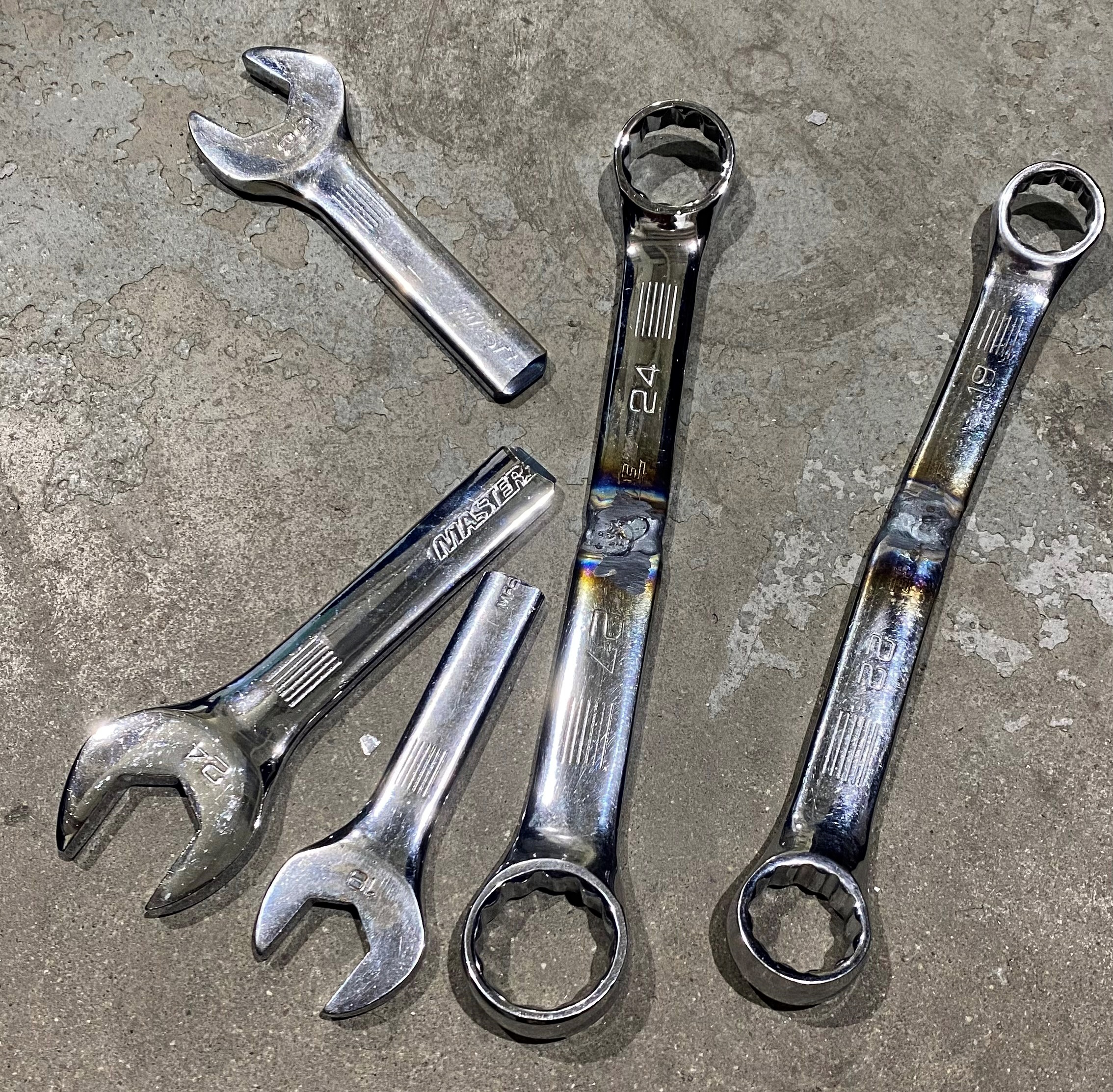
The longer the ride and the more remote the ride the more prepared you want to be. In the same vein, there’s a school of thought that suggests that even if you don’t know how to use a tool, it doesn’t hurt to have it because it may be easier to find a knowledgeable bush mechanic than a model specific tool. As you familiarize yourself with your bike and gain more skills, you’ll likely find that you don’t need to carry as many tools or you may find ways to combine one tool into two (I’ve cut wrenches and welded opposite ends together). For dedicated pavement travelers, sometimes a phone and a credit card is enough. Roads are built for travel, so if you sit along the roadside long enough, eventually someone will happen by. For off-roaders however, the ability to fix a flat or tow a fellow rider is priceless as tow trucks seldom traverse the best parts of the holler.
To check out a full list of what I pack for Adventure, dual-sporting, and racing, check out my personal tool list.
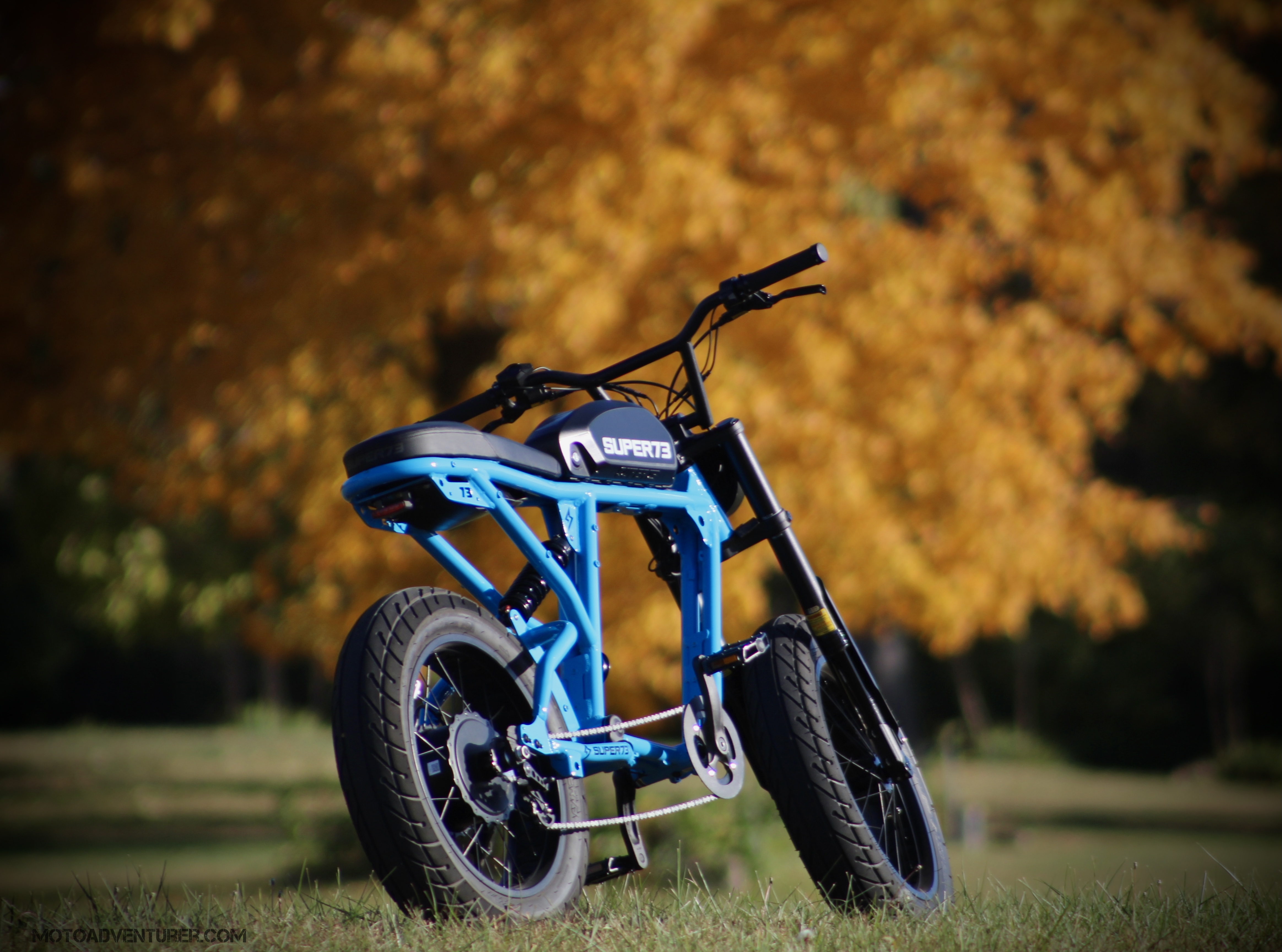
Pollution. Jet planes, semi-trucks, gridlock traffic. The unmistakable ring-da-da-ding-ding of a two-stroke dirt bike, or the unfettered lope of an American V-twin. In the absence of roaring engines, honking horns, and inattentive drivers surfing the rumble strips, you gain a superpower. Without noise pollution, you can actually hear traction. The tires groan, whimper, and eventually scream defeat as they let go of the pavement. In the dirt, you hear every stick and acorn beneath your wheels with the predictable shuffle of gravel in the loose dirt. The cost of this superpower? Ticking of the derailleur, the metallic cadence of the chain, and a low-pitched electric whine of the SUPER73 twelve-hundred-watt motor.
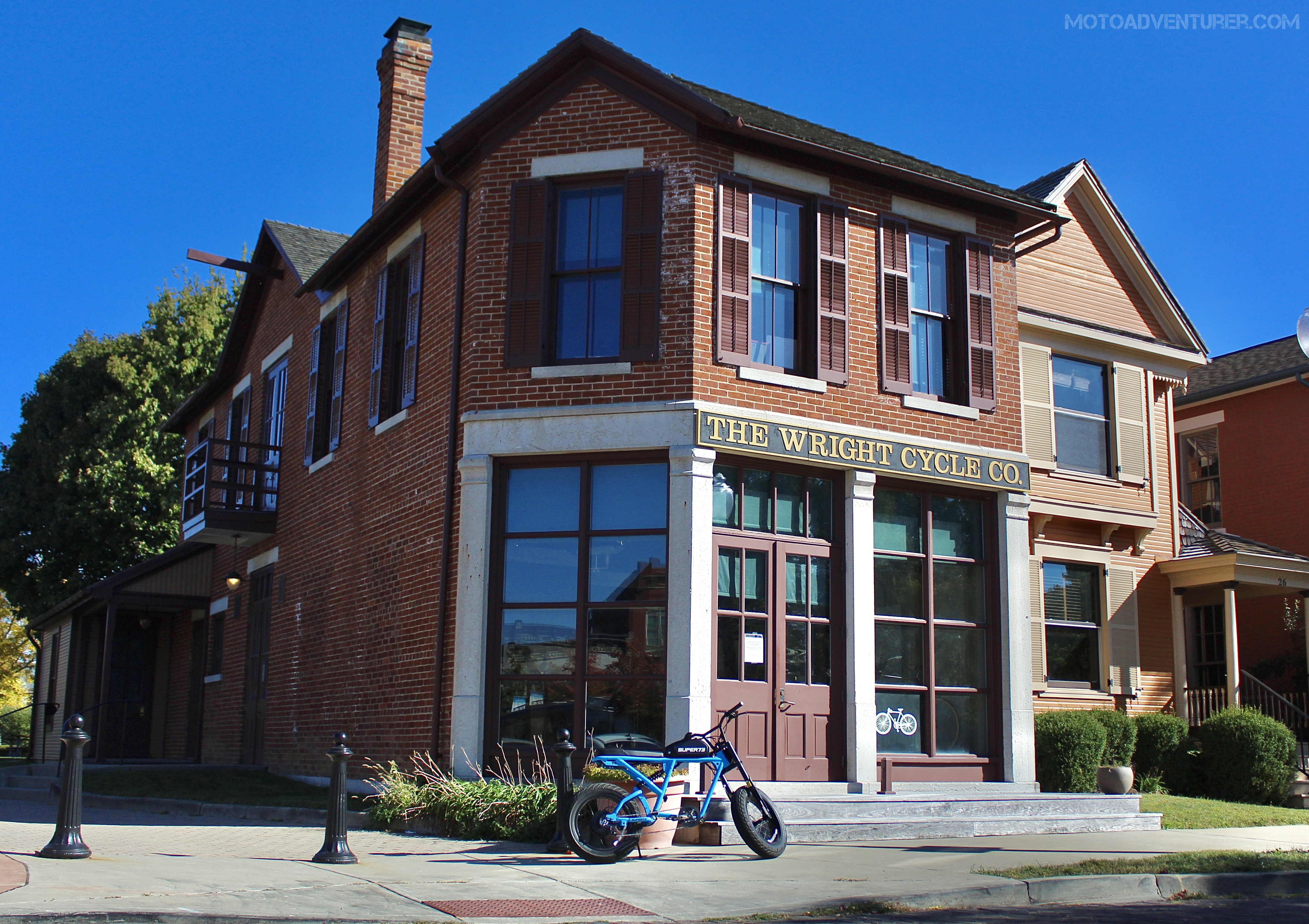
Thanks to a recommendation from my buddy Matt, SUPER73 reached out to me about potentially test-riding one of their electric bicycles. Longtime readers here obviously know I’m a pre-mixing, two-stroke-obsessed gearhead; however, upon receipt of an e-mail from SUPER73, I was immediately intrigued by the opportunity to experience a machine diametrically different from my typical two-wheeled mode of recreation. They lent me the bike to ride for two weeks and asked me to publish my thoughts in Vicarious Magazine before Christmas. Even after those 900-odd words, I felt I had more to say about their R-Brooklyn, and more about the new opportunities it’s bringing to the market.
Who’s SUPER73?
For those unfamiliar, SUPER73 was founded in 2016 as a start-up company out of Irvine, California. They launched their first electric bike after a successful kickstarted campaign. Thanks to some incredible marketing, they’ve grown dramatically into a full-blown multi-line electric bicycle manufacturer over the last few years.
What’s an E-bike?
The short answer is “electric bicycle”, but that definition gets a little more fuzzy depending on where you live. Here in Ohio, there are classes of electric bicycles and therefore laws about where you can and cannot ride. Locally, these are the definitions:
Class I – Electric bicycles equipped with fully operable pedals and an electric motor under 750 watts that can only provide pedal assist up to 20 MPH.
Class II – Electric bicycles equipped with fully operable pedals and an electric motor under 750 watts that can provide pedal or throttle assist up to 20 MPH.
Class III – Electric bicycles equipped with fully operable pedals and an electric motor under 750 watts that can only provide pedal assist up to 28 MPH.
In Ohio, Class I & II e-bikes are permitted on bicycle and shared-use paths. Class III bikes are required to have a speedometer, can only be ridden by people 16 and older, require operators to wear a helmet, and are prohibited from shared use paths.
R-Brooklyn Specs
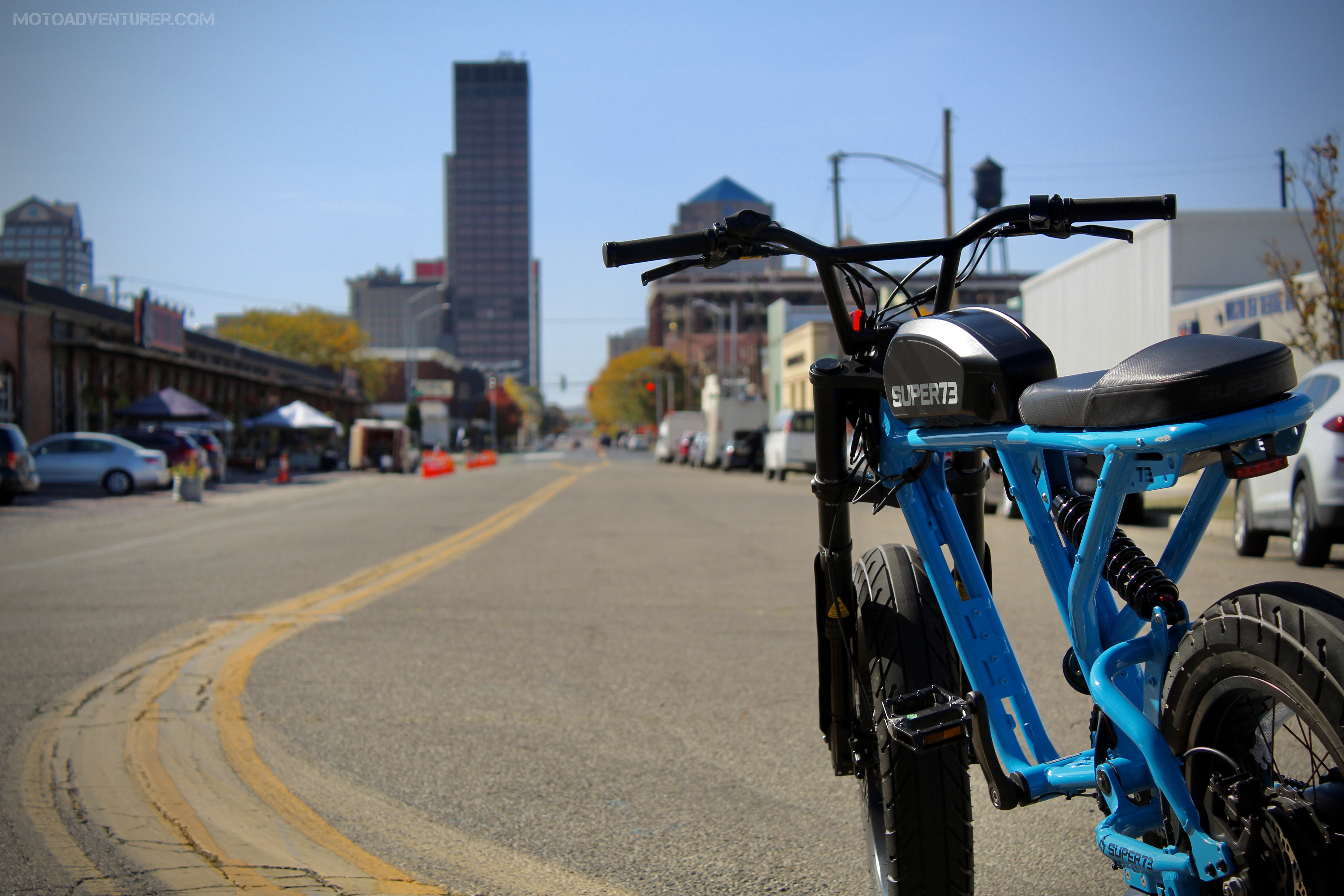
Brawler bicycle looks, the SUPER73 R-Brooklyn is unmistakable with its fat beach tires and bespoke “LZRD” tires. The bike wears dual 20-inch diameter wide-rims (4.5″ front, 5″ wide rear). The bumps up front are soaked up with telescopic forks, with an adjustable coil-over rear shock mounting to a swingarm in the rear. The 750~1200 Watt motor is integrated into the rear hub, mated with a single-speed sprocket set and traditional derailleur. The 960-watt-hour batter sits in front of the big banana seat, and what I assume is intentionally resembling a motorcycle gas tank. The Brooklyn has a bright LED headlight for urban night riding, with a matching brake-light in the rear. Similar to an ATV, there’s a thumb throttle on the right handlebar, with the smart display taking up residence on the left. The smart display can show the rider’s speed, odometer, range, and when paired with the SUPER73 app, can also give distance and direction to the next turn. The Brooklyn, like the rest of the R-series is shipped as a Class II e-bike. However, by logging into the app, riders can unlock level III and unlimited modes after agreeing to a disclaimer. To stop this 80-ish-pound bicycle, the Brooklyn has hydraulic disk brakes front and rear. Note to the motorcyclists, the right-hand lever is rear, not the front brake. Also, when attacking urban traffic, riders have a push button for a horn that rivals the one on my motorcycle.
Riding Experience
Pedaling out of my driveway I was reminded that I’d not ridden a bicycle in countless years. The saying is indeed true, but it’s markedly different than riding a motorcycle. The oddest thing is how 28 miles per hour feels shockingly fast on an 80-pound bicycle. After falling in love with the fat tire traction at full-throttle and aggressive lean angles, I was subsequently struck by the serenity of (near) silence while pedaling through the countryside. While riding along the bikeways, you can hear the tires grip the asphalt, moreover their squeal as they let go at full-tilt. Hooliganism aside, I was still surprised by the ease at which I snuck up on deer. At one point I stopped on the path and had a stare-down with several does on the hillside. It’s a very contrasting experience considering animals are typically already on the run when I see them from the seat of my dirtbike.
Peddling around town, ther ergoes of the R-Brooklyn feel more intended for sitting. The center of the crank is forward enough from the seat and close enough to the bars it takes a bit more effort to stand and keep cadence to climb the hill in my local housing development. Fortunately, the seat is comfortable and in the pursuit of grinding the chicken strips off the tires, my knees can grip the battery (tank) effectively while sitting.
Power delivery from the rear hub motor rolls on smooth and consistently. Performance motorcycle people may be disappointed that the SUPER73 doesn’t surge from a stop, however, folks need to remember this machine serves two masters. The Brooklyn is bridging the gap between efficient commuter and urban assault bike. Dumping buckets of torque into the motor drains the battery with a quickness, so the throttle controller feeds it in smoothly to maximize range. Similarly, SUPER73 obviously expects the rider to take advantage of the pedal assist or throtte. The single-speed drivetrain is geared for prime comfort between 15-20 mph; without power it takes some effort to get going from a stop, and depending on what level of assistance you’ve selected, you may find yourself peddling frantically if you get beyond the “boosted” speed.
Smashing the throttle and “going” is obviously the best part about riding the Brooklyn, but the dual-disk brake setup means that stopping is an uneventful affair. That’s of course assuming you don’t get a fist full of front brake, in which case you will find yourself lifting the rear wheel from the ground. The brakes SUPER73 have put on this bicycle are some of the best brakes I’ve experienced anywhere. I’ve never found myself so eager to pull “stoppies” at every opportunity.
As a child of the 80s, full suspension is also a welcome addition. Skipping over small logs in the local park trails and jumping curbs at full throttle puts a smile on your face. Similarly, riding the bike off-road is a lot of fun, but similar to comments about power delivery, there’s only so much suspension travel to work with. The springy bits keep the ride comfortable but remind you that the Brooklyn is a city bike, not an enduro competitor. Similarly, hardcore off-road bicyclists may bemoan the SUPER73’s weight, but after dragging my 250-pound dirtbike through the mud, I found lifting the Brooklyn over the big logs at my local trails an easy task.
Like anything electric these days, I’m sure most people are immediately curious about the range. SUPER73 advertises up to 75 miles on a full charge and I believe that to be very accurate. I rode the Brooklyn from my place in south Dayton, all the way downtown to the river and back while using pedal assist on levels 1 through 3, and the occasional burst of throttle to climb out of the valley. After 46 miles of mixed-use, the smart display told me I had 9 miles left on the battery. Using only level 1 pedal assist, 75 miles on mostly level terrain would be very achievable.
While I know my way around town pretty well, the SUPER73 app added to the convenience of riding almost anywhere. Like my motorcycles, I mounted my phone on the handlebar for easy navigation downtown. However, if I decided to leave my phone in my pocket, the SUPER73 app sends directions to the smart display which shows the rider their distance and direction to the next turn. Beyond navigation, the app can also be used to change settings on the bike, check the charge status, and toggle the headlight.
The SUPER73 R-Brooklyn, despite its stunning good looks, is still a competent commuter. While not a traditional stunt bike, bland utilitarian e-bike, nor hardcore off-road machine, it finds itself adept to dabble in each segment. All in all, I found the bike most enjoyable winding up and down the twisty hillside bicycle paths with the throttle pinned, or just exploring the wooded outskirts of the city. Moreover, I can reiterate enough, there’s something about the Brooklyn’s looks and performance that beg the rider to embrace their inner hooligan.
Commentary
As they say, beauty is in the eye of the beholder. One may not share my affinity for this BMX-supermoto electrified love child, but after seeing the fleet of urban e-bike rentals downtown, SUPER73 has aesthetics on lock. Big LED headlight, the tank-like battery pack, copious “73” branding, and lock-on moto-style grips, SUPER73 has minded the details while forging its own niche and imagery.
At some point, I’d like to get the chance to ride a SUPER73 with the 10-speed cassette option. While I find it unlikely I’d surpass the 75-mile range available, I’d like to see if I could stretch the full-wide-open range a little further with perhaps more pedal power. With that, like any motorcyclist, I’d like to see the rear hub motor get a little more poke. Word on the street is that the mothership launches a 2300-watt firmware upgrade, so I’m curious to see how that affects the power delivery. Also, I don’t know if this is in the pipeline, but I’d like to see a regenerative feature to the hub motor. Again, the existing range is likely plenty for the target audience, but in this space, I think it’s wise to keep pushing boundaries.
Potential on the Horizon
The electric bicycle market is very much still in its infancy. While I’m unquestionably old-school, I very much see the future that SUPER73 is paving the way for. As noise and emission regulations get tighter, it’s getting harder and hard to ride and race around the globe. As a city dweller, even riding at a designated off-road club, it’s becoming more difficult to avoid running afoul with the neighbors. Fewer and fewer kids grow up riding motorcycles, and more and more folks are less and less noise tolerant. SUPER73’s R-series bikes all carry the same legal rights as bicycles while being simultaneously prime for urban competition. SUPER73 bikes competed in oval track races at the Red Bull Moto Beach Classic in 2022; that’s the same event where they held Straight Rythm. The R-Brooklyn in today’s form would be a blast at an urban bike park, racing on a cart-style track, and even stunt competitions. Long-term, I’m hopeful that SUPER73’s success leads to a full-on off-road model. Something we can race on local single track, without pissing off the neighbors.
SUPER73 has built more than an electric bicycle. It’s more than a bicycle, and it’s not a motorcycle. The R-Brooklyn and its stablemates are in a new category of brand-new two-wheel recreation that we’re just starting to understand. They have their own flavor of customers, and we’re just getting a taste of what these kinds of machines can do.
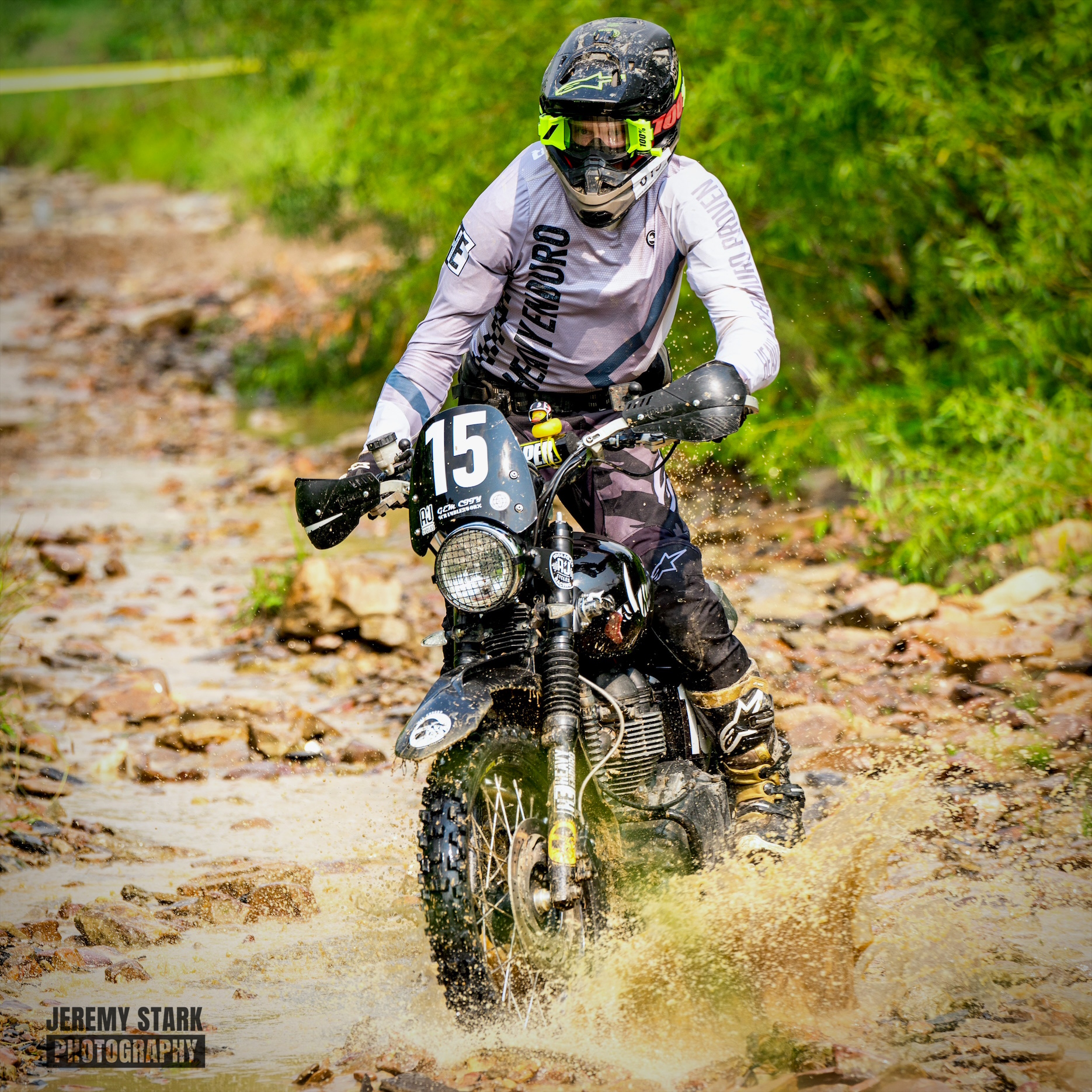
Just days ago, Triumph announced the end of the Thruxton. While I’m sure it’s not the end of modern cafe racers, it signals that consumer interest is waning. The modern Thruxton dates back to 2004, and similar to the Bonneville it was derived from, is another example of manufacturers attempting to capitalize on consumer fads by offering “factory customs”. Following on that trend, in 2006 Triumph released the “Scrambler 900” built on the same chassis. After 20 years of factory cafe racers, the sun is setting on the Thruxton, and yet Triumph has just released a new Scrambler 400 X; now offering “high-pipe” nostalgia bikes in three different displacements and multiple trim levels and price points. On the heels of the Thruxton’s retirement announcement, I’m reminded of a discussion with Chris Cope years ago, and can’t help thinking, “How are scramblers still a thing?”
Functional aesthetics
Choppers and race replicas have long fallen out of favor in modern moto culture. Certainly there are a myriad of reasons, but among them are the extremes of performance and aesthetics; both being less functional for us street riding mortals. Performance “nakeds” and “modern classics” have surged in popularity, however in both classes, muffler positioning often to limits access to the chain, street faring suspension prefers manicured asphalt, and the sparkly bits tend solicit more attention. Scramblers however, tend to get a subtle boost in the suspension department (much appreciated in our urban midwestern moonscape), are often adorned with elevated exhaust silencers, and are almost unanimously more charming with a subtle layer of dirt and road grime. Scramblers, while welcome garage queens, gain significant street cred when they arrive “lived in”.
Simplified maintenance
As previously mentioned, owning a Bonneville meant removing a muffler to clean a chain. To this day, changing an air filter on many modern ADV machines means removing a gas tank, let alone the ordeal that is checking the valve clearances. Modern Scramblers, with their throwback looks and “antiquated” architecture means that upgrading shocks is a half-hour job, if engines are liquid cooled, the radiator is hidden in the frame which makes it easier to access the tank, no fairing plastics are involved, and the popularity of the 19-17-inch tire combo simplifies finding and swapping tires. While the iconic look of the scrambler is what most of us notice first, function is predominantly what we see, despite the nostalgia driven sparkly bits.
Affordable adventure prowess
Guys like Pol Tarress and Toni Bou are pushing the limits of what’s possible with modern adventure motorcycles. Despite Pol racing hard enduro on a 700cc twin, the rest of us in the Starbucks brigade might ride the occasional forest service road. I wish it weren’t true, the reality is that wrestling a 500-pound pig in the slop is well outside the fun-zone for the average motorcycle consumer. That fun-zone shrinks dramatically when the retail price of said machine climbs north of twenty-grand. When the average annual mileage of the American motorcycle owner is in the neighborhood of 2,000 miles, how much of that could be off-road? Considering much of that range is covered in the pursuit of caffeine or fish-and-chips, modern Scramblers have sufficient off-road chops to explore gravel and neglected country roads at a significant discount compared to their wind-screen adorned ADV brethren.
It’s the American way
The Ford F-150 has been the number one selling “car” in America for as long as I can remember. Meanwhile, Jeep Wrangler prices have appreciated 168% in the past five years. Bed covers are often the first thing owners add to a new truck, and like Jeeps, giant rims, low profile tires, and sparkly perfect paint are all the rage right now. It’s not about what the vehicle is for, it’s about how it looks. We may not take said vehicle off-road… “but we could if we wanted to.”
Function aside, Scramblers are still sold on sex appeal, and for the time being, it’s working. Considering Triumph’s modern Scrambler is just two years the Thruxton’s junior and Honda just launched its new SCL500, this era may or may not be coming to an end. Like the Ducati, that new Scrammy Four-Hundo is distinctly missing the mandatory high-pipe, so perhaps this fix is already in.
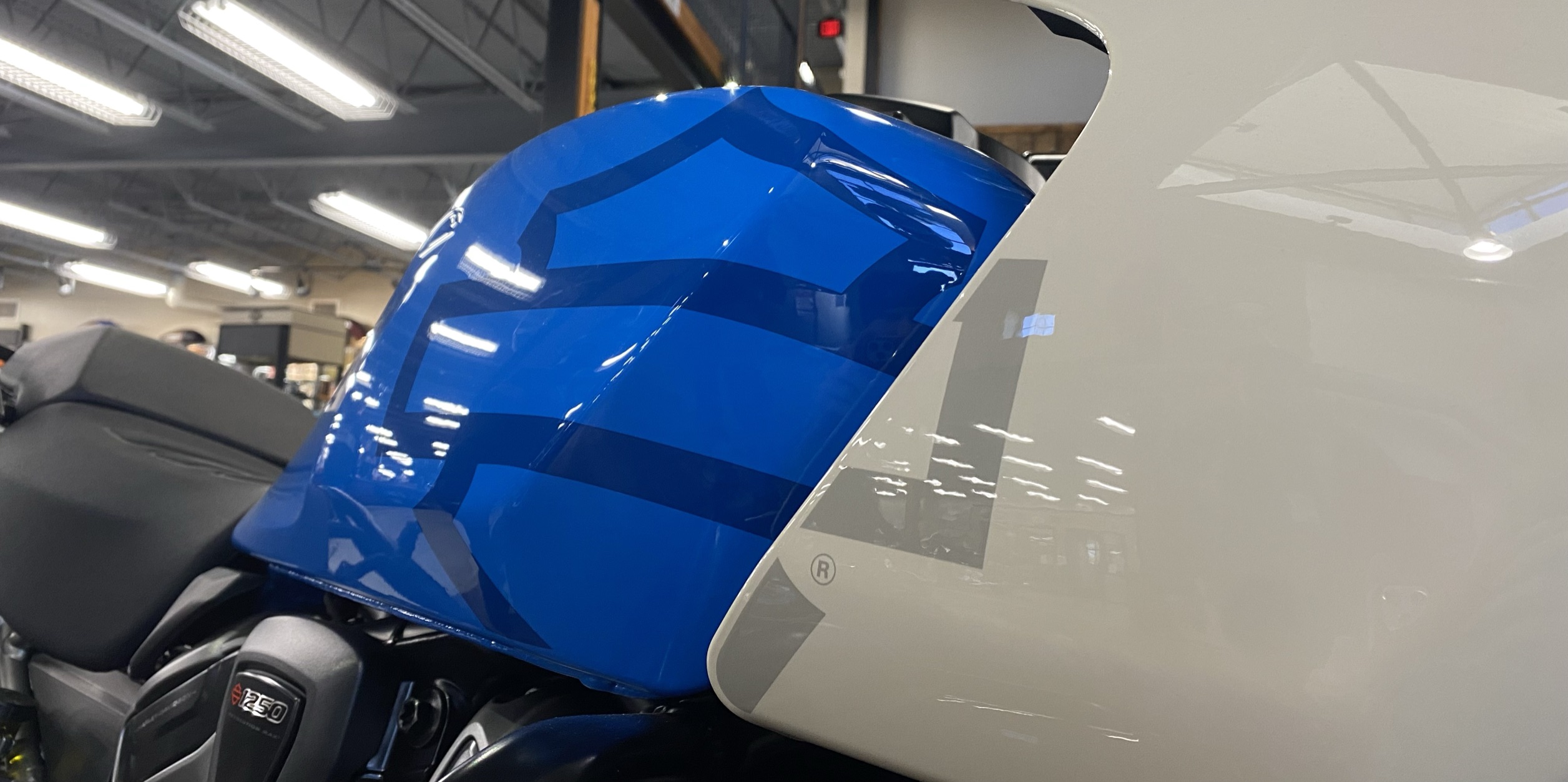
According to the headlines in late 2021, Harley’s first foray into the adventure market was the “Best-selling ADV motorcycle in America”. Two years later, I believe we’re on the cusp of a very different story. In 2021 the two-tone Pan America Special carried a suggested retail price of $20,249. Today, low-mileage Pan Am Specials can be found for 14-grand or less on Facebook marketplace. In the time that I’ve been watching used motorcycle values, I’ve never seen the value of a new motorcycle take a nosedive this steep. Motorcycle dogma clearly states: “Harley’s hold their resale value”, so why is the Pan Am tanking?
Everyone that wanted a Pan America has bought one
When I saw the “Bestselling” headline back in 2021, I instantly recalled a similar headline regarding Triumph’s new Bonneville Bobber. Back in 2017, Triumph set a company sales record for the new Bobber, a bike undoubtedly with a somewhat niche customer. Two years after seeing said headlines, garage queen Bonnie Bobbers were listed for sale all over; at the time of this writing, there are three leftover 2022 models sitting on the floor at my local dealer. When the bike was launched, those most excited to have one ran to their dealer and pre-ordered one. When the dust settled, the most anxious customers had already made a purchase, and it evolved into a bike chasing a rare customer. Sadly, I fear the Pan America may have suffered a similar fate, but that’s not all.
New buyers speed-date motorcycles
Despite performance statistics, interest rates, or utility, at the end of the day, motorcycles are primarily sold on sex appeal. People fall in love with a motorcycle for emotional reasons and simply have to have it. Let me recant that statement, they fall in “lust” with a motorcycle. At some point, the honeymoon wears off, and folks begin searching for that “new bike” feeling somewhere else. To finance the hobby, the old battle-axe gets traded in for a “younger”, “hotter” model. I have strong suspicions, that existing Harley owners, sufficiently curious enough to dip their toe into the adventure segment, ran out and put their money down on a new Pan Am. Just like their previous bikes, after two years of “fun”, they got their fix and were ready to bring home a different Harley. It likely didn’t stop with brand loyal customers; considering dealer network, “the new thing” and other tempting qualities, existing adventure touring folks tried on the Bar-and-Shield for size, but that irresistibility had a shelf life. While “lust” sells motorcycles, there’s no doubt some particular turn-offs may have ended some of these relationships prematurely.
First model-year gremlins
Ironically, I think Harley-Davidson has an unfair reputation of unreliability. While there are plenty of interesting statistics to fuel that debate, word on the street is that some Pan America models had various electronic issues. Officially, a limited number were actually recalled for display issues below a certain temperature. Anecdotally, I spoke with several friends who have ridden the Pan America, or even own them, mentioning various electrical gremlins that seemed to plague the bike, or at a minimum, annoy the owners with frequency (i.e. throttle-by-wire issues, going into limp mode, adaptive ride height malfunctioning). Obviously, this isn’t a new phenomenon, numerous manufacturers have issues with first-model-year vehicles. In this case, the damage to Harley’s reputation is worse because it’s their first and only entry to the adventure segment. When a more (presumably) reliable motorcycle can be had for the same money, or even less, it’s a taller hurdle for the Motor Company.
Swimming up stream
Reliability aside, there’s no understating the challenge of dropping a flagship adventure bike into a market that was already well saturated with liter-plus displacement offerings from well-established brands. Undoubtedly, significant American consumers have powerful FOMO, so it’s not difficult to convince a fresh crop of buyers to come try on the newest thing. However, trying to hold onto a slice of the heavyweight ADV market share against the backdrop of established Austrian, British, and Bavarian offerings several years post-launch is a bolder ambition. A bike that has perennial gravity to attract new buyers has to “do the thing” and won’t survive on hype and marketing alone. To make matters worse, the adventure market is clearly making greater moves toward smaller, lighter adventure motorcycles. Rather than drop an offering into a less established, growing segment, Harley chose to launch an aspirational model in a much more competitive class where it’s much harder to stand apart. In a world where you can get all the creature comforts and electronic rider aids on a 700 cc bike, what induces a buyer to pay more and consider a heavier, 1250 Harley against the backdrop of comfortable, capable middleweight machines let alone the established big-bore ADV machines that have a track record of reliable accoutrements?
The straw that broke the camel’s back
The truth is that I don’t believe that any one of these issues is the sole reason the Pan America as the fastest-depreciating motorcycle I’ve ever seen. I actually believe it’s the convergence of each of these issues, and more importantly, our current economic climate. Inflation is still running high, interest rates are at the highest levels we’ve seen in decades, and in a consumer economy, where lots of spending is fueled by debt, new motorcycles are a luxury. A Luxury that pandemic accounting and living habits supported, but in a more “normal” world, Pan Am owners are realizing they don’t ride as much as they thought they would. Worse, lots of folks are looking at their grocery receipts and realizing there are more important things that payment could pay for every month. As new bikes are sitting on dealer floors unsold, used bikes with “for-sale” signs are multiplying and the resale values are sinking.
This isn’t what I want
Selfishly, a cheap Pan America is a good thing for me. I’d like to find a smoking deal on a used one and have a great adventure touring machine. Inversely, this is bad for the Milwaukee mothership, and if I’m correct, it threatens the possibility of getting a middle-weight entry to the segment. This sword also cuts both ways; while I believe that Harley’s dealer network is not staffed or culturally equipped (in most places) to properly support the customer base for adventure bikes, the lackluster sales performance of the bike will likely cause dealers to turn their back on the Pan America as well. I stand firm that I believe that Harley would have been wise to play on their strengths and produce a capable V-twin scrambler in tandem with the Pan America and attack this segment in both directions. It’s not too late, but the sun is setting on this opportunity. If market forces continue on this path, I fear we’re looking at the end of the Pan America as we know it in less than 4 years. There’s tremendous value in having a successful brand making the bikes we want to ride here in America, so I hope I’m woefully wrong. Time will Tell.
Crisis accelerates evolution. In 2019, buying a vehicle meant negotiating on price with a sleazy salesman, followed by long waits in a side office with lending applications, extended warranty pitches, and endless paperwork. Even after signing the deal, you often had to wait on bike setup. If you were lucky, a couple of days later you walked out of a dealership and rode away on a new bike, smiling ear to ear following an otherwise painful experience. In 2020, this process was miraculously reduced to a series of text messages, and I’m told maybe an hour visit to sign papers and pick up your vehicle (at least for cars). What happened?
Life got easy
When confronted with evolution or bankruptcy, savvy entrepreneurs discovered how to streamline the bloated, archaic retail processes to get goods into the hands of eager consumers. The world essentially took advantage of the available technology and jettisoned obsolete sales tactics, much to the celebration of customers. Buying motorcycles became a faster and more pleasurable experience.
On a different end of the consumer experience, buying motorcycle stuff got a lot easier too. With retail outlets adopting severely limited operating hours or completely closed to the public, internet retailers were all the rage. Some shops got smart and figured out how to manage orders via text and e-mail, set up pick-up times, or even “drop ship” parts directly to the customer. With a little extra jingle in our pockets from limited travel and stimmy checks, we built the bikes of our dreams thanks to modern conveniences.
The bullwhip
Related to an article about motorcycle financing, recent world events had a massive impact on supply chains. In 2019 we had 24-hour convenience stores, fully stocked shelves at local grocers, and motorcycle showrooms with almost any model you’re looking for. Since that time, we’re all overwhelmingly familiar with empty sales floors and long waits for replacement parts on backorder. As a result, today every consumer has a very vivid understanding of how supply chains are like a bullwhip; the smallest change in the input has a stunning impact on the result.
Inflation
Without stepping in a pile of politics, let’s suffice to say that supply chain interruptions led to limited parts and inventory available for buyers. With more money to spend and less stuff to spend it on, consumers were competing against one another, and the prices rose to match the heated demand against the shrinking supply. Supply and demand are obviously concepts most of us are familiar with, but I bring this up to highlight a recent trend that has upset a number of consumers: mark-ups and fees.
As a guy that never stops surfing the used bike ads, I’m pretty put off by the asking prices above retail pricing I’ve seen. In the used market it’s an individual seller with an individual identity, and their own perceived value of the item they’re selling. When that item becomes a replicated commodity sold against the backdrop of identical models, like at a motorcycle dealer, folks seem to get a little testy about increased costs. I’m as frugal as the next guy, but we need to pause a moment and consider this unique situation from the other side of the counter. What has this experience been like as a shopkeeper?
In March 2020, retailers around the country were told to close. Like most of us, many of them weren’t sure where their next paycheck would come from. Many of these retailers had loans on “floor plan” motorcycles they had to pay, combined with continued overhead costs. Fortunately, when they adapted to the new sales conditions, anything remotely outdoorsy was selling like gangbusters. Until the showrooms emptied.
Brick-and-mortar stores went from fully stocked to nearly depleted inventory on all kinds of things, and likely everything, just at different times. For you and me, when we don’t know when we’re going to find our next meal, we start rationing. When dealers are unable to get more stuff to sell, they’re forced to increase prices to cover the gap between the sale of the last item to when the replacement finally arrives. Obviously, this doesn’t happen all at once. When the reality of supply starvation started to set in, dealers realized they could easily collect the full asking price, if not more, along with freight charges, documentation, and setup fees. Jacking up the sticker price of the vehicle, despite highly limited supply, potentially exposes the dealer to conflict with manufacturers who set the retail price. Thus retailers are more inclined to find other methods to collect cash to cover their next meal.
The last time I bought a new bike, I was a bit miffed by things I considered junk fees. Fortunately, the bike I wanted was in overwhelming supply everywhere, so a local dealer essentially ate the excess fees to give me the “out the door” price I wanted. In a buyers’ market, dealerships have all kinds of creative ways to reduce fees or take a haircut on list price as a means to get the customer into the monthly payment they can afford. One way or another, the total cost paid is a lump sum, despite whatever is listed on the receipt, and the manufacturer isn’t overly upset so long as their invoice is paid in full. Unfortunately, most of us motorcycle consumers aren’t familiar with the inverse of this formula, at least most of us shopping since 2008.
The fallout
Just as things were heating up in 2021, I released a podcast about the future of brick-and-mortar retailers. This idea had been rolling around in my head for some time as online retailers were making it vastly more convenient to buy motorcycle farkles versus waiting on parts to be delivered to a dealership and making multiple trips. The landscape has evolved considerably in that time. When confronted by companies like Carvana, and especially Amazon, providing anything and everything consumers want delivered to their door, many companies figured out how to duplicate the success of online retailers. So much so, those before-mentioned companies are now struggling by comparison. As a consumer, I see this as a good thing, I can now get high-quality products shipped direct from the retailer to my house. This situation puts increased stress on the middlemen. When it’s a faceless distributor, most folks don’t fret. When it’s a personal friend, trying to make a living selling you the toys you both love so much, it’s a different story.
I said privately back in 2020, the pandemic propped up power sports businesses that were already failing. Everything outdoors was gold and money was easy. When the bullwhip cracks, interest rates reach the moon, and the consumer base shrinks, the dealers that have failed to evolve with emerging technology and the whims of the customer may not be the only victims. The market forces of both limited supply and a potentially shrinking customer base may put insurmountable pressure on retailers that were until recently keeping their heads above water.
I fear this story gets worse as I suspect manufacturer politics will force a degree of corporate cannibalism among dealerships. In the automotive realm, there’s been much gnashing of teeth between the mothership and the dealers over price markups. The brands are concerned that in a receding market, their reputation will be tarnished by “greedy” salespeople. There’s an argument about the manufacturer’s hands being tied by politics and supply chain challenges, but this doesn’t change the fact that working folks at the dealership still need to be paid, especially if business is less than consistent. The very uncomfortable truth is that, despite searing prices, there were folks still foolish enough to pay them. This of course doesn’t change the fact that competing dealerships will be heavily at odds with one another, along with manufacturers depending on how this plays out. Brands may decide to slow output in preparation for a recession, putting more pressure on retail establishments. Equally problematic, if manufacturers attempt to resume 2019-era inventory, they could be forcing overstock conditions onto dealers. Conflict is brewing between the two parties, and I fear the manufacturers are the most likely victors.
The upside
This is unfortunately an ugly story for sales folks handing out business cards. However, all uncomfortable situations are also opportunities to excel. Dealerships facing inventory challenges will be forced to focus on customer relations, improving customer experience, enhancing their service department, and building a riding community. Reduced inventory means folks will have to sell the “value-added” factors and building customer loyalty. These facets, combined with yet-to-be-discovered sales innovations means more appreciation for the customer. The most successful businesses aren’t built when things are good, they’re built in the hard times.
2020 will undoubtedly go down in history as the year that the world changed. Outside of global health impacts, here in the U.S., it felt like a motorcycle Renaissance. Many manufacturers had record sales, and dealer floors went from overstocked to barren overnight. I personally bought and sold four motorcycles since that time. After riding 365 days straight into 2018, 2020 was one of the best years I spent in the saddle; riding, racing, and adventuring. Unbeknownst to most of us, those days marked a distinct evolution in the motorcycle market.
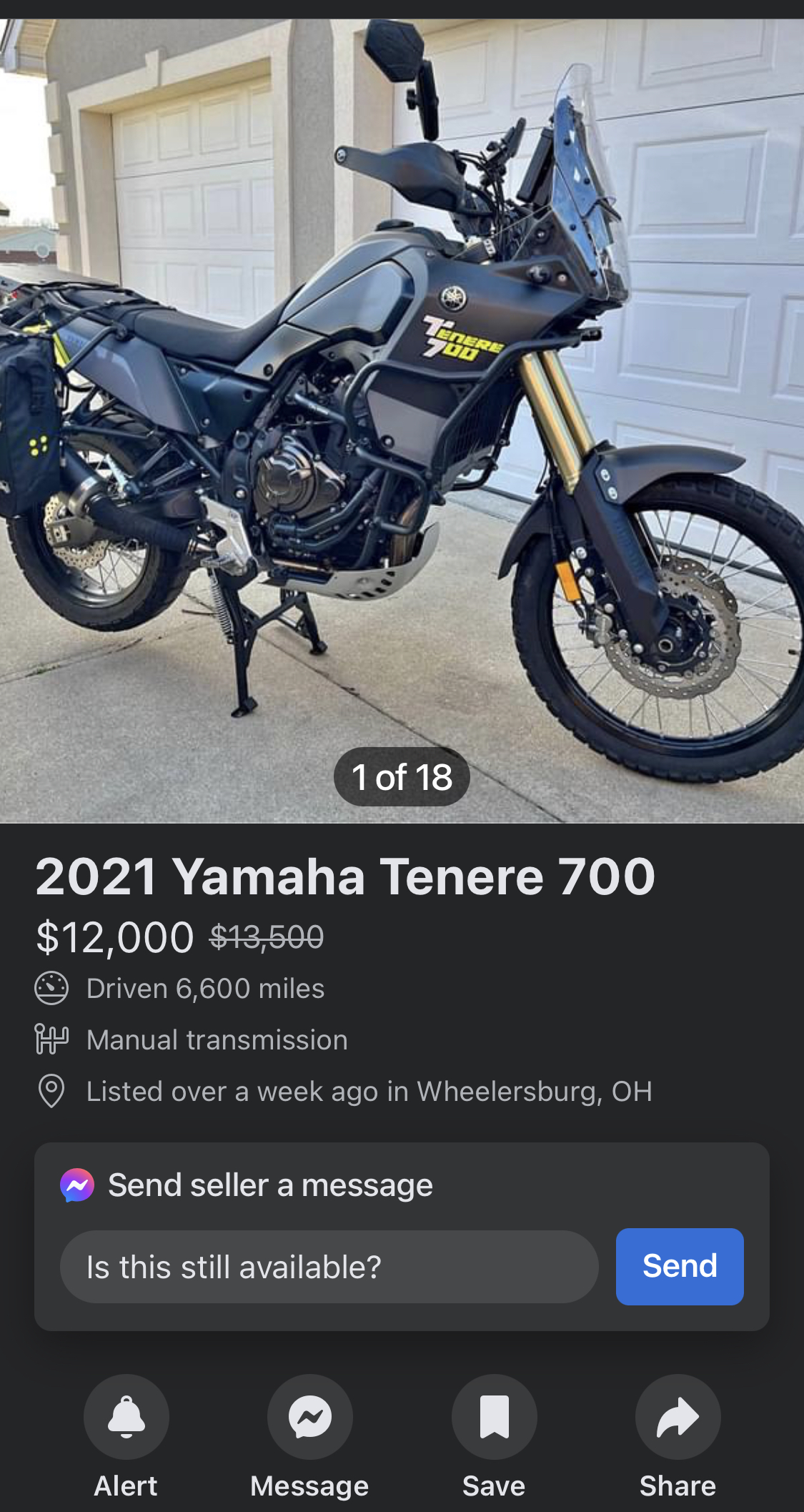
Anyone that’s surfed for-sale ads recently is well aware of the fact that many used motorcycles are being listed at or above the manufacturer suggest retail price (MSRP). Many local motorcycle dealers are still struggling to keep various motorcycles in stock, propping up asking prices for high-demand bikes like the Tenere 700. All of us have already heard, if not experienced firsthand, the ongoing supply chain woes. However, there’s a new problem on the horizon, high interest rates.
An Era has Ended
In 2008 after a string of banking issues, massive mortgage defaults, and countless other financial details I don’t recall, the economy came to a grinding halt. To fix the economy, the Federal Reserve cut the interest rate to almost zero; then proceeded to keep it below one percent for a decade. When I started driving a car back in the ’90s, Fed interest rates were around 4-5%, but in recent memory, all of us have become conditioned to seeing 0-3% APR listed on car and motorcycle stickers. This stretch of cheap borrowing from ’08-’17 is virtually unprecedented in U.S. history, and I suspect we won’t see it again.
Compounding Problems
At the time of this writing, the fed funds rate is near 5%. While closer to 4% back in September, that translated to a 9% interest for a used car I was looking at. While supply chain challenges have limited the supply of highly desired motorcycles, the increased cost of borrowing may start to “solve” that problem, as more common motorcycles are starting to sit longer on dealer showrooms. This breakneck change in conditions has put both the customer and the retailer in a pretty awkward position. A new motorcycle is out of reach for many buyers considering inflation and interest rates. Meanwhile, dealers are sitting on more and more inventory, some of which includes paying interest on “floor plan” loans for unsold models.
Incentives back in vogue
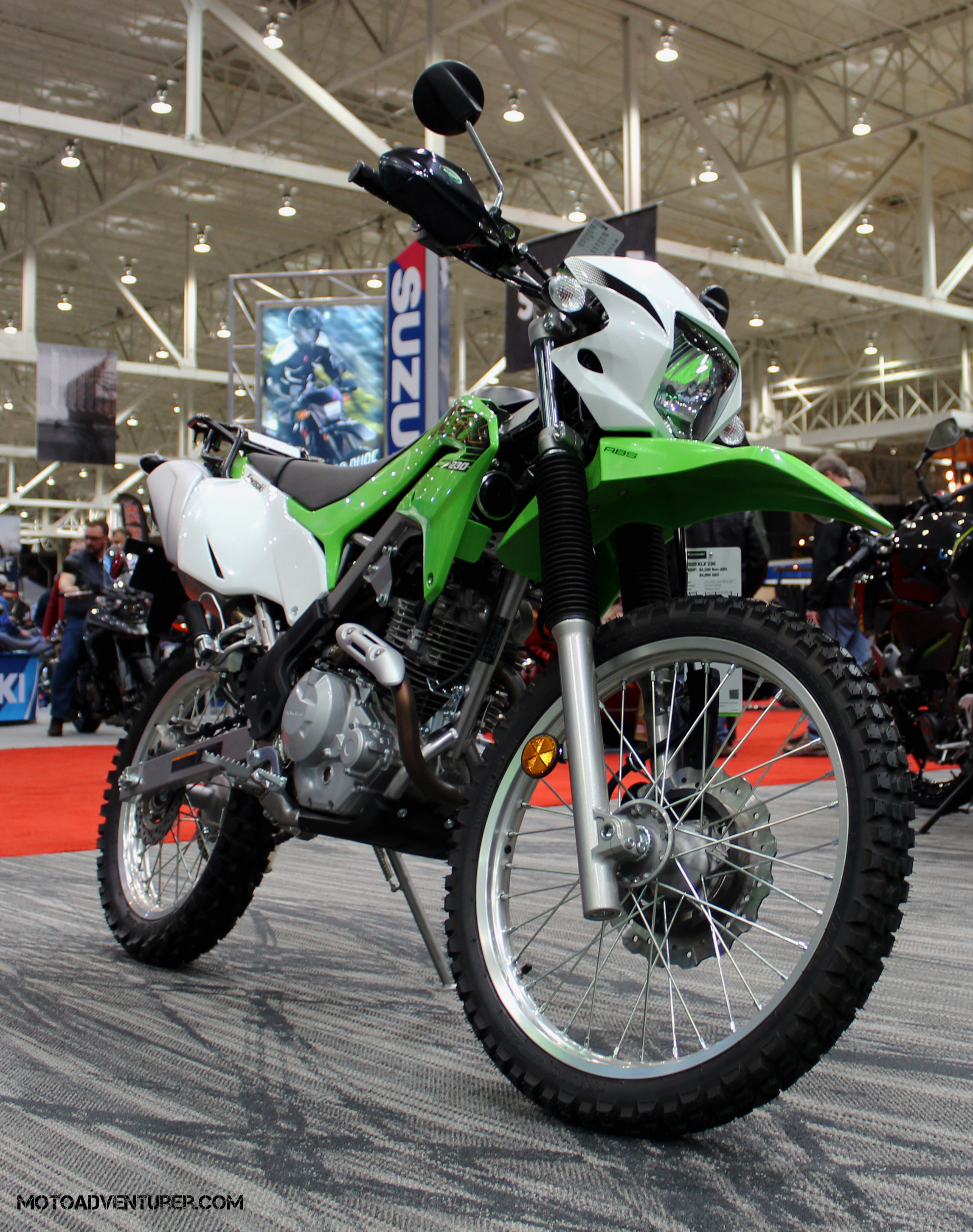
Scoffing at the insane asking prices for dirt bikes on Marketplace, I looked over some of the manufacturer’s list prices. To my surprise, some manufacturers were already offering incentives for specific models on their websites. This was further confirmed while walking around a dealer last weekend; I saw Kawasaki offering a $1000 rebate on the new KLR, $2000 off their KX dirt bikes. Assuming it’s not happening already, I have a strong suspicion we’ll start to see shops offering discounted upgrades on trim levels, factory options, luggage, and so on to entice buyers and move aging inventory.
Getting used
The consequences in the pre-owned market will take time to resolve. At the moment, many people have (arguably) overpaid for the bikes they are currently selling. Worse, some of these sellers are still sitting on a loan for a bike they bought above MSRP. As many of us have seen, the whiplash of frozen supply and pent-up demand drove up prices, and within a year, interest rates have increased almost 5-fold; many sellers are currently left holding the bag.
Simultaneously, sellers that are still “even” don’t realize that new prices are essentially “coming down” through incentives. Understandably, these folks are trying to hold out for the price they want, but they don’t see the market shifting under their feet. The longer these sellers wait, the more used bike inventory grows; essentially adding more competitors to the market. If competing sellers decide they need to move a bike and cut prices, the stalemate may end.
With limited supply on certain models, I won’t be surprised to see some of these in-demand used bikes maintain lofty prices. However, off-road and dual-sport models are seriously starting to stack up. 2020 may have been the record year of off-road growth for all ages and segments, but unfortunately, the rising costs of food and housing have forced many Americans to jettison the expensive motorcycle hobby. I fear this reality will settle in for lots of sellers over the next year, and the consequences that follow.
Predicting the fallout
There’s no way to know for sure what the Fed will do in the coming year. It’s likely safe to say rates will increase marginally, pause, and then be reduced slowly over time. However, I stand firm that I don’t expect we’ll see 0% interest for any prolonged period going forward.
For the motorcycle market, this essentially means returning to what my parents would describe as “normal”. We’ve seen impressive price inflation since 2008, but with higher borrowing costs, we’re likely to see shifts in both pricing and offerings in a higher-interest world. As I mentioned, I expect we’ll see more concessions to clear inventory, but manufacturers don’t want to rock the boat too hard with recent customers. Buyers tend to get a little bent when they pay full retail on a bike, just to see it marked down a few months later. To thwart this, I think we’ll see certain model names disappear from line-ups in the coming future; likely to re-appear with revised features to justify the asking price. On the opposite end, companies are likely to slash features and offer new, low-spec models in pursuit of more affordability. To this point, Honda recently announced a new XR150L here in the U.S. In the era of TFT dash, adaptive cruise control, and electronic suspension, it will be interesting to see how these “high-end” features trickle down the model offerings when customers are paying 5% APR. If we’re lucky, we may even see the rebirth of the “trail bike”, considering many of them date back to the ’90s.
We’re presently on the front end of this trend. Interest is still rising and prices are still high virtually everywhere. If things play out the way I think, in the coming year I believe folks with cash may land some incredible deals. I fear dealers are going to struggle tremendously after the gear grinding shifts from 2019 to 2020, to 2023. I certainly wish we could skip the pain we’re all experiencing right now, but I expect we’ll see interesting things come out of the manufacturers in the next 5 or so years.
Am I wrong? Do you think we’ll make a “soft landing” and go back to business as usual or are higher interest rates here to stay? How do you think Manufacturers will respond?
I petition to you the masses, and more specifically, east coast residents, to legalize lane filtering in your state.
What is filtering you ask?
The horrors of California gridlock are legendary. As such, folks in the Golden State warmed up to motorcycles sharing lanes, or “white line surfing” many years ago and recently canonized that practice in their legislature. Many folks call this practice, legal lane splitting.
Here in the midwest, seeing some motorcycle ripping between cars on a 65 mph highway strikes fear into the hearts of suburban drivers and brings outrage to seniors as young punks are “cutting in line”, riding like maniacs, and risking the lives of automobile drivers. I’ll concede. We are not ready for “lane splitting” here in the flyover states.
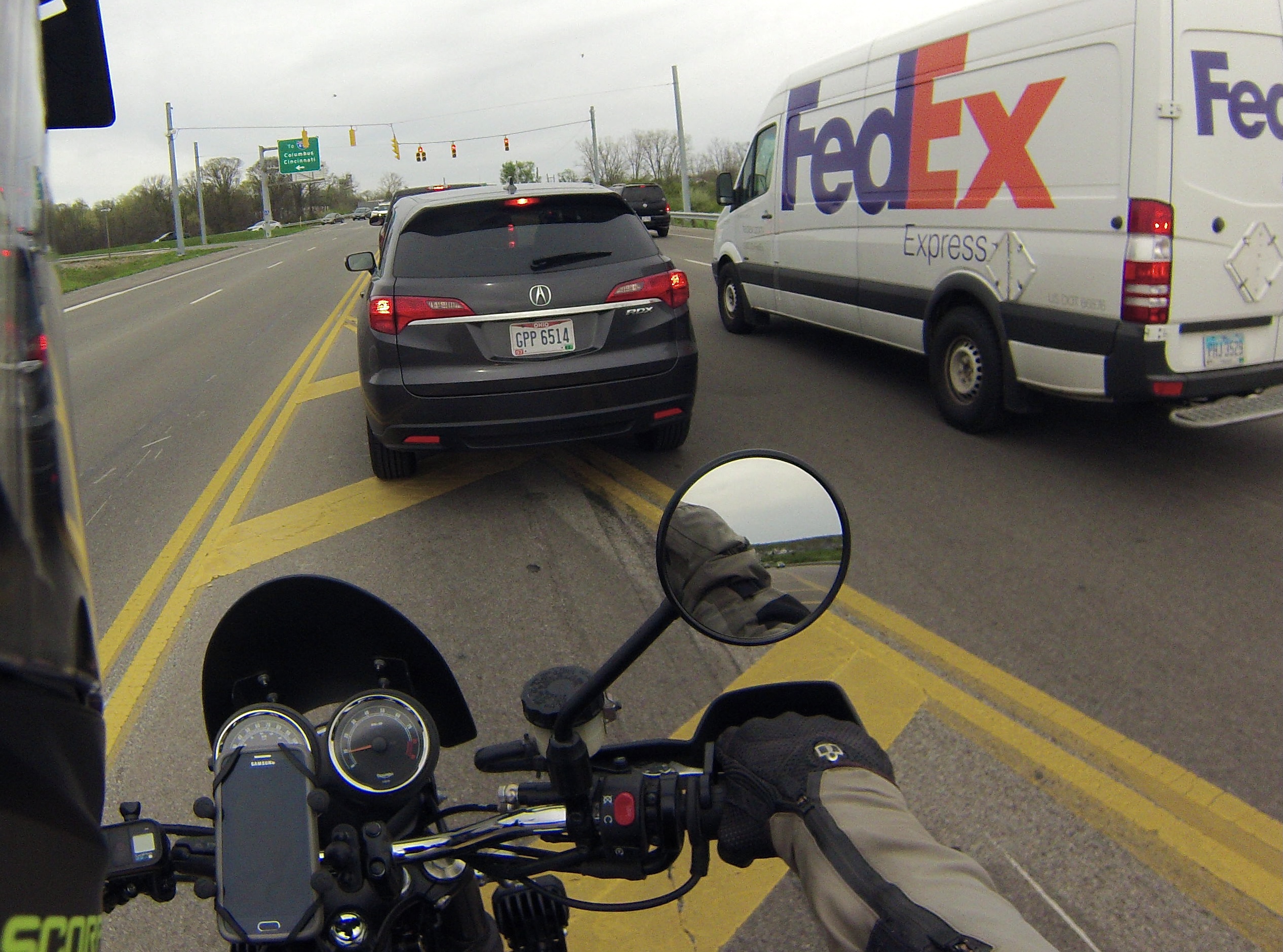
However, if we were stopped at a traffic light, you in your car, and me on my motorcycle, would you object if I carefully rolled up to the front of the line, and subsequently made legal and efficient use of my power to weight advantage? This is what I call “lane filtering”, where motorcycles use the gaps between lanes to filter to the front, removing the motorcycle from taking up excess space between cars at a stop.
Why shouldn’t motorcycles wait in line like everyone else?
While I’ve had the “luxury” of traveling the world, I’m a born and raised Daytonian. I’m intimately familiar with the snarling gridlock of rush hour in Cincinnati, as I am with the ongoing, multi-decade construction project that is the I-75 corridor between north Dayton and the Ohio river. Moreover, my commute has expanded from 20 to 30 minutes across the entire city, including an unfortunately large number of mall traffic control devices. Great lengths of this barrel-ridden wasteland, have been traversed by motorcycle as part of the routine commute.
Needless to say, midwestern traffic etiquette, and arguably the law, dictates that my motorcycle take up an entire space, despite being a third the size and nearly a tenth the mass of an automobile. Parked behind a line of vehicles at a light, my bike length, plus the safety distance behind, may mean the difference between the chasing vehicle making it through the intersection before the light changes again.
On the highway, I’ll respect that passing cars between the lanes at higher speeds adds more risk than most of us corn-country dwellers are prepared to stomach. Unfortunately, when traffic comes to an abrupt stop, I’m incredibly concerned that I’m likely to become a pancake against the trunk of the car ahead of me when an unsuspecting driver rear-ends my motorcycle at a standstill before I’m noticed. “Distracted driving” feels more prevalent than ever and while I don’t speak for other motorcyclists, it seems many of my peers are concerned about a texting driver plowing right through them at a stop.
Pay it forward
In the interest of getting more cars through controlled intersections and reducing rear-end collisions, motorcycles should be legally permitted to ride on white lines and filter between stopped cars at intersections and on designated multi-lane highways.
For non-motorcyclists, I imagine it feels like you’re being cheated. Some kid on a crotch rocket is rolling right past a line of a dozen cars and takes the lead the moment the light turns green. Worse, you sit through yet another light cycle. In this one instance, this may be true. However, given sufficient time and distance, my little 250 will squeeze through traffic much faster than my Jeep. More importantly, in most cases, from a stop, motorcycles have a significant acceleration advantage over most urban cars. Moving a motorcycle forward will free up excess lane space for more vehicles to drive through, and once at the front, most motorcycles will accelerate away from traffic without hindering following vehicles. All of this to serve the ultimate goal of getting more vehicles to their destinations safer and sooner.
Success won’t happen overnight
If I legalize filtering tomorrow, swathes of motorcyclists will rejoice, many drivers will be irritated if not irate, and even many motorcyclists will reject the practice. Folks will be unhappy, and we’re likely to have consequences on the streets and at the ballot box. I understand the fears. How will filtering be defined? Who will police offenders? How will we convince drivers to accept the practice? What will prevent drivers from opening doors and causing accidents?
My suggestion for filtering is not new. Filtering and “splitting” has been going on throughout foreign countries for many years, especially in the UK and the rest of Europe; also note, European roads are more narrow than ours. Limited forms of filtering are already legal in Arizona, California, Hawaii, Montana, and Utah. My point is that these questions have been addressed in great detail by other governing bodies, and we can draw upon their experience.
As far as the law is concerned, I think looking at Arizona and Utah is a good start. In short, their rules are as follows:
The speed limit can’t be greater than 45 mph
The motorcyclist’s speed can’t exceed 15 mph
Traffic must be stopped
I would prefer that the law offer opportunities to filter on interstate freeways when traffic is stopped, but the importance of progress should take priority in my opinion. It’s important that drivers and riders become comfortable with filtering, and over time the law can be revised as it becomes more accepted by the culture.
I also think it’s critical that a massive infomercial campaign be launched to educate drivers and riders about the practice prior to the law going into effect. I suspect that motorcycle safety organizations would be more than happy to donate money to support the practice considering recent studies about safety, and the potential increase in commuter motorcycle purchases.
Here’s an example of a Utah lane filtering infomercial:
Regarding safety, the University of Berkeley recently released a study stating that under specific conditions, motorcyclists are at lower risk of rear-end accidents by moving into the spaces between cars. It’s important that laws permitting filtering take these ideal conditions into consideration, and that the findings of this study be promoted in the information campaign for adoption.
I also think it’s important to mention, lane filtering should not be mandatory. Motorcyclists should be permitted to filter to the front of stopped traffic when they feel safe, and should be able to choose not to do if uncomfortable with the practices or conditions.
Do you support lane filtering as I have described it? Are there specifics that should be addressed before legally accepting the practice?
I just saw the news that Yamaha is adding two additional trim levels to the Ténéré 700. Needless to say, I’m in the tank for the T7 so I’m happy to see the availability of more factory performance bits. The middleweight Ténéré is now being offered with a touring package and a more aggressive off-road package depending on your leanings. Triumph has been offering a swath of packaged tiers for their fleet of Tigers for years, in many cases, I’m a bit perplexed by the package components and especially the pricing strategy.
When triumph launched the new series of tiger 800s back in 2016, you had to minor in linguistics to understand all the alphabet soup involved with each trim level. While they’ve cleaned it up a bit with the new 900, there’s still a mess of jargon to decode. At any rate, suffice it to say, that brands’ base-level adventure bike offerings start as bare bones, but progress in price and features as they go up. Per my previous assertion, manufacturers are getting wise to the fact that many of these bikes never go off-road and are thus tailoring to customers with optional touring-focused trim levels, and as in Yamaha’s case, offering premium performance bits and fewer frills for the bravest of adventurers.
While I appreciate this effort, pricing your most advanced off-road model higher than the premium touring bike in some cases seems especially odd. If we were debating premium models among dirt bikes, those gold suspension bits and fat price tags make perfect sense. In the world of 500-pound adventure machines, there’s a point where the price tag starts to make the thought of off-road rowdiness a little ridiculous, and premium dirt features superfluous.
In recent months it’s become overly obvious I tend to swim against the current. Considering I race a decade-old street legal nostalgia machine, perhaps I’m a little disconnected from what the average adventure consumer wants. That aside, here on the deep end of the ADV pool, I’d like suggest a slightly alternative strategy.
Defining premium
I feel like I keep saying that. In the world of adventure bikes, performance accessories, premium suspension, and creature comforts are items I see potential buyers considering when looking to roll everything into a packaged sale. Hard luggage, skid plates, electronics packages, touring screens, and the like are items I don’t question when we’re talking about top trim-level adventure touring bikes. Furthermore, regarding grand touring options, I think it’s wise for manufacturers to offer tubeless wheel options as stock, if not a dealer-fitted add-on. Various suspension trims also make sense. Again using triumph as an example, a base model with nonadjustable springy bits is the industry standard. More aggressive street riders will also appreciate the bump to upscale suspension or even electronic suspension along with a appropriate price increase.
Pricing strategy
To me, premium and value are not the same things. Something may cost more, but it may also be redundant, thus not adding value. As an off-road ADV gumby, tubeless wheels are lost on me. Tubeless wheels (potentially) put me in a situation where lower pressure is necessary to traverse an obstacle, followed by getting a flat, and then trying to reseat the bead by my lonesome with an anemic tire inflator. That just sounds like a spoiled afternoon. Moreover, endless electronics and hard luggage are liabilities in the woods, to say the least. I get it, these are “rider aids” for folks that want to take their two-wheeled SUVs down fire roads. I understand, and I think premium packages for those folks make sense. Inversely, in a world where Pol Tarres and Toni Bou are testing the capabilities of these behemoths, “off-road pro” trims including heated seats and creature comforts seem off-target, if not just an excuse to rack up the price.
Yamaha seems to have taken the bait with their new Ténéré 700 Extreme. More suspension travel, skid plate, radiator guard, and larger foot pegs; all things most offroad hooligans can appreciate. I’m eager to see Triumph, Aprilia, and Honda follow suit in this category.
I don’t speak for the gnarliest of off-road adventurers, but I assume they want to see robust tube-type rims, so we can potentially install rims locks, possibly bib mousses, or at least fix them easily in the field. A serious skid plate, not just an aesthetic paper-thin aluminum cover. Crash protection, or, if I may suggest, sacrificial plastics, akin to something like what dirt bikes offer. Fully adjustable, suspension, on par with 9 to 10 inches of travel, high fenders, and if rider aids are included, when disabled, settings should be “sticky” and maintain position after power cycling the bike.
Inverting the paradigm
Taking it a step forward, I think the base model ADV bikes should be off-road focused. Adventure bikes are far from dirt bikes; no one questions this. At the same time, they’re far from cheap and they tend to cost more to fix when you crash. While I respect premium pricing for premium suspension, most of the “value-added” electronics and creature comforts are a waste for the most dirt-oriented riders. I would suggest that Yamaha, et al, should stick with cheap LCD dashes, ABS only, no rider modes, and no frills. Essentially how the Tenere 700 was launched. I’m also prepared to concede ABS to save a few bucks (I realize Europe won’t permit such dangerous thoughts). If buyers want tubeless wheels, up-spec suspension, heated grips, rider modes, fancy dash screens, and electronic doodads, absolutely, upcharge for all of that stuff. However, for goons that are going to toss their bikes down the trail on the regular, we just need a bare-bones machine. Fear not manufacturers, what you lose from the initial sale margin, you’ll recover in replacement parts; and I can provide references to prove it.
I obviously don’t speak for everyone, so what do you think? Are manufacturers selling you the trim levels of bikes you want?
I feel it best to begin this article with the statement. I hope I’m wrong. I look forward to writing a sequential piece correcting my flawed premise. Time will tell.
Fourth-quarter earnings calls came out at the beginning of February. As one can imagine, lots of eyes were on Harley Davidson as they’ve been hemorrhaging for years now. Despite growth from many European brands, H-D claims their sales were down 8% globally for 2022 (vs. 2021 global quantities).
During the call, Edel O’Sullivan, Harley’s Chief Commercial Officer made a statement that’s stuck in my craw, “…continue to emphasize the balance of desirability and profitability… but also restrained and very, very careful management of inventory…”
But before unpacking that, let’s rewind the clock a bit. When confronted with aging demographics and market headwinds by any other name, former H-D CEO, Matt Levatich launched an initiative he called “more roads to Harley-Davidson”. He promised something like 100 new Harley models, plans to attract younger riders, and so on. We know that the Pan America we see today is the fruit of this labor. We also know, after several quarters of negative press, Levatich left the Motor Company. His replacement, Jochen Zeitz, countered with “Project Rewire” and “Project Hardwire”. Most of which is a bunch of corporate buzzword jargon to send messages to savvy traders and snow the public wherever possible. In short, Zeitz directed the company to slash spending, slash offerings, and stifle supply to boost margins and keep the stock price aloft through “very, very careful management of inventory”.
I don’t begrudge profits. Nor do I oppose change and evolution. I do oppose cutting off your nose to spite your face. I believe Zeitz’s slash program is killing the golden goose, moreover this it’s a symptom of a global problem. That being, publicly traded companies have no stomach for hardship.
What is the golden goose?
Harley-Davidson, as recently as I’m aware, is half of the American motorcycle market in new bike sales. Yet, Harley-Davidson, until very recently, only participates in one segment, cruisers. From the 50s until now, Harley has arguably been selling “lifestyle” accessories to American consumers. Not all that long ago, for ten to thirty grand you could land a piece of Milwaukee muscle. Arguments aside, “entry-level” up to luxury touring models were available for all customers. I’m told Harley even had a commercial that said you could have a motorcycle for the cost of a cup of coffee a day (hat tip to Aled). In the pursuit of higher-margin, uber-premium status, I think those days are ending.
Regime change
I’m not a savvy stock trader, nor am I a Harley insider. Thus, this is my theory, and again, I hope I’m wrong. That said, I suspect the new models we’re seeing released today are carryovers from the “More roads…” program. The Pan America, a record-selling bike, is the flagship of that program. Further spin-offs of the revolution max engine, to a much lesser degree. And for all intents and purposes, it appears that the Bronx has been sacked.
After seeing recent press releases of the new Nightster (Sportster), I was reminded of a couple of legacy Harleys, and came to the conclusion, if someone at the bar and shield was ever phoning it in, that’s what it would look like. Ironically, AMF legacy paint schemes are suddenly in vogue. Those color tones, along with new styling blunders, tell me that a regime change is immanent.
To further expand, I suspect that the powers that be were forced to launch the new Revolution Max line of new bikes. The research and development and perhaps even the production money already spent. The Pan America, while aesthetically radical by Harley standards, still fits inside the “touring” bubble that Harley commands. The rest of the models, however, are dramatic departures from (most) Harley styling and culture.
Some will say that this redesign was necessary because of emissions. Others will say it was prudent to attract the next generation of riders. At first, I believed this. I may even concede this was the initial intent, however upon further inspection, I believe these new models are a result of the bare minimum effort required. This perspective is further solidified by the fact that the Street line of motorcycles was discontinued in 2021, and yet these new Sportster models follow so many of the “unfinished” styling cues that plagued the budget 500 and 750 twins.
I believe the bigwigs in Wisconsin don’t want to sell these base-model bikes. They’re only on the showroom floor because they need to recoup the start-up costs. I arrived at this conclusion judging by the lackadaisical, piss-poor fit and finish, combined with premium price. In a statement, holy leaf blower Batman!
Infinite growth is a fantasy
I understand Zeitz’s strategy, and on its face, it makes sense. Trim the fat, focus on what people are buying, and invest in core products. With regard to shoes, appliances, and cars, I get it. However, Harley Davidson is selling products to something like 1% of the road-going population. Slashing and cutting whilst having at least one eye on the horizon is an even more delicate dance when we’re talking about one segment of one sector of recreational goods. This is compounded by the fact that Harley-Davidson’s business model has more in common with a ford dealer than most motorcycle shops. Dealerships are selling a solely branded riding experience, with bloated overhead, and an ingrained culture making for a much larger ship to steer. Are dealers interested in evolving their internal culture? Are they interested in contracting the motorcycle supply? Will they sell these new models with the same vigor as the bloated touring models? The success of the stock is hinged on more than just what motorcycles roll off the line.
These challenges also run deeper. As others have pontificated before, are these actions just a temporary strategy to make the company profitable long enough to broker purchase from a larger organization that will invest in the brand’s future? To me, it seems feasible. Whether or not this strategy is true, and whether or not it succeeds or fails doesn’t change the fact that most investors don’t care if Harley Davidson is profitable in ten years. Stockholders are not in it for the long haul. Most people own shares in Harley because it makes money. When it stops appreciating, for long enough, they’ll jump ship. This is a systemic problem all across the nation. Companies are beholden to shareholders who are only concerned about returns over the next few quarters. Losses now to invest in a brighter future is not something Wall Street has the stomach for. Amazon, until very recently was the poster child for Wall Street because of its infinite growth business model. At some point, that strategy becomes unsustainable, and that’s fine because when it is, those shareholders have realized their gains and moved on. The company be damned. Unless Harley is privatized post-sale, this is one likely outcome.
Define premium
Limited supply, desirability, quality, and the perception of value, that’s how I see a premium product. Ducati, BMW, and the MoCo have historically held these attributes. Some of these attributes can be fake, others not so much, but just being expensive isn’t enough to sustain a business model built on premium status for long. Shoddy craftsmanship and high prices for fugly modern cruisers are unlikely to keep desirability aloft. I realize I’m picking on one flavor from the menu, but regulation and shifting customer taste could make their better offerings obsolete as well.
Harley Davidson is desperately trying to cling to its premium status as a way to prop up value and zero in on the fattest profit margins. Again, solid strategy, but I don’t think it has longevity on its current trajectory. Holding onto premium perception is a tricky task. Ferrari, Chanel, and Tiffany’s come to mind when I think of brands that are regarded as perennial premium brands. Inversely Kirby (vacuums), Pan American Airways, and Minolta strike me as premium brands that have not stood up to the test of time. Harley Davidson has had its fair share of flop models in the past, so certainly it would be premature to assume copious plastic and exposed wires on new models is the ultimate downfall of the company. However, a shift into “modern performance” isn’t instantaneous and it seems unwise to leave the existing customer base out in the cold.
Know yourself & play to your strengths
Per my above comments, a new, lighter-weight, comfortable touring alternative was a solid strategy with the Pan America. Undoubtedly, aging touring riders are meeting more of their peers at motorcycle hotspots sporting the 1250GSA. Harley band loyalty is literally tattoo worthy, so many folks weren’t going to stray from the black and orange so the flagship ADV machine capitalized on existing strengths in a growing market. Solid move.
On the flip side, I fear that the current Harley leadership has embraced their bean counters and lost sight of what makes Harley Harley. In my opinion, outside of the Pan America, the launch of the new Sportster is half-assed, and while they may see the new Sportster as sacrificial, their impact on the brand reputation will still be felt. Are they going to fix the apparent low quality or just let it ride? Will they axe the new stuff and claim youngsters aren’t interested? I honestly don’t know. I’m completely dumbfounded by the new bike launches. Harley absolutely needs to get people in the door as early as possible, but they can’t sacrifice who they are to do that.
I’ve recently discussed this, people like Harley Davidson for a reason. The reason, as silly as it sounds, is sex appeal, character, quality, and status. Essentially, they sell a premium motorized accessory. Do people want more performance? Sure, but it’s evident that sex appeal and fit and finish have greater pull than the stat sheet; this is also not exclusive to Harley Davidson. On the other end of the spectrum, despite extremely “premium” touring bikes, I don’t think Harley can successfully hang its hat on large-margin bloated touring bikes long term. They have to design and sell bikes that aren’t my grandpa’s bike, but still hold the image of premium quality and sex appeal. Something most of their “new” offerings find lacking.
A lot of words to say what exactly?
I believe Zeitz’s and his associates believe they can look profitable long enough to soak up cash for either meaningful evolution or land a potential buyer that will invest to do so. They may think they can stay afloat as a boutique brand that deals in high-end touring bikes, but I find it hard to believe that strategy has legs. History books are loaded with American car companies that have attempted it. Some may say Cadillac is that brand, but at this point, it’s seldom listed in the top ten luxury brands; if I’m wrong, it’s definitely no Ferrari. That’s what Harley would have to become, a premium motorcycle brand dealing exclusively in top-tier motorcycles that are not known for performance. Perhaps Rolls Royce is a better parallel, but I still don’t think that’s conceivable in the motorcycle micro-economy. In addition, I think there’s a tactical reason they have spun off the Live wire brand as a separate company. I don’t know if it is so they can mothball the petrol-powered company or the electric company when they fail, but I’m sure there’s a reason.
Also, without serious effort invested in cleaning up the imagery of the new revolution max line of motorcycles, these bikes will struggle to sell against similarly priced Milwaukee-8 powered cruisers. The new bikes have better performance than the Harleys of yore, but we also know the V-rod, while it had a cult following, never caught on the way classic pushrod twins did. These new bikes look more soulless than ever, and that’s a major strike against bikes that sell on status and sex appeal. I think Zeitz’s direction was to expend the least effort necessary, and that’s what we’re seeing.
As far as the Pan America, if it’s not already evident, I’ll concede it’s been a success. However, as of late, I’ve noticed a great deal of used Pan Ams for sale on market place. Many of these are top-level trim models with low mileage listed at prices near the base models new. For a bike this new, that doesn’t bode well. In a 2021 economy when credit was cheap, I see why a lot of buyers snatched these bikes up. I question whether or not the initial rush of customers will continue. A few years back, Triumph”s Bonneville Bobber broke all previous sales records. I have a strong suspicion that dealers struggle to move those new cruisers these days. I expect the Pan Am will face a similar fate if certain things aren’t changed. It’s good, but against the competition, it’s not as great as the price would indicate. There are rumors of major quality issues to boot, but that’s a different article.
Again, I hope I’m wrong. I look forward to saying so. If I’m not, I expect we’ll see some interesting shakeups in the next 3 years. If I forget to set an alarm, please be sure to come comment here and remind me to follow up.
























 Moto Adventurer
