Ride Every Day: Reflections on 270 Days in the Saddle

“…I’ll give you a winter prediction: It’s gonna be cold, it’s gonna be grey, and it’s gonna last you for the rest of your life.”

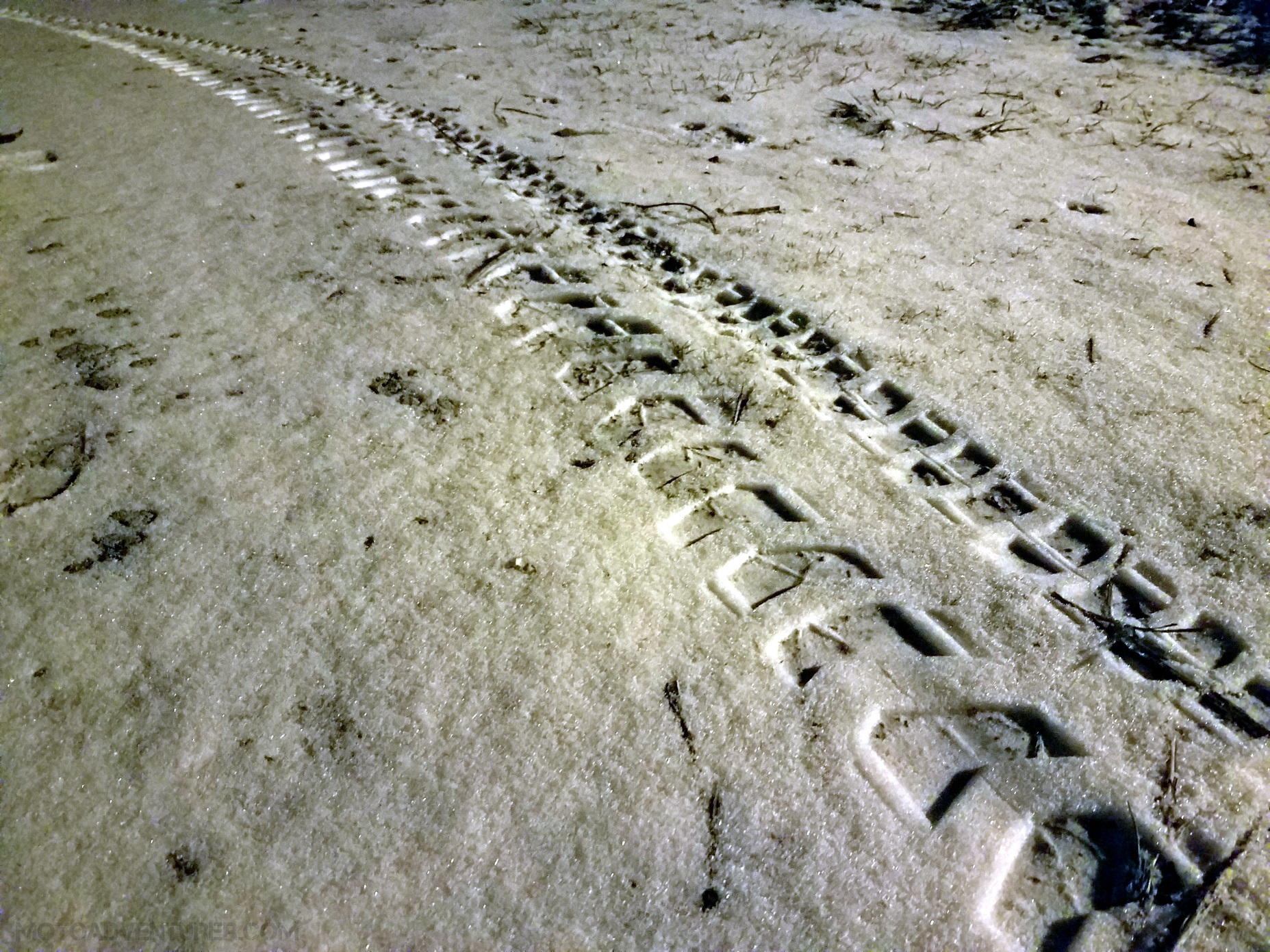
FEB05 Snow Tread

Endless Winter

With snow spitting from the sky just days ago, I began thinking about the distance I’ve covered in the last 90 days. Bill Murray’s immortal words from Groundhog Day rapidly came to mind. While I discussed the worst days of January in my previous write-up about 180 days in the saddle, the last 90 have kind of run together.

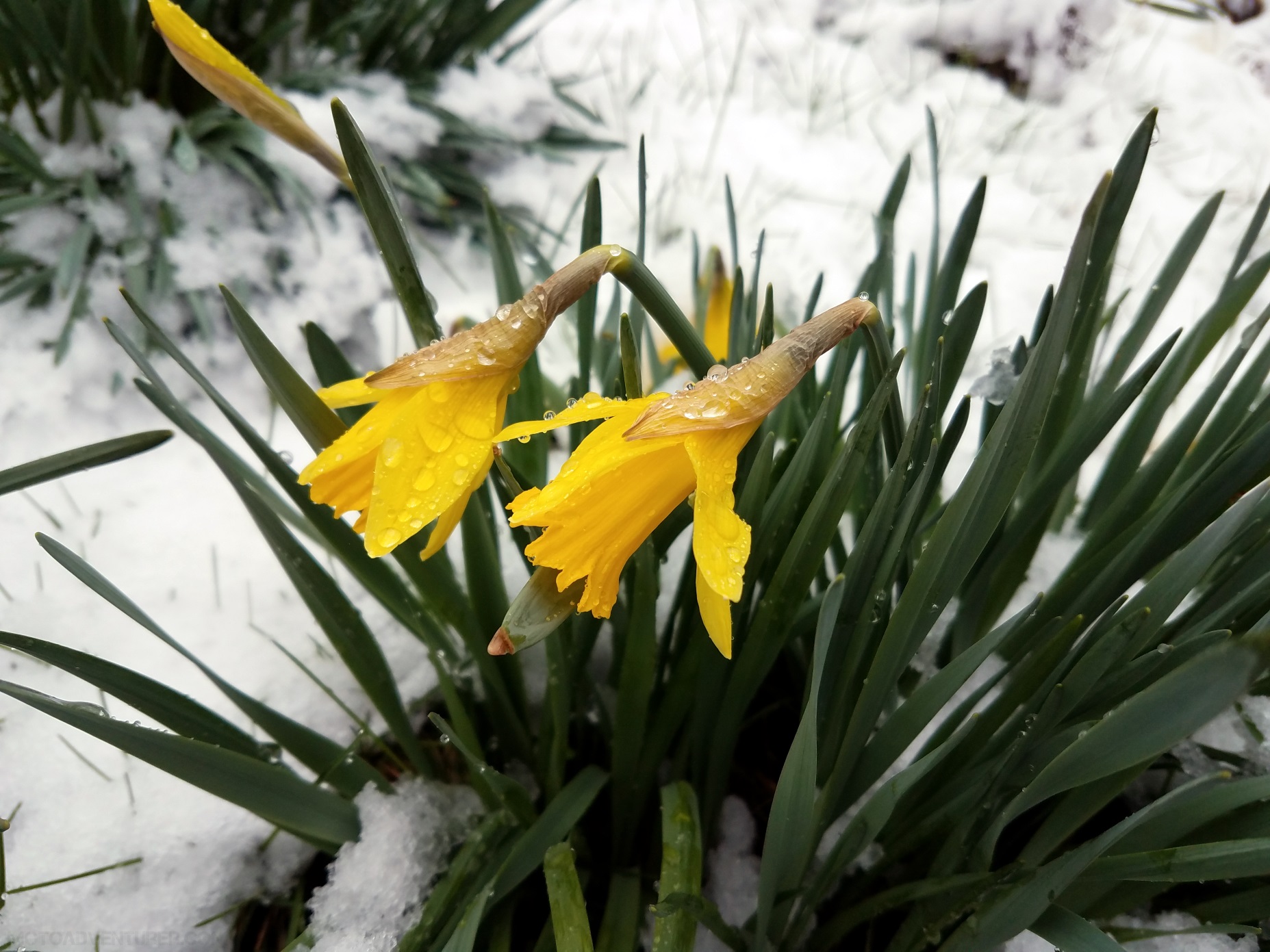
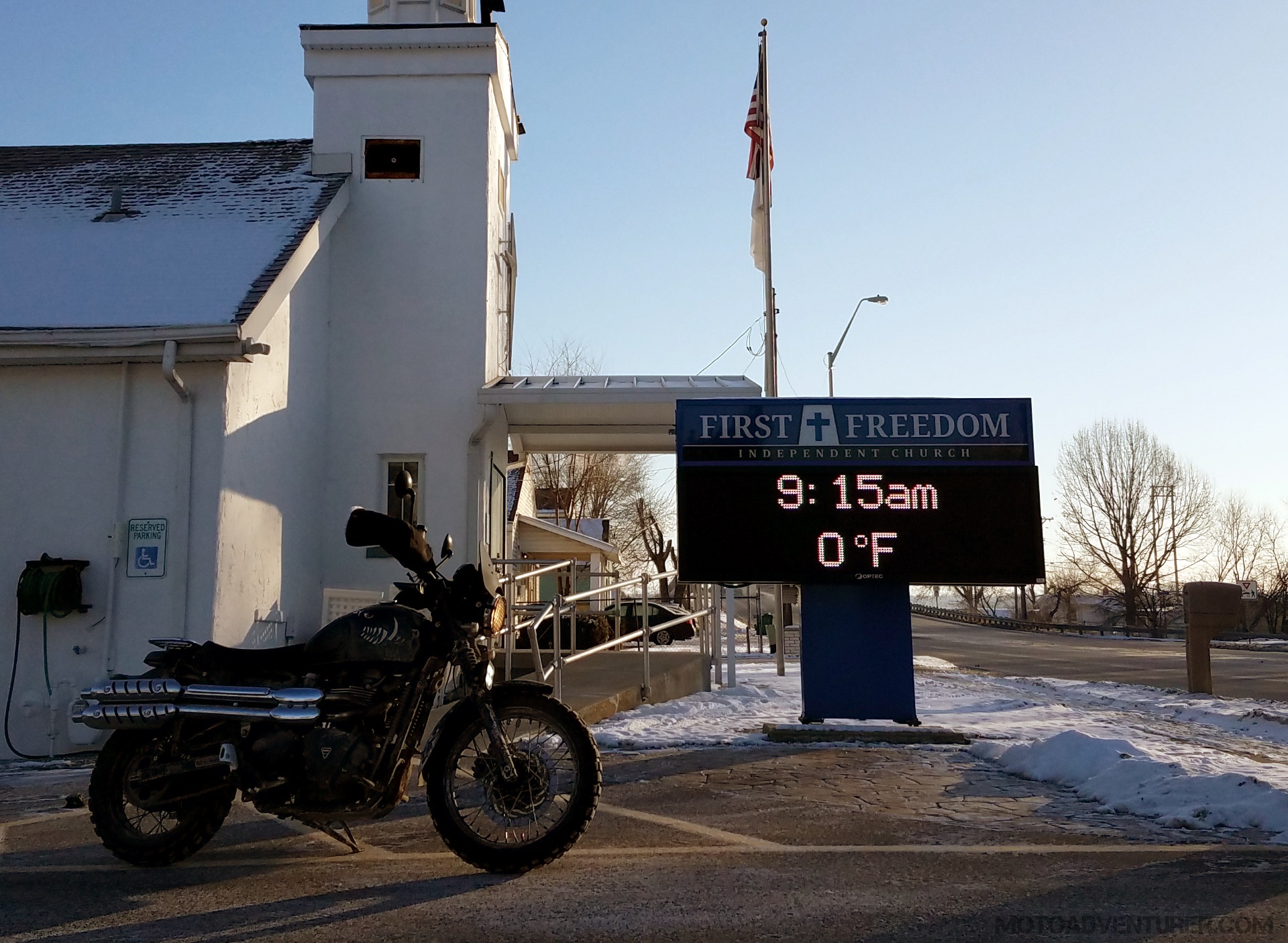
I unquestionably dealt with more snow and frigid temperatures back in January. That said, the heaviest snow we received this winter actually occurred in early February.MAR10 Snow on Daffodils MotoADVR  While I think it was only about 6 inches of snow (northerners please proceed to laugh hysterically), Daytonians have obviously forgotten how to drive in winter weather after experiencing such mild winters over the past couple years. That particular morning, cars were stacked up for half a mile in front of my office. Last time I checked, you need momentum to get up a snowy incline (not that I would know anything about that). At any rate, the last 3 months have involved a lot of snow, not so much in volume, but unquestionably in frequency.

7:30 AM, Wednesday, February 28th

The typical morning commute…

When it Rains it Pours

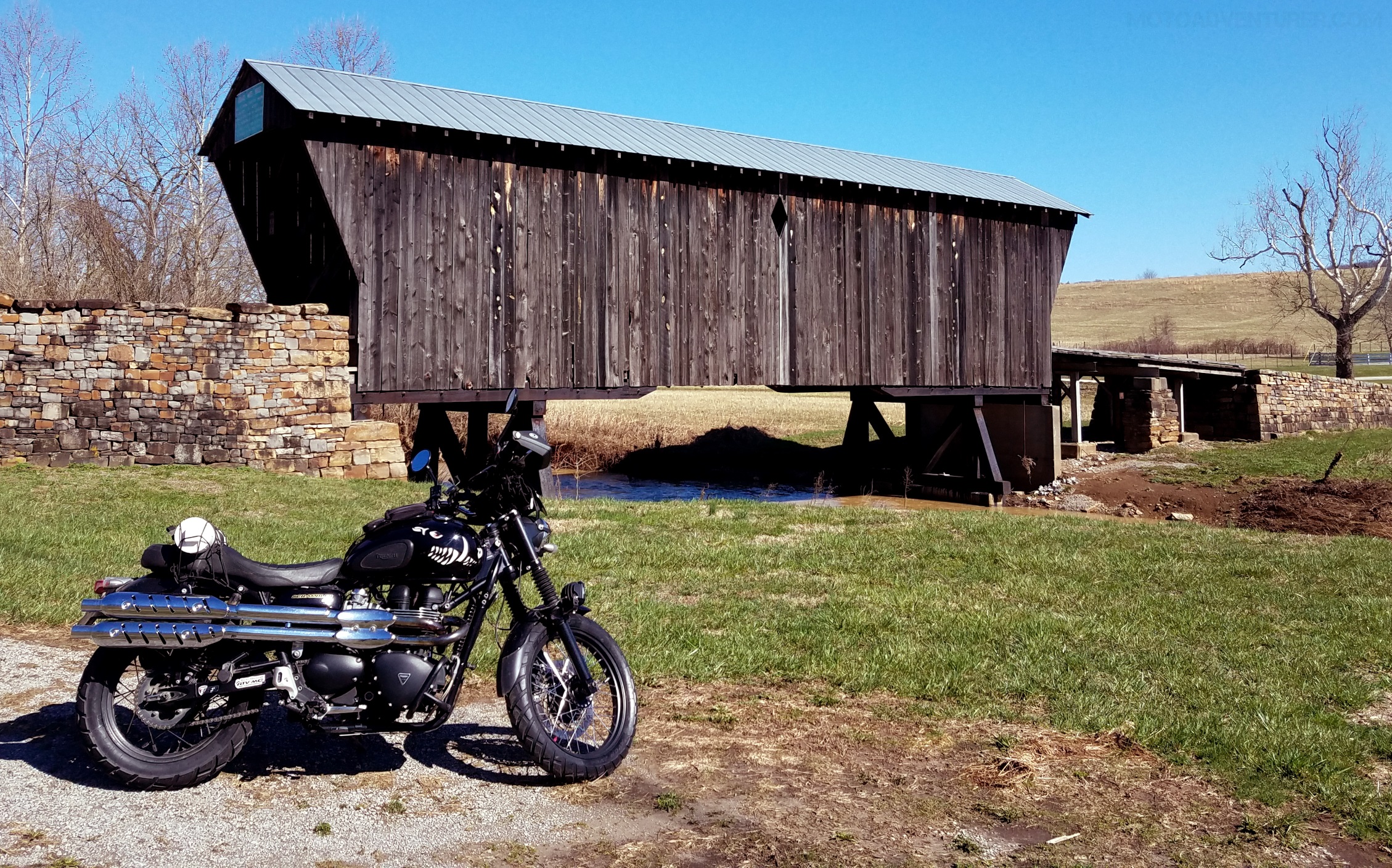
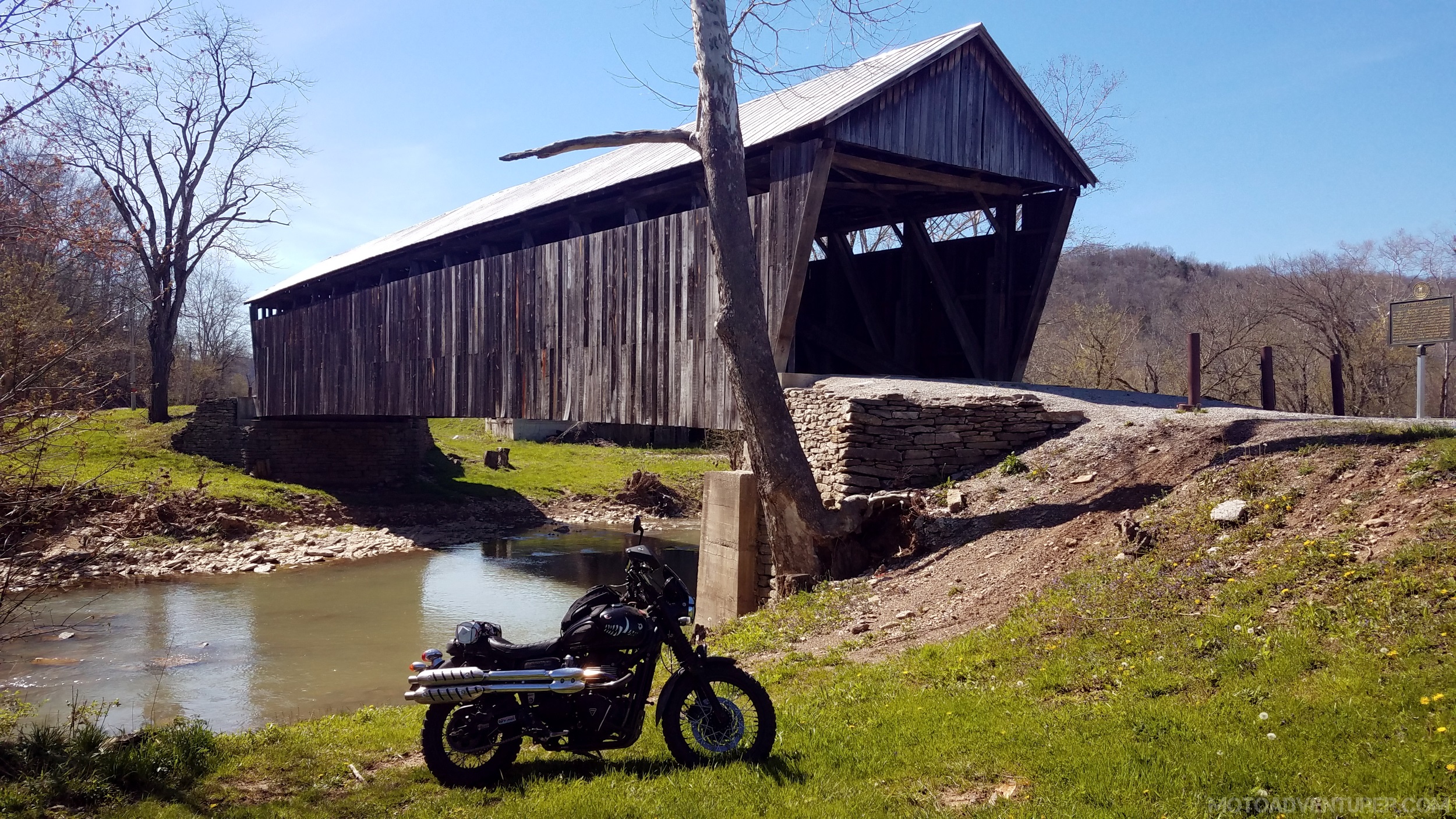
While snow accumulation wasn’t particularly of note, we did in fact receive record rainfall in February, March, and April (almost 3 inches in 1 day in April). FEB26 Kentucky Flooding MotoADVRAs I saw temperatures rising right around my birthday, I decided I was overdue for a trip down to the bluegrass state as a treat to myself. The high was only going to be mid-50s but I decided to brave the morning cold so I could go see a few covered bridges I hadn’t yet visited in northern Kentucky. Naturally, I ignored the fact that the Ohio River was above flood stage; a fact I rapidly discovered as I neared Cabin Creek Covered Bridge just east of Maysville. I watched a truck ford a section that was probably over 100 yards long. I dared not attempt it myself, considering I wasn’t familiar with the path of the road in order to stay on it and not sink into the obscured culvert.

FEB26 Goddard Covered Bridge MotoADVR

The saturation of the Gem City continued in early April. Days of endless rain brought the Great Miami River to flood stage unlike any time I’ve ever seen before. Various avenues around town were closed due to high water, including my street and several main thoroughfares nearby. Weeks later, local roadways are still littered with gravel, sand and silt, making every ride an “adventure”.

Always Wrenching

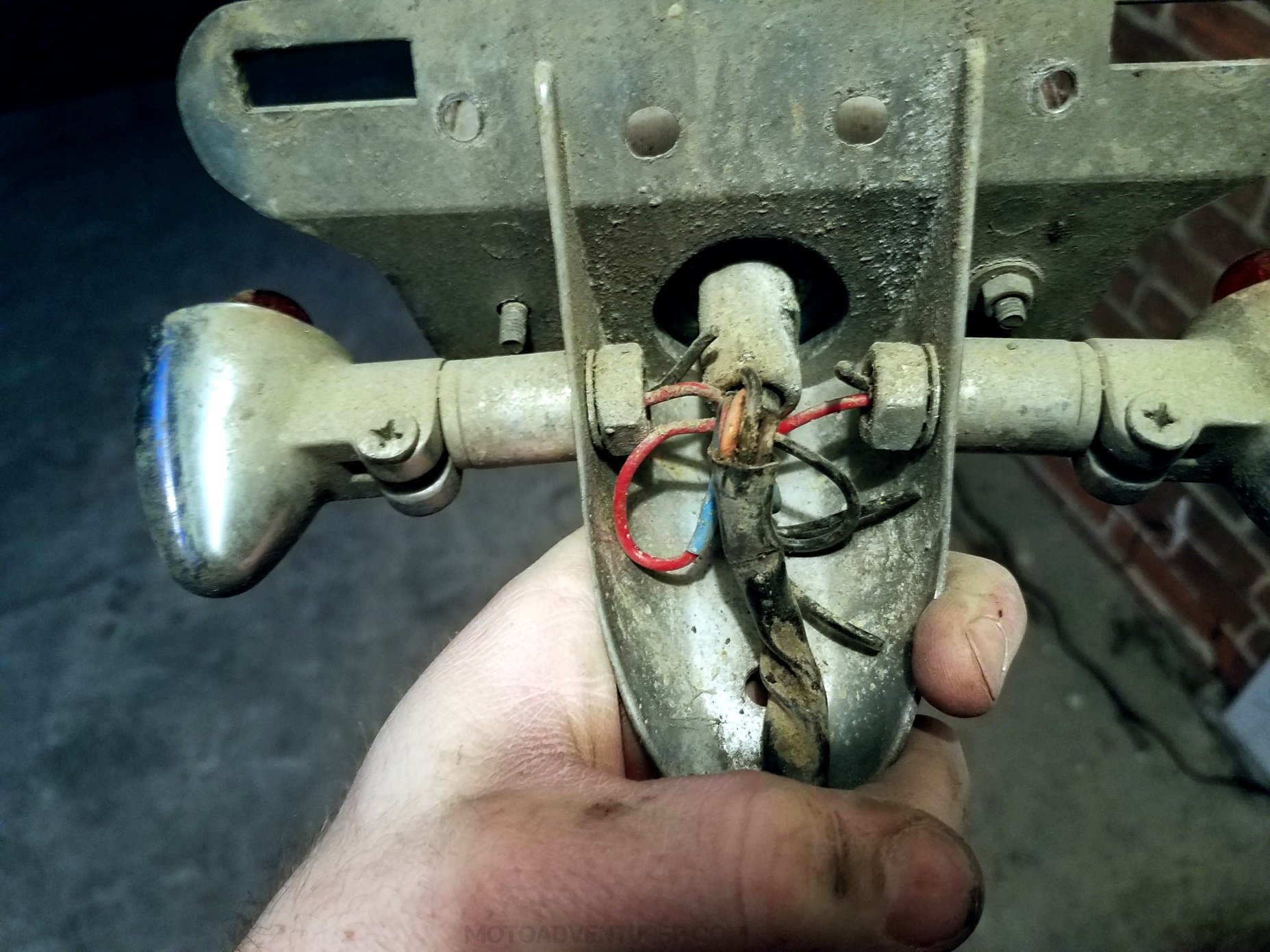
Electrical gremlins, one of my bigger fears in completing this challenge, did come to fruition right after my first big ride to Kentucky this year. On the return trip, as I neared my house I noticed my turn signals were acting a little funny.FEB27 Tail Light Fail MotoADVR The next day I poked around on the bike for a bit in the cold, noticing that if I activated the left indicator, all four lights would blink. After unplugging the rear brake light assembly, the front lights functioned properly. I pulled the stock tail light assembly out of the basement and plugged it in to see how it functioned. Naturally everything worked fine, so I swapped out the aftermarket unit and put the bike back together.

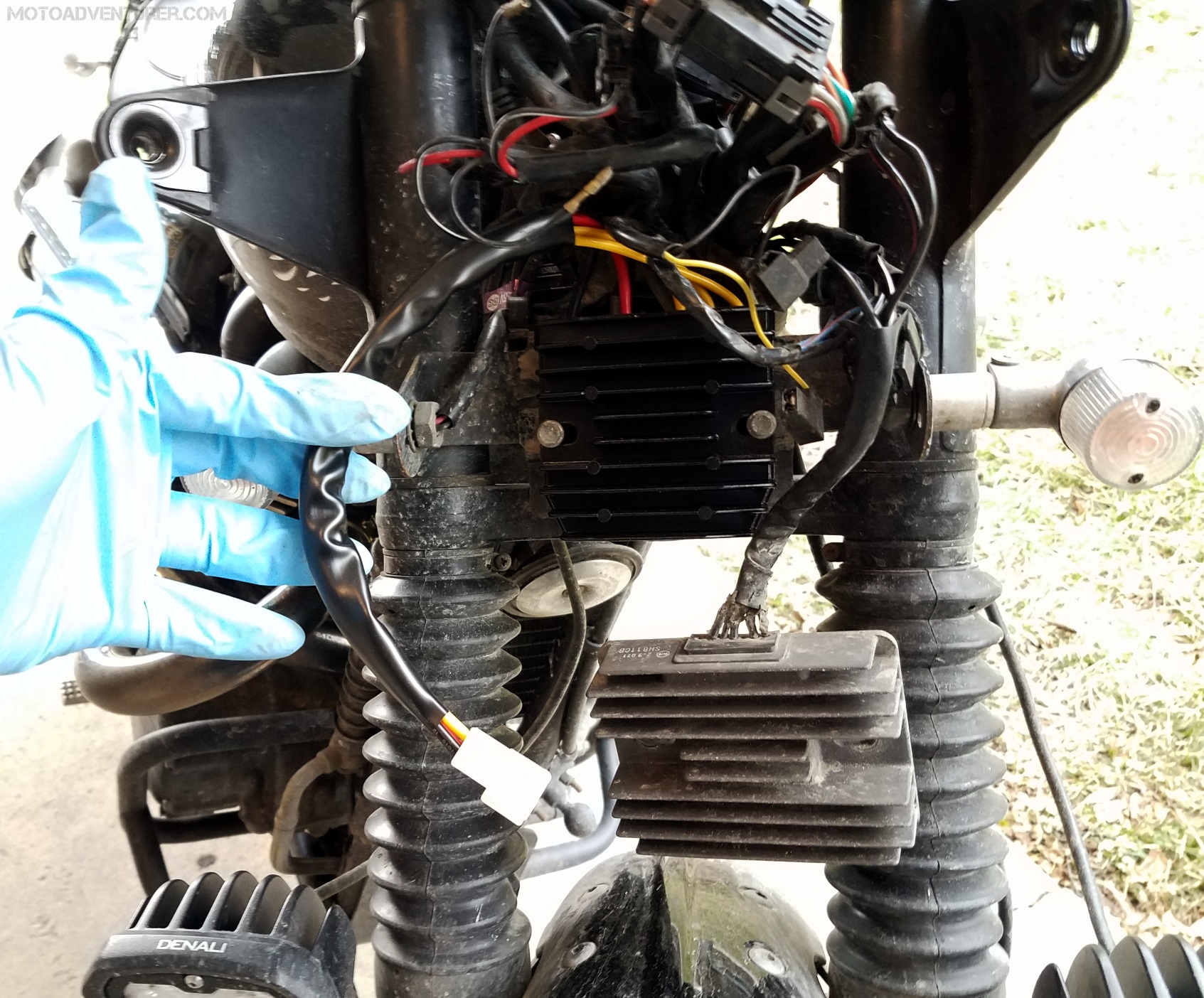
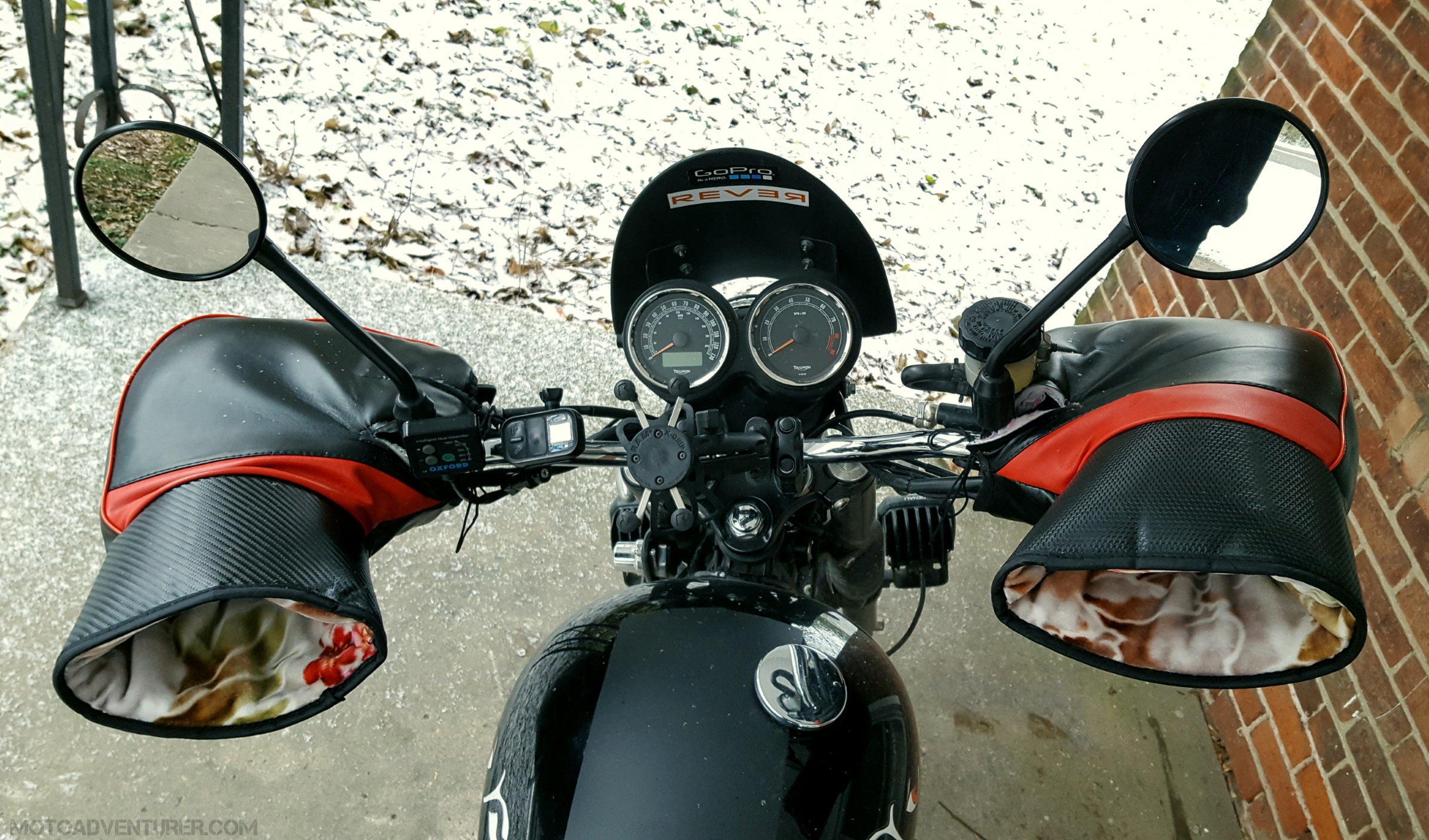
Things went swimmingly for several days, but shortly thereafter I noticed that my heated grips were throwing up the “bike not running” warning light. Mosfet Rectifier Installation Triumph Scrambler MotoADVRI found this a little odd considering I was riding, so I suspected I may have a faulty grip controller; it didn’t seem out of question, it’s been in a lot of weather since it was installed almost 2 years ago. That suspicion was proven false when I found the battery dead just a few days later. Per my comments about recent Scrambler upgrades, tearing into the wiring again, I discovered a short out of the rectifier bundle and decided to ditch the stock rectifier in lieu of a MOSFET unit. Thus far that seems to be working out quite well; I admit I’m not entirely sure if all of these incidents are related, but electrical gremlins preceded by wet encounters seems to be a common theme (“It’s a Triumph Mate!”).

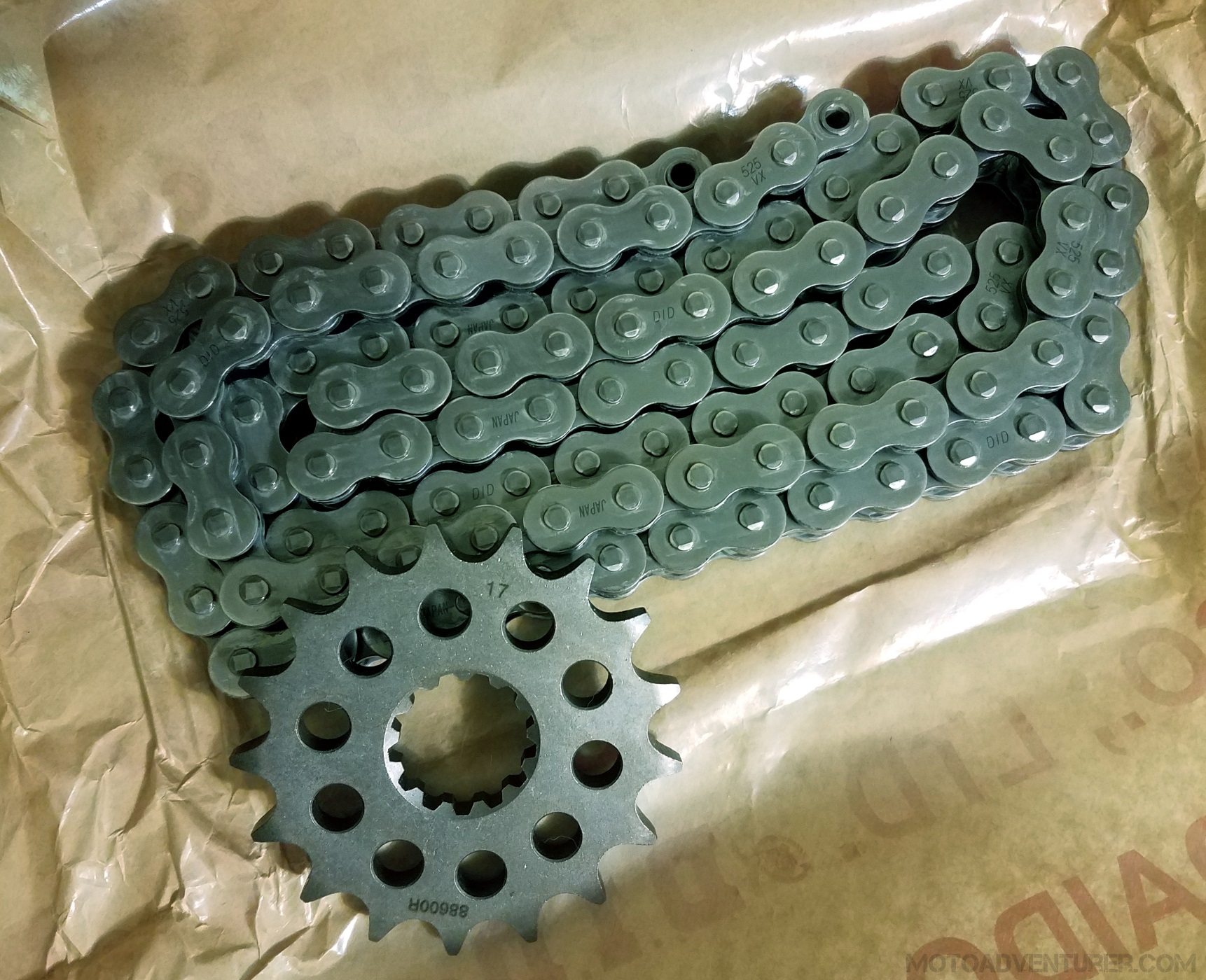
Thus far, the unplanned maintenance events have been manageable;FEB13 New Chain MotoADVR I hope that trend continues, not just through the summer, but frankly, indefinitely. Riding every day has naturally driven a lot routine maintenance as well. While I did change a tire last February, between March Moto Madness and to spite Old Man Winter, this year I’ve actually swapped two sets of tires since January. Looking back at my maintenance records from this time last year, I was forced to cut off a heavily abused chain much sooner than expected, but it appears I did an oil change only 30 days earlier than last year. I also find it interesting that I’m actually down about 1,000 miles versus 2017, including my trip to Tennessee; I suppose that’s a testament to the ever persistent winter.

Tenacity

A few folks in my riding circle have said “you picked a hell of a year to ride every single day.” That is definitely the case, however I’ll be the first to admit, I remember far worse winters.APR10 Morning Sunrise MotoADVR While it’s not completely out of the question, I think the likelihood of 6 inches of snow falling this April is not very good. I’m not upset about that, because I honestly thought I would have spent more time riding in the snow than I have, and I’m thankful for that. I do admit, I’m pretty run down from piling on all the gear day after day in preparation for another battle with the elements. The rain has been punishing this spring, and I don’t expect that to end anytime soon; but it’s still better than temperatures in the teens with snow and salt scattered across the local streets. I’ve seen two 60°F days this weekend, including my second covered bridge adventure into the Bluegrass state. Hopefully that’s the light at the end of the tunnel. With weather trending up (hopefully for real this time…) and my sights on Pennsylvania in mid-June, I suspect the next 95 days will have equally interesting challenges.

More of the Ride 365 Challenge

APR20 Cabin Creek Covered Bridge MotoADVR

Posted in Opinion | Tagged , , , , , , , | 3 Comments

Triumph Scrambler Project: Stage 3 Upgrades

Triumph Scrambler Stage 3 MotoADVRIt’s been a while since I did an in-depth update on the status of Rosie the Scrambler. Things have fell by the wayside considering my workload at the “day job”, trying to document the Dirtster Project, and getting ready for rallies this spring. Per my previous comments about “rally planning”, I have some lofty goals, but I have finally accomplished most of the short term items, with a few wild cards on the horizon.

Left Side Pannier

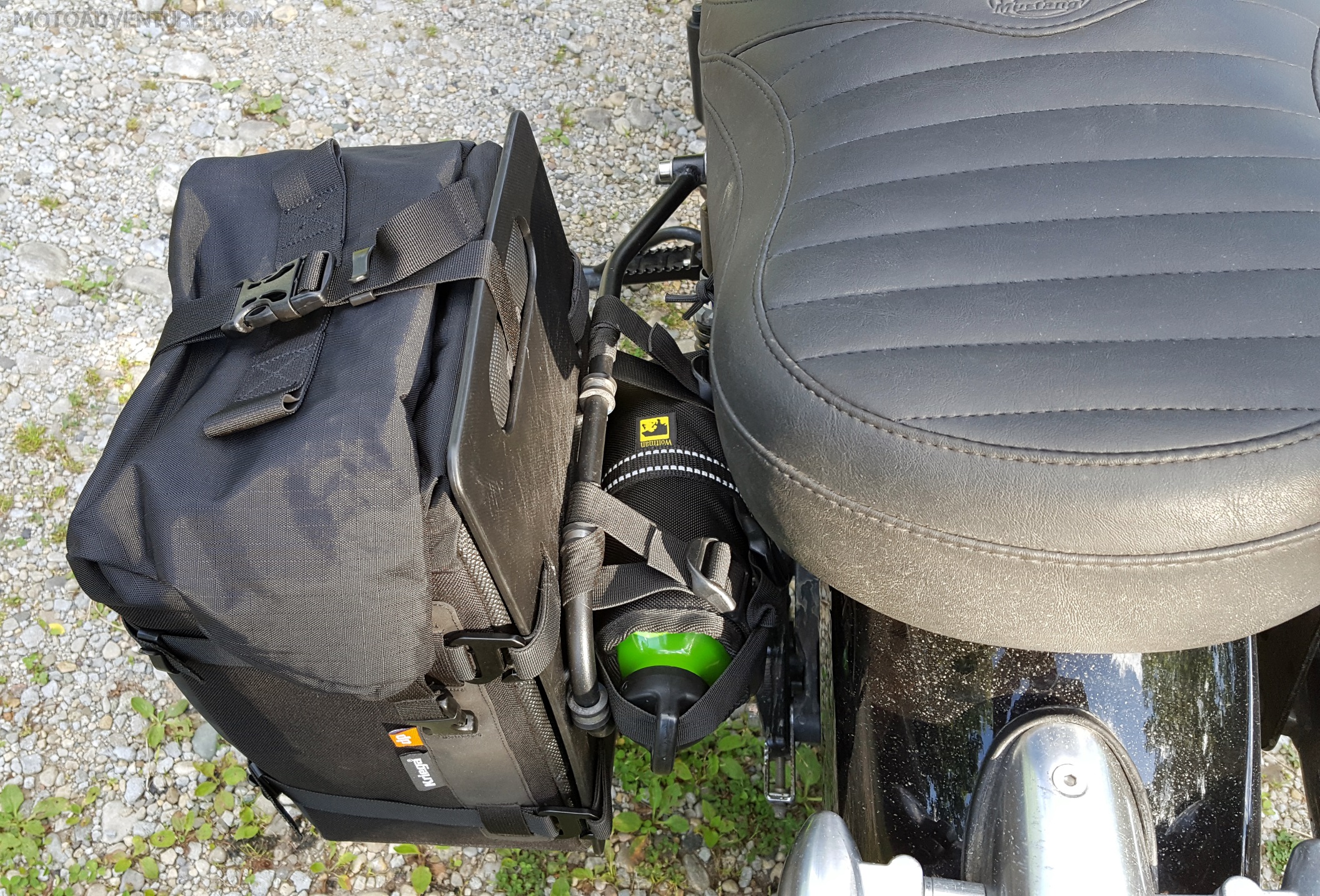
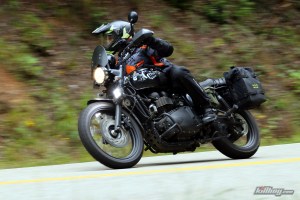
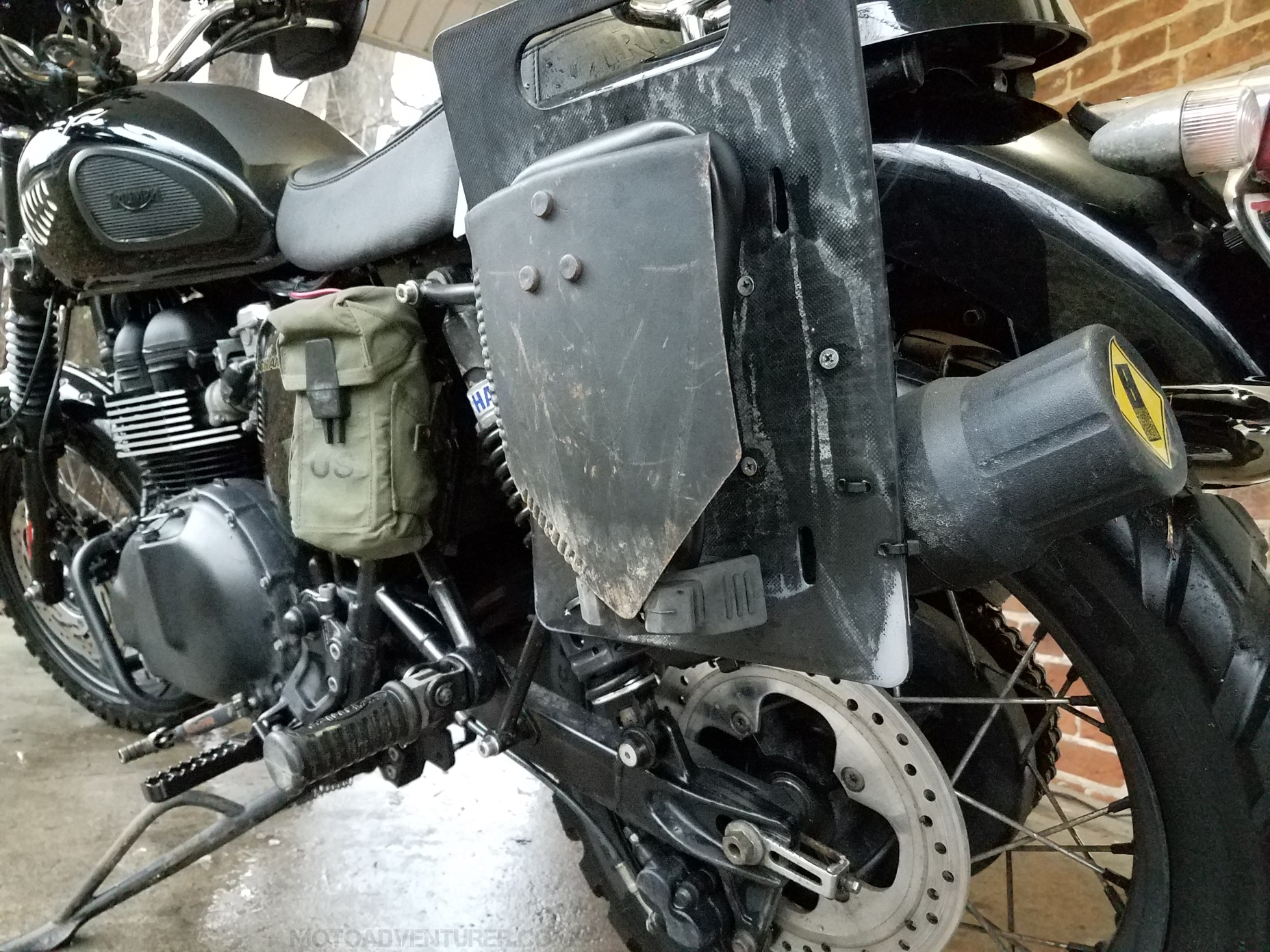
I’ve actually received a myriad of questions about my pannier mount set up and I apologize that I’ve not published anything about it before now. Pannier Rack PMR Triumph Scrambler MotoADVRLast spring I was desperately trying to add storage space to the Scrambler without breaking the bank. I found a company called Precision Motorcycle Racks that sells pannier racks for the Triumph Bonneville line individually; this is important as I only needed a left side rack. The rack was cheap, like $50, so I was somewhat concerned about the hardiness of the construction. The pannier rack bolts onto the existing stud for the top of the shock mount and includes a bracket to secure to the back of the left passenger peg. With the rack installed, I beat on it pretty hard to see how sturdy it was; considering the price, I was impressed with the quality (more on that in a minute).Pannier Rack Tail of the Dragon Triumph Scrambler MotoADVR With the rack in place, it was a matter of selecting a suitable pannier to hang on it. Originally I had plans to sling a cheap ammo can off the side. I admit, I still want to do that, but considering the price, weight, capacity, and concern about sturdiness, I decided to pick up a waterproof softbag instead. The soft-bag also offers the option to mount it on the pillion seat if I didn’t want to use the pannier rack, something the ammo can doesn’t do as easily. Ultimately I selected the Kriega OS-18 dry bag as the pannier of choice. Long term I want to get a matching set of Kriega bags for both the left and right sides, so I figured having an extra compatible bag would be a good start. Pannier Rack Top view MotoADVRKriega does sell a mating attachment “board” that can be fitted to your luggage rack. I’m cheap, so despite getting better hardware, $75 seemed like a lot to spend on a plastic plate and some screws. Instead, I pulled an old cutting board out of a drawer in the kitchen and went to work with a “speed-saw” (like a drill bit, but used for lateral cuts). I cut slots in the cutting board to match the attachment straps on the bag, and then drilled holes to align with half-inch-diameter “Adel” clamps (cushioned wire clamps) I used to mount the board on the pannier rack. I painted the board black and bought 5 screws and nylon lock-nuts at the hardware store to mount the board to the clamps. Now the dry bag can fastened to the pannier rack when I want it, or I can ride “blank” when I don’t need the extra storage.
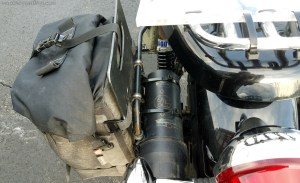
Noticing the space between the rack and the rear fender, I realized I could mount a fuel bottle on the backside of the rack. Pannier Rack Tool Tube Triumph Scrambler MotoADVRAt one point I had a Wolfman canvas fuel bottle holder and a 3” tool tube mounted behind the rack, but when I relocated the brake caliper, I had to make room (more on that later). This whole setup has worked really well, and has all been accomplished under $200, something that’s hard to say for modern motorcycle luggage systems. That said, I admit I want to improve on the setup. When scrambling the highly technical stuff, I want to ride “lighter”, however I still need tools in case of a breakdown or flat tire, along with rain gear depending on the conditions. Because of this, I would like to beef up the rack a little bit and make it possible to mount more tool tubes to the rack when I’m not using the pannier. That will probably mean making an investment in a slightly more robust rack, and likely a larger mounting surface; but for now this is getting the job done.
 

Tool Tube

PVC Tool Tube MotoADVR

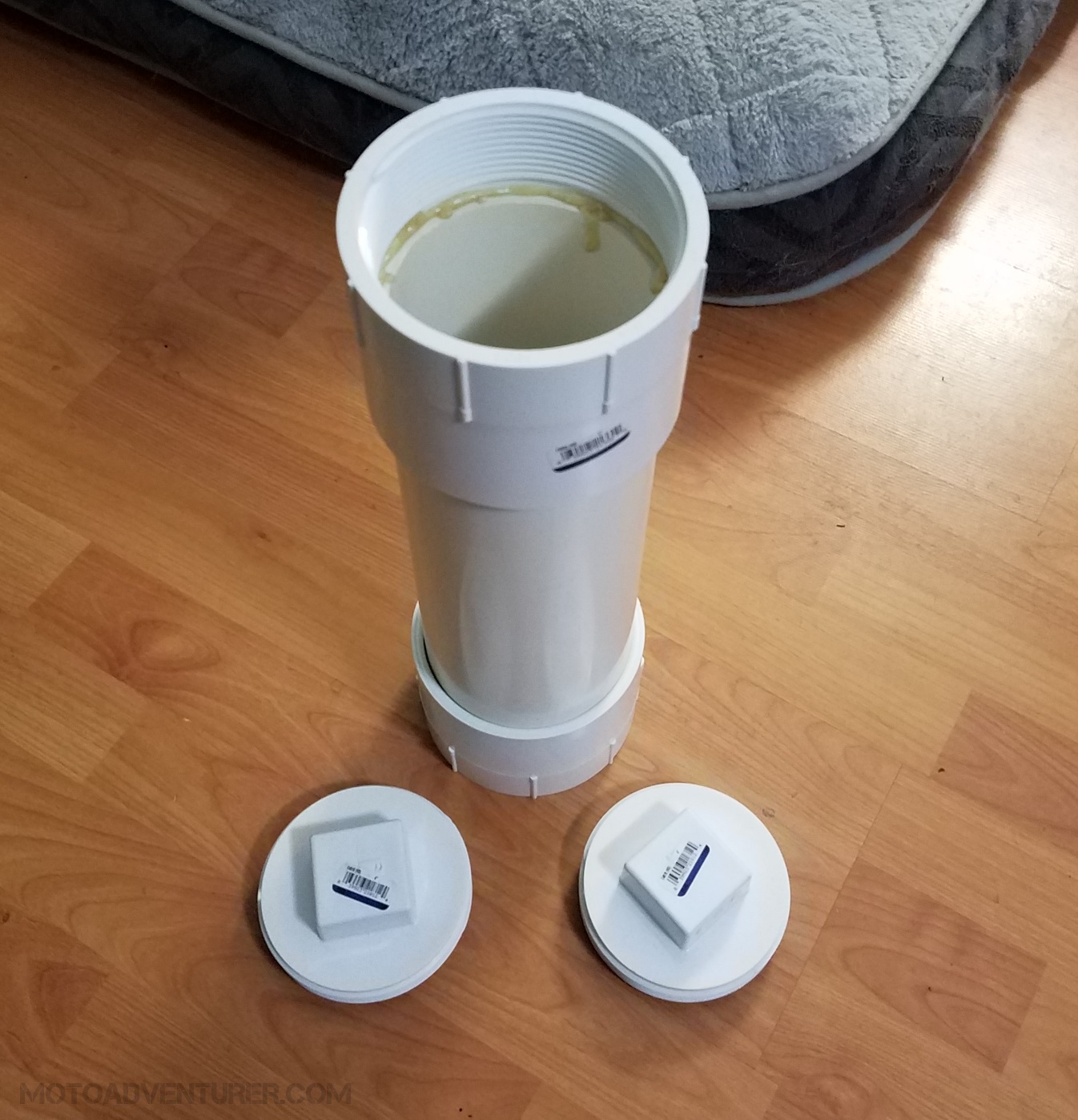
While I admit touring solo was an early driver for upgrading the tool kit, riding off-road has really hardened that stance. That task gets a little tricky as I want to carry the weight closer to the center of gravity, and certainly not on the left side pannier as the tools are a bit heavy. I’ll accept that a light tool kit might be more advisable, but per usual, I’m taking on a lot of different scenarios with one weapon; sacrifices are being made. At any rate, traditional tool tubes will set you back about $15, and with enough space, you can bolt up two or three of them and accomplish the same task. Real-estate obviously comes at a premium on the Scrambler, so I needed a better waterproof solution. Ultimately I dropped by the hardware store and started looking at 4” PVC pipe. PVC Tool Tube Installed Triumph Scrambler MotoADVRI bought a 3 foot section of 4” pipe, two threaded ends and 2 threaded caps to seal the deal. I used a coping saw to cut the main pipe down to a reasonable length to fit on the pillion seat (or luggage rack), and used gorilla glue to fasten the end caps (you can also use PVC cement). Now with a hideous piece of $30 white plastic fastened to the back of the bike, I lathered it in all of the motorcycle stickers I had laying around and now I’m all set for the road. The new tool tube holds all the normal tools I use to work on the Scrambler, with exception of my multi-meter and air compressor.


E-tool Shovel Mount
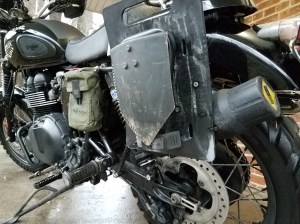
E-tool Mount Triumph Scrambler MotoADVRI talked about this in the lead up to all of these upgrades; it doesn’t necessarily make a whole lot of sense, but I want the option to have my entrenchment tool on the trail. Thanks to a Christmas gift from a friend, I now have the ability to mount my trusty “Army field shovel” to the side of the bike. It may not get used a whole lot… but if nothing else, it will certainly be a conversation piece. This mount is really simple, I saw the setup that Ural is using on their sidecars, and did the same. Considering that the mounts were a gift ($15 on grainer or amazon), I drilled a couple holes and spent a couple bucks on screws and nylon lock-nuts; done deal.


Rear Brake Relocation

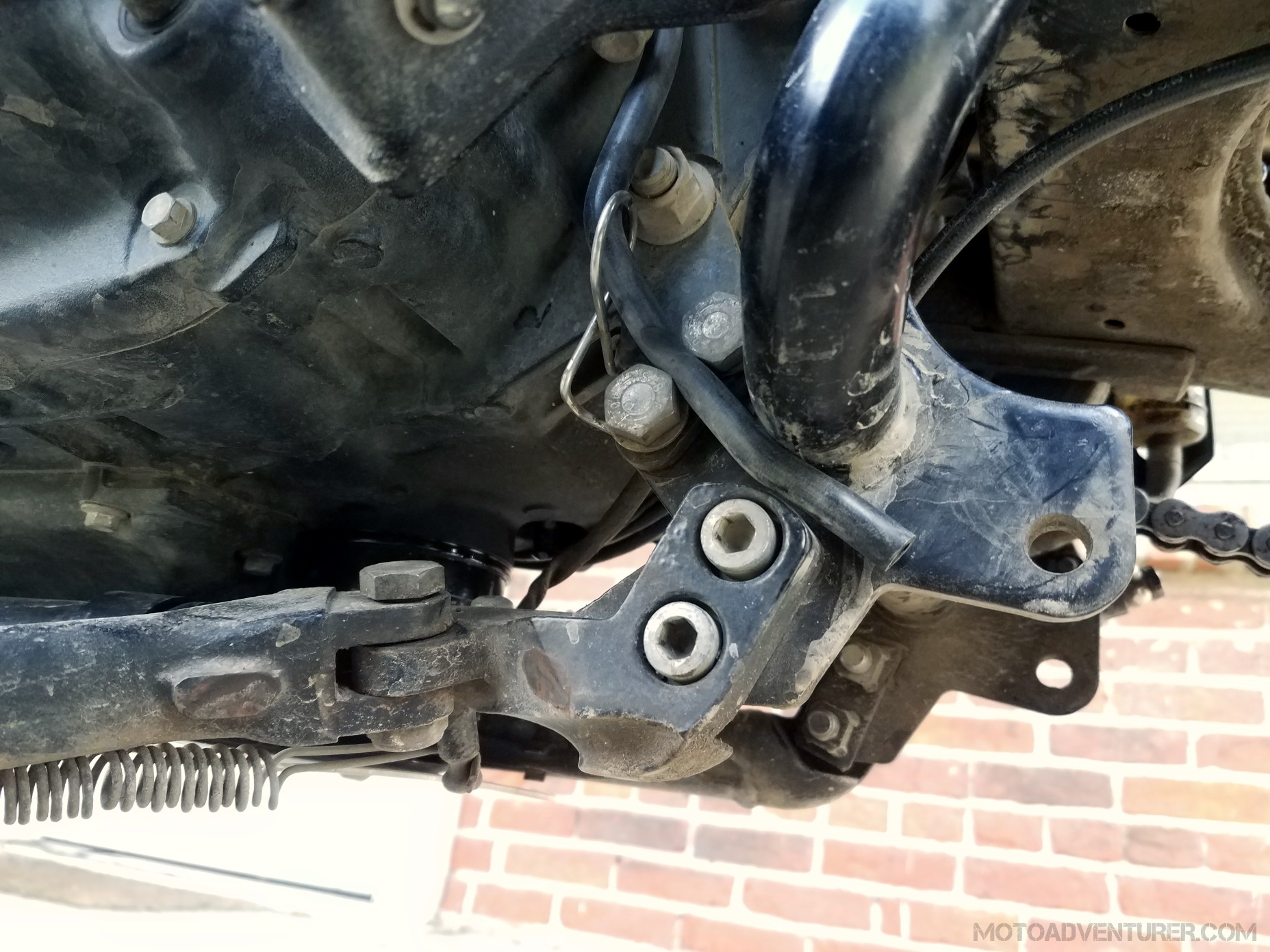
This was arguably the most important modification I wanted to make before I dove too deep into off-road riding. For about $100, per my comments, you can buy a bracket from various outlets; ultimately I chose the Motone bracket. Mounting the bracket itself is actually quite easy; I frequently remove the rear caliper prior to removing the rear wheel of the bike, so I’m quite familiar with manipulating the caliper mounting bracket. The brake line however is another story. Rear Break Relocation Bracket Motone Triumph Scrambler MotoADVRPer my comments about fussing with the California Emissions Canister, there are challenges in finding the best routing method. I actually rode the bike for a couple days with the caliper relocated and the break line riding between the charcoal canister and the swing arm, but I just wasn’t happy with the tight quarters so I decided to remove the canister. With the canister removed, the route is pretty obvious; the brake line makes a 90° bend from the brake master cylinder, under the swingarm, through the inside of the swingarm, then up to the top of the brake caliper. I admit, I’m still a little unhappy with the existing path of the brake line. I recognize the likelihood of something hitting or “slicing” the brake line between the wheel and the swing arm isn’t particularly high; however something about it just seems like a bad plan. Ultimately I suspect I will go visit Spiegler Performance and have a custom brake line made to fit the path better (~$100 or less I assume). Perhaps I’ll spend the extra $65 and upgrade the front at the same time; maybe leave a little extra room for a 30mm travel upgrade and taller par risers.


Spiegler Banjo Bleeder Bolt

If installing the brake caliper relocation bracket wasn’t challenging enough, no thanks to the brake line constraints, bleeding the brakes after disconnecting the brake line was worse. With the brake caliper now relocated to the top of the swing arm, the stock bleeder valve was no longer the highest point of the brake system. I’d put a $25 “Bleeder Banjo Bolt” on my Scrambler project Pinterest board a long time ago, so I stopped into Spiegler to pick one up after work one day. Installation is a simple bolt replacement, you just need to make sure you torque the banjo bolt to spec and take it easy on the bleeder bolt; after that it’s business as usual.


17 Tooth Front Sprocket

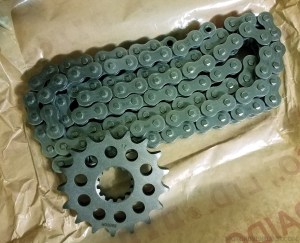
Similar to relocation of the rear brake, I was pretty convinced I needed to shift the gearing a little lower for the nasty off-road challenges. I stand firm that the Scrambler is a tractor, but it’s still a street oriented piece of agricultural equipment; the torque band is down low, but I think first gear could still stand to be a bit lower after slipping the clutch up Pumpkin Hollow Road a few months ago. Installing the 17T primary sprocket was easy. When I had a feeling the last of the winter salt was finally washed off the roads in late February, I decided it was time to replace the chain (big assumption on my part, snow is somehow still in the forecast here this week…). Considering the chain was already coming off, I took that as a window to swap out the stock 18T sprocket for the 17T. Normally I would buy a chain and sprocket kit when replacing the chain, but in this case, I figured the rear sprocket was virtually unworn, so I was just going to replace a chain and sub in front new front sprocket.

How the bike feels is a much larger issue than installation; thousands of miles later, I’m still on the fence. 17 tooth Sprocket Triumph Scrambler MotoADVRThe 17 tooth sprocket makes the bike wind through the gears much smoother and much more quickly than the 18T. The bike “feels” a lot faster and acceleration “seems faster” on the odometer. Dropping to a 17T sprocket, I expected that the bike would potentially loft the front wheel, but that doesn’t seem to be the case, but it certainly does feel like it will get to “The Ton” a lot faster. Much of this is speculation as a result of the current state of tune of the “Butt Dyno”; also, I can empirically tell you that the speedometer is now 5 MPH slow when traveling at 80 MPH (Speedo indicated versus GPS measured). On the same note, “Cruising” in a 70 MPH zone now means that the engine is turning between 4500-5000 RPMS depending on grade and actual speed. Trying to stay ahead of interstate traffic on the way to March Moto Madness through Kentucky was pretty brutal; 5000 RPMs for hours on end was really draining.
 

With the 17 tooth front sprocket, the bike is an absolute gas in the twisties. The gearing just feels right, and the bike wants to squirt out of the corners. The off-road performance feels equally better. I admit I’ve not been in an excessive amount of mud since the change, but the gearing has worked very well for creek crossings and steep hills. Despite how awesome the bike has been from 0-65 mph; the buzziness at interstate commuting speeds is taxing. As a result, I’ve just re-installed the 18T sprocket. Despite being partially worn, I’ve ordered extra lock-washers so I can switch back and forth between the 17 and 18 tooth sprockets between on-road and off-road events; I definitely want to make sure I have it installed for Conserve The Ride in June, despite the 600 mile journey it will be to Pennsylvania.


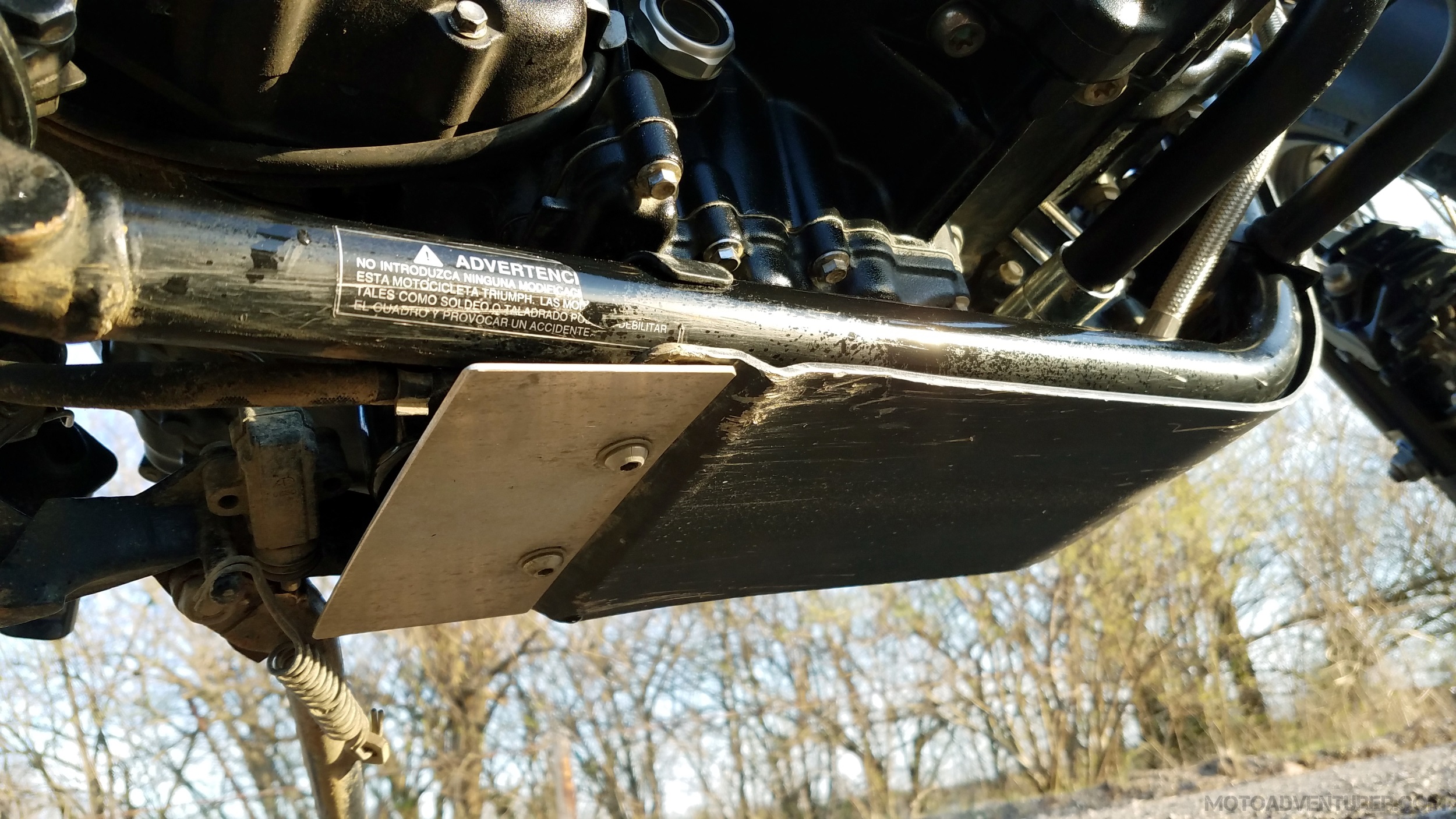
Skid Plate Extension
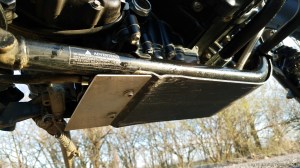
Skid Plate extension Triumph Scrambler MotoADVRPer my write-up about “rallying up” for 2018, I wanted to extend the skid plate so that the thin-skinned oil filter didn’t become a victim of a rock strike. I’m a big fan of the “KISS” principle (“Keep It Simple Stupid” for those unfamiliar); my approach to the skid plate was no different. If I could find a piece of aluminum of similar dimensions and thickness, drill a couple holes in it, and use existing hardware, I’d be happy. I found such a piece of aluminum in a scrap bin at work one day. Things went exactly as planned. I might even paint it black… maybe…


Crash Bar Reinforcement

I’m going to warn you, this is ugly. Per my comments from the very beginning of the Scrambler Project, the crash bars need a little help. I knew I just needed to put a length of pipe in the gap between the two crash bar sections. Cutting a length of pipe the same size with a hacksaw was the easy part (okay, not easy, but conceptually…), finding a suitable bracket to hold it in place however… not so easy. I settled on a set of conduit “joints” as temporary solution. These pieces are metal, and they’ll hold the pipe in place, but it’s still ugly as all sin, and there are certainly better solutions. Without removing, cutting, drilling, or welding the existing crash bars, this is the best solution as stop-gap measure (no pun intended). Ultimately I may decide to remove the bars and craft a permanent solution.


Dart Flyscreen

I’ve wanted a Dart Flyscreen for my bike since just after I bought the Speedmaster five years ago. Dart Flyscreen Triumph Scrambler MotoADVRSome things worked out my way, and I mounted a classic Dart screen on the Scrambler just weeks after posting my “Rally” plans last December. Installation is again pretty easy, especially as I basically copied their design with my own garage brewed screen; just remove the bolts from the “headlight ears”, install the brackets, and then install the screen to the brackets with the provided fasteners and bushings. Dart’s quality is absolutely top notch; the hardware, fasteners, and screen are easily better than OEM quality is some respects.
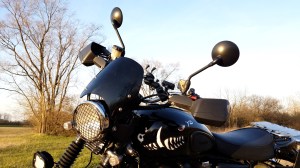
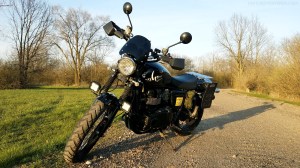
On the road I’ve been very happy with the Dart. I’m often asked if a flyscreen really makes any difference, to which my reply is typically “more than you think”. For those unfamiliar, I obviously appreciate the “naked”, “classic” look of the Triumph twins, among other bikes (I.e. the XSR 900), and I don’t want a big windshield to detract from that. Triumph Scrambler Sunset MotoADVRWhile the utility of a large screen cannot be overstated, especially on long distance rides, I simply prefer the more engaged experience in the wind. The flyscreen knocks down the wind blast just a bit, especially across the chest and shoulders, making the highway rides a lot more comfortable. To my surprise, my garage brewed screen seemed to move the airflow up a little higher than the new Dart, however I haven’t adjusted the angle on the screen yet to offer final judgement in that respect. Either way, the Dart is of much better quality, and has already done a hell of job under pretty poor conditions.
 

Rear Brake-fluid Reservoir Cover

This is completely cosmetic; in a departure from my mostly functional perspective on things, I have never liked the flat aluminum rear brake reservoir cover. The bike is black, the frame is black, even the seat is black… and the break reservoir is flat aluminum. I scuffed it with 220 grit sand paper and spray painted it black. Now it matches the bike, and when I scuff it with my boot, I can do the same thing again.


Oil Filler Cap

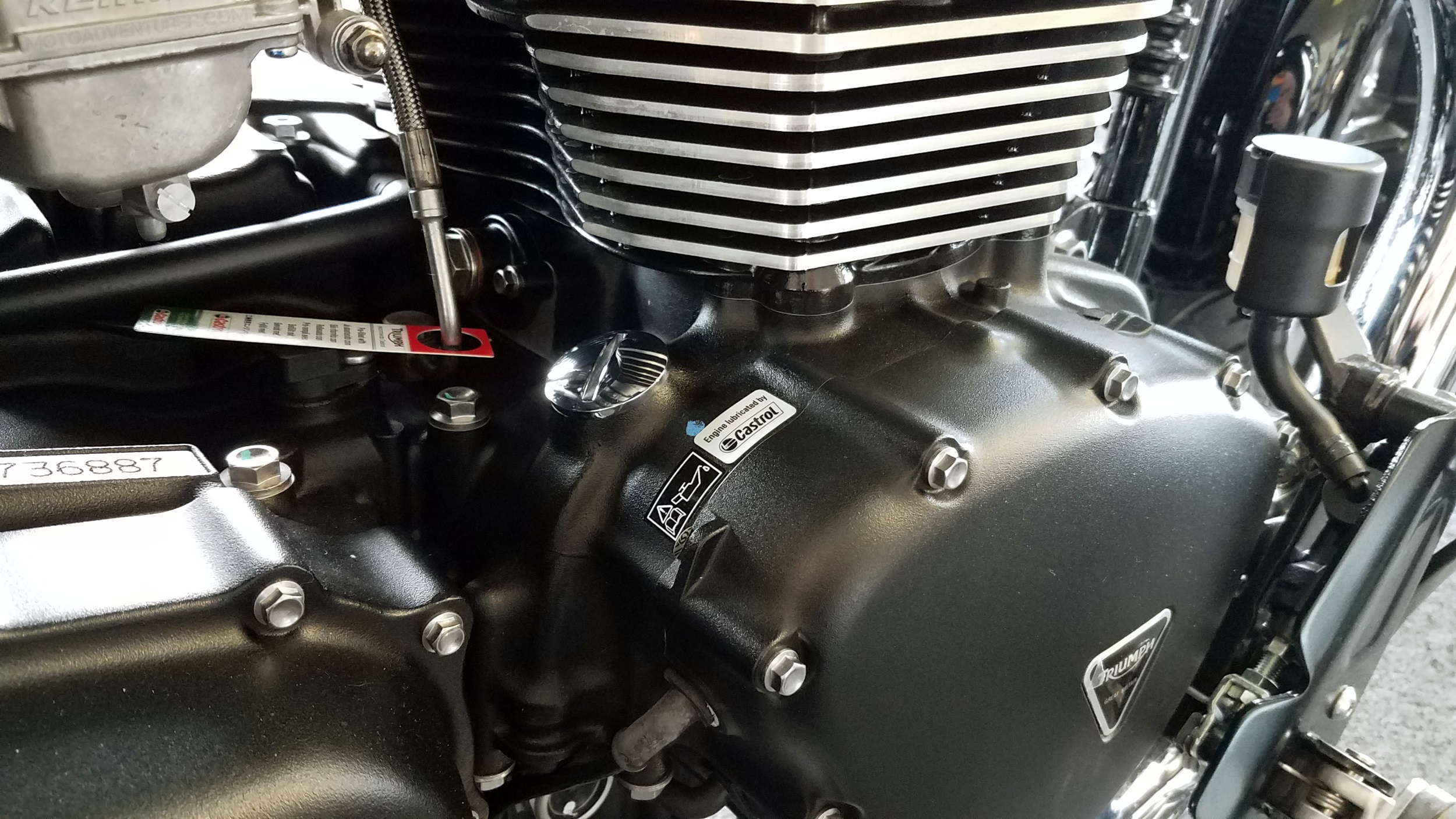
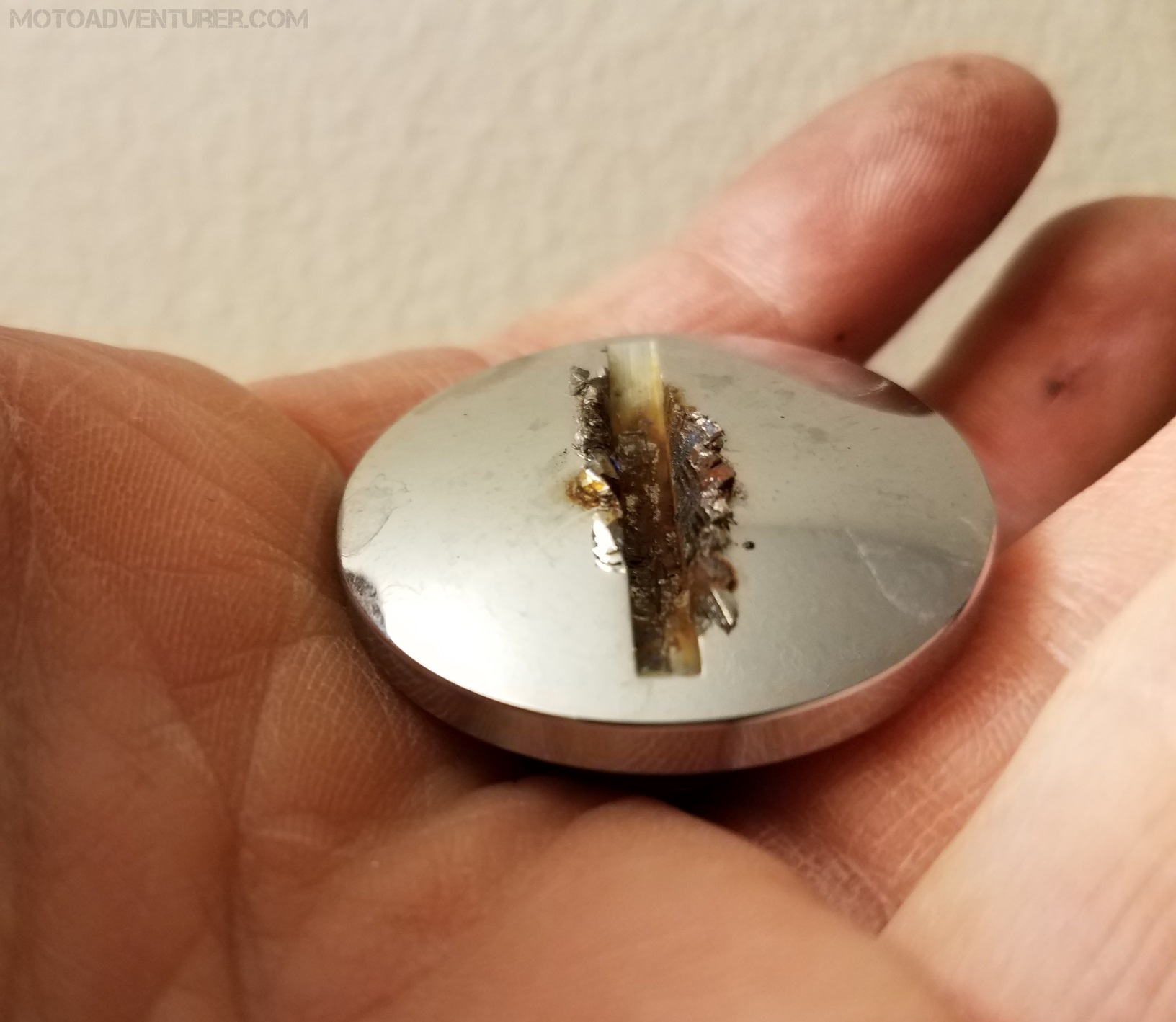
From the very first oil change I did on the Speedmaster way back in 2013, I’ve hated the oil filler cap on these bikes. Assuming you’ve never heard me mention before, I love the 865 cc Triumph mill; it just ticks a lot of boxes for me. Oil Filler Cap Triumph Speedmaster MotoADVRThat damn oil filler cap however… “is bloody rubbish.” It’s all shiny and chrome, which is fabulous until you decide to change the oil for the first time. After which it’s marred from use, which only gets worse after each service. Moreover, if your bike ever sees water of any variety, that wonderful chrome bit, now marred from whatever tool you used to remove it, is rusting in the weather.

Along with all of the other items on my lengthy Pinterest wish list, I’ve had a replacement oil filler cap on that board almost since go. Oil Filler Cap marred Triumph Scrambler MotoADVRAfter I had significant trouble removing the cap for the 42,000 mile service a few days ago, I bit the bullet and purchased a replacement. I chose the Joker Machine cap considering it offers me the ability to safety wire the oil cap in place. The likelihood of that necessity isn’t particularly good, however at some point I’ve debated taking the scrambler to a track day, and that may be useful at that time. Until then, I have the convenience of removing the oil cap with a wrench, hex key, or a screw driver, depending on what’s available to me. That and well, it’s black… as it should be.


Rectifier Replacement

On day 230 of the riding streak, I went to start the bike and got the dreaded “Click…. Click… Click…” of a dead battery. I charged up the bike and rode 10 miles to keep the streak going, after which I started pulling the bike apart to ascertain what was going on. Whilst riding on days just prior, I noticed that my Oxford heated grips were throwing up the “engine is not running” warning light, threatening to turn off the grips to save the battery; I obviously knew otherwise, as I was actively riding!

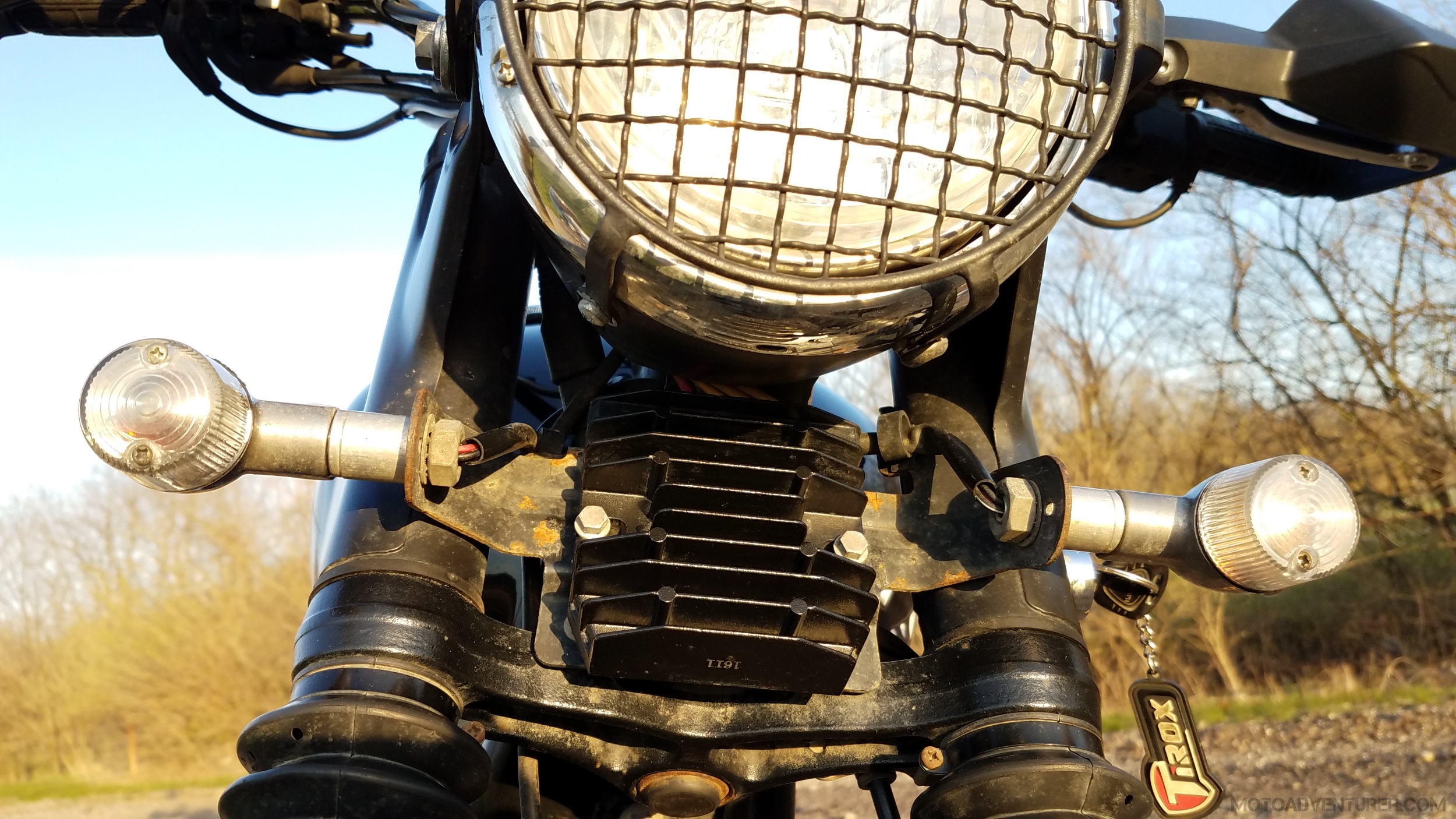
Pulling apart the headlight bowl, yet again, I noticed some of the wire splices looked funny. Mosfet Rectifier Installation Triumph Scrambler MotoADVRUpon closer inspection I found that some of the splices had melted together and grounded the hot wire from the rectifier. That was the last nail in the coffin for the stock rectifier. Admittedly, the stock regulator/rectifier was not positively identified as the culprit, however after enough internet research and finding melted wires in the leads from the rectifier no less than twice, I took it on good advice from the Triumph forums, that it was time to upgrade to a MOSFET rectifier (Metal-Oxide-Semiconductor Field-Effect Transistor).
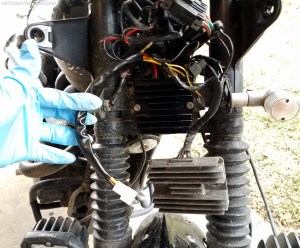
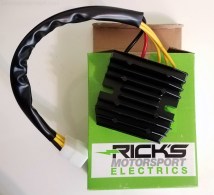
 

Mosfet Rectifier Triumph Scrambler MotoADVR

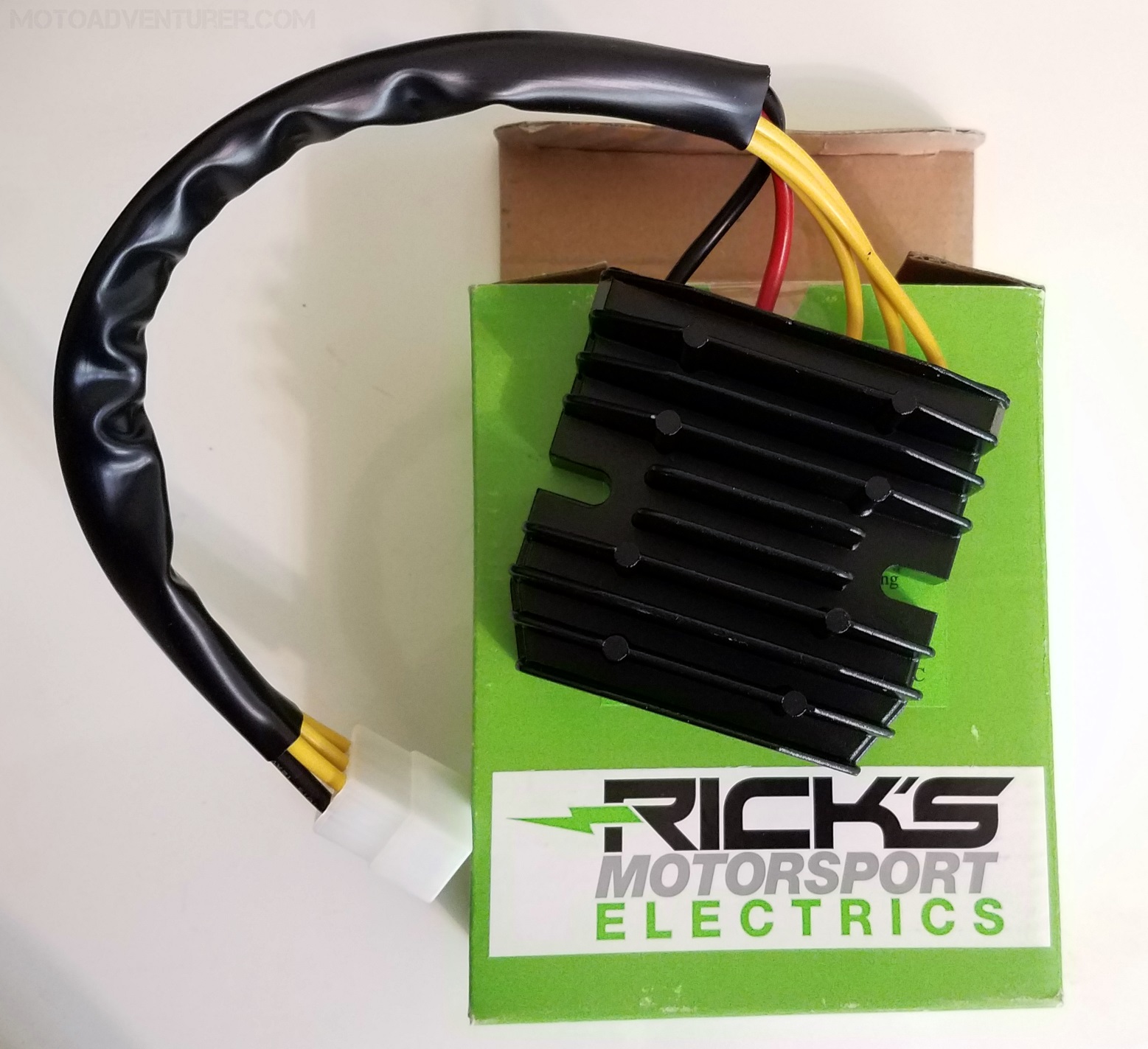
After searching the web for various options, I decided to make the investment on a unit from Rick’s Motorsport. The Rick’s MOSFET unit is more toward the upper end of the price spectrum, but had the most positive reviews and is provided with a connector that mates to the OEM main wiring bundle. That OEM connector was obviously damaged in the first go-round last July, so there was a extra little electrical work on my part, but for the most part it’s a quick bolt-in replacement for most folks.
Mosfet Rectifier Installed Triumph Scrambler MotoADVRAfter installation, the new MOSFET regulator/rectifier had better output voltage; I will go as far as to say that even the heated grips “felt” warmer, and seemed to warm up faster as a result of the change. Hopefully the advice on the web is true, that the MOSFET will run cooler and more efficiently. I’ve done about 2,500 miles since the replacement, so far so good.


Posted in Bikes | Tagged , , , , | 4 Comments

March Moto Madness: Scrambler Adventures

Friday, March 23rd

02:54 AM

I woke to the sound of my own teeth chattering. I’m not entirely sure when and for how long I actually slept. Hands exhausted from holding my sleeping bag closed with a death grip, I frantically fumbled to put on my already frigid riding gear in the dark. Shivering from the frozen surfaces of my armored gear, I stuffed myself back into my sleeping bag, hoping the extra layers would be enough to weather the rest of the night.


Thursday, March 22nd

08:45 AM

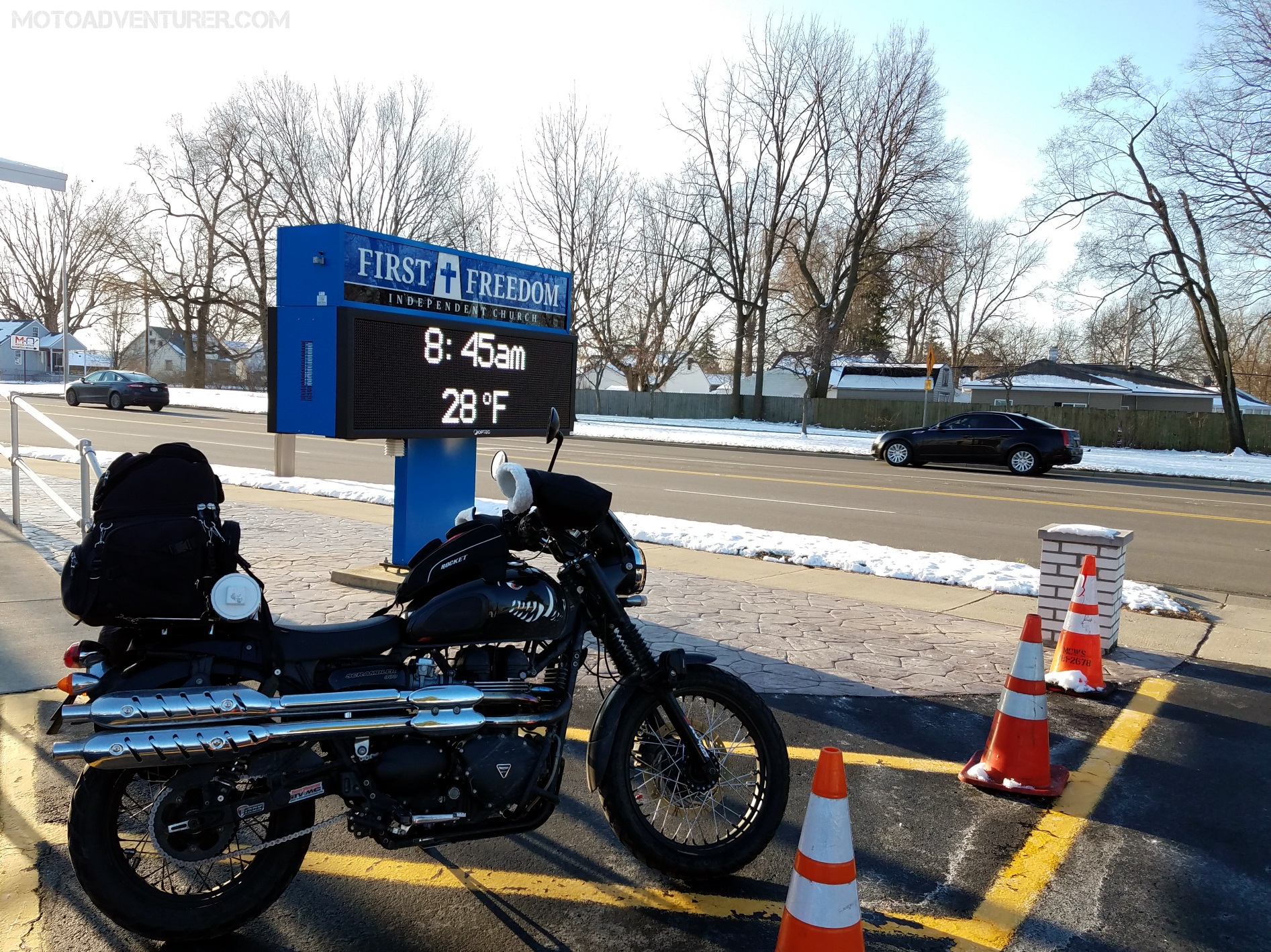
MMM Bound MotoADVRAfter rummaging through the house to get my gear set, transfer routes to my GPS, and set up my latest SPOT messages, I finally loaded the bike for the long ride south. I had originally planned a scenic route through the bluegrass state, but with a 7 AM temperature of 22°F, I decided perhaps it better to delay and conserve a little energy. It started getting late and apparently 26°F was about as good as it was going to get so I set out for the 400 mile trek to Tellico Plains, Tennessee, for March Moto Madness.

10:19 AM

Snowy Pine Trees Triumph Scrambler MotoADVRHaving combated the cold for the last 110 miles through Cincinnati and northern Kentucky, I needed a break. Pulling to the side of the road I couldn’t help but be captivated by the heavy snow that blanketed most of Kentucky the previous day. Topping off at the local Love’s station, I scarfed down a sausage biscuit and selfishly clutched a cup a coffee hoping to absorb whatever warmth there was to be had as the temperature finally rose to about freezing.


1:26 PM

After 4 grueling hours on the highway, I finally ducked off I-75 in Corbin, Kentucky, to do a little sightseeing.

About seven years ago, I did some rafting just down river from Cumberland Falls. Since attaining my motorcycle endorsement, I’ve had a return trip to Cumberland Falls on the Moto Bucket List. At 125 feet wide and dropping 68 feet, with an average flow rate of over 5,000 cubic feet per second, Cumberland Falls is the second largest waterfall east of the Rocky Mountains, and the 2nd place on earth where you can see a Moonbow with regularity (only place in the western Hemisphere, Victoria Falls in Africa being the other… “with regularity”).


1:55 PM

After snapping photos and video of the falls from all angles, along with letting the temperature rise a little, it was on to the backroads for the rest of the journey to the campground in Tellico Plains. KY-700 leaving Cumberland Falls was a welcome taste of solemn bluegrass pavement before finding myself on US-27 for the vast majority of the last leg.


5:25 PM

Winding down the hill into the valley toward the campground, off in the distance I caught the shape of what I, at first, thought was just a bunch of grey clouds. After my eyes focused, I realized that the grey shapes in the distance were actually the peaks along the Cherohala Skyway, covered in snow (more on that later).


5:45 PM

The mountains are calling.Appalachian Mountains Triumph Scrambler MotoADVR


18:05

I met up with my buddy Jeff along with Jason and Nico from Hugo Moto. It’s beer-thirty.

Dualing Scrambler MotoADVR


Friday, March 23rd

7:45 AM

Finally stirred by the “Ring-da-ta-ting-ting-ting” sounds of two-strokes firing up, I reluctantly emerged from my tent after a frigid, sleepless night. Unzipping the tent’s rain-fly, I found more frost on the inside of my tent than the outside.

“29°F… Coffee… I need coffee…”


11:14 AM

After grabbing a pancake and sausage breakfast, huddling around the fire, and otherwise loitering around the campground in search of warmth, I finally got my crap in order to take a ride. Having seen bikes of all shapes and sizes pass by, I figured I would check out the local trails.

Triumph Scrambler Dirt Trail MotoADVR


12:01 PM

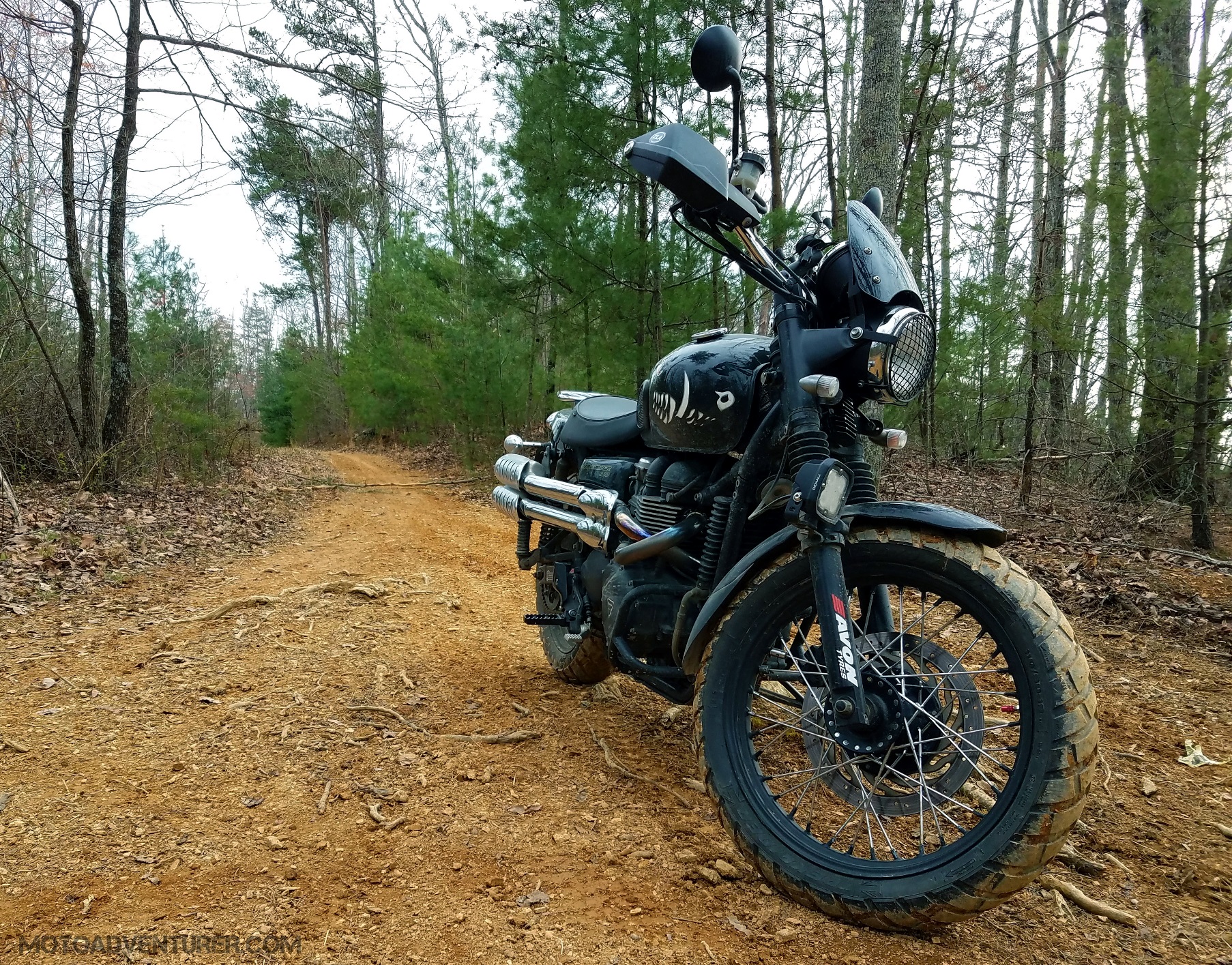
I take the Dirtster, “Ripley”,  for the first (serious) off-road run.


12:45 PM

Jason and “Chinnie” want to take a ride out to some local trails to take some photos of the latest World Tour Kit build (HD2 Enduro). Despite being exhausted, I came to Tennessee to ride trails; they let me tag along.


13:46 PM

I get schooled off-road.


16:40 PM

After chasing two Harleys down local forest service roads, back at the campground I get my second wind. I tackle the local trails a little harder and test the new Avon Trekriders in more dirt and mud.


Saturday, March 24th

07:45 (ish) AM

It’s a cold, rainy, morning. I’m again in no hurry to go anywhere. I debate when to get dressed to ride over coffee and breakfast burritos while again huddled next to the fire.


12:03 PM

Waiting for the weather to break, Jeff and I decide to drive to lunch; we see the most eccentric bike in the parking lot.Honda RAT Bike MotoADVR


2:09 PM

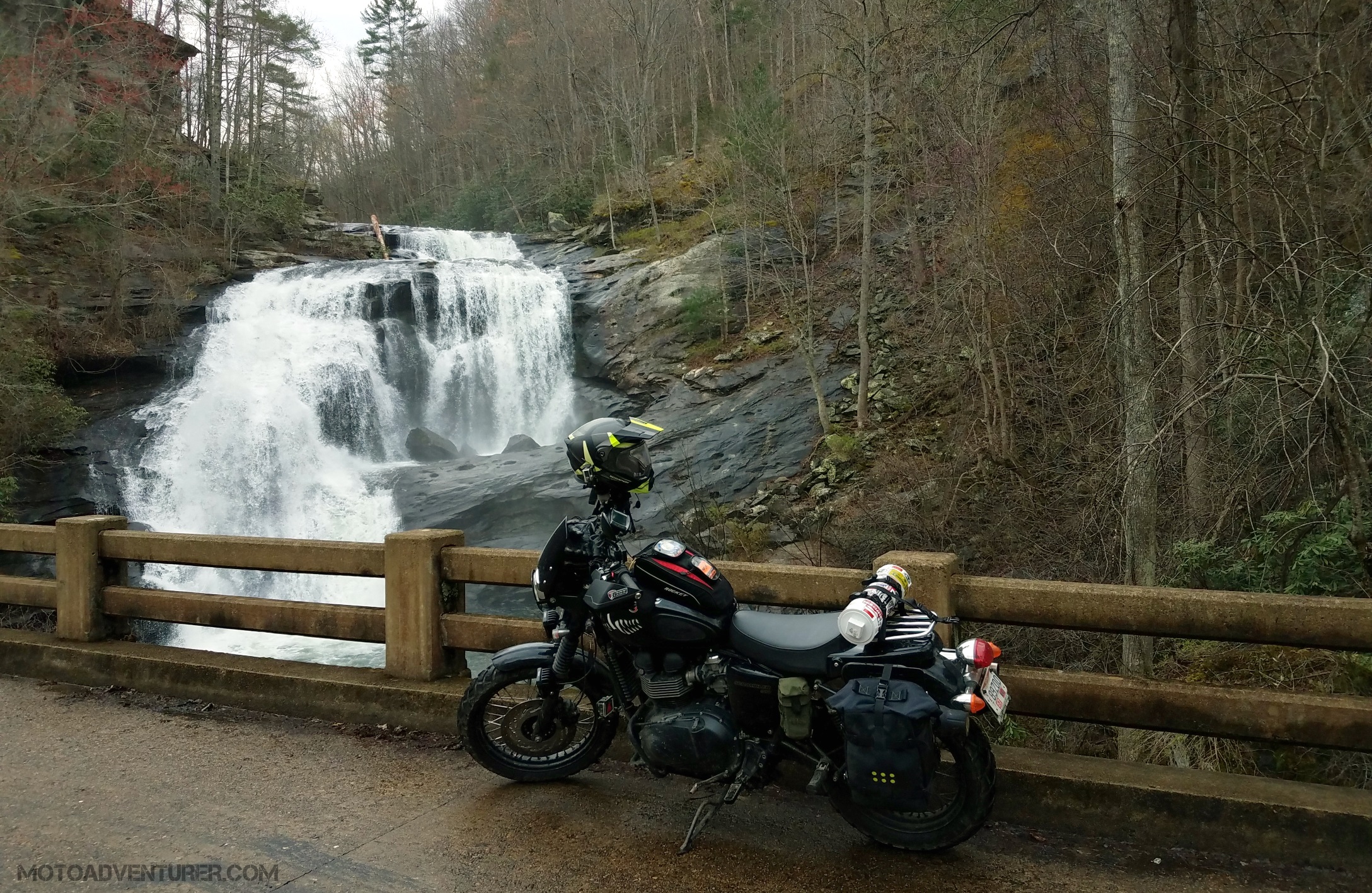
With a short window between passing storms, I decided to head over to Bald River Falls for a photo.

Bald River Falls Triumph Scrambler MotoADVR


3:01 PM

Arriving at Bald River falls a lot sooner than expected, I felt froggy enough to tackle a little bit of “Gravel-Hala” (North River Road) solo. Oh yeah… about that snow…

3:24 PM

Finding the forest service road into Robbinsville closed, I decided to get up on the Cherohala Skyway and beat it back to the campground before I got rained on. Naturally I find the Skyway lined with snow and fog. It’s not the notorious pea-soup mess I’ve heard stories about, but instead proves to be the quiet solace of solitude I enjoy so much.


16:24 PM

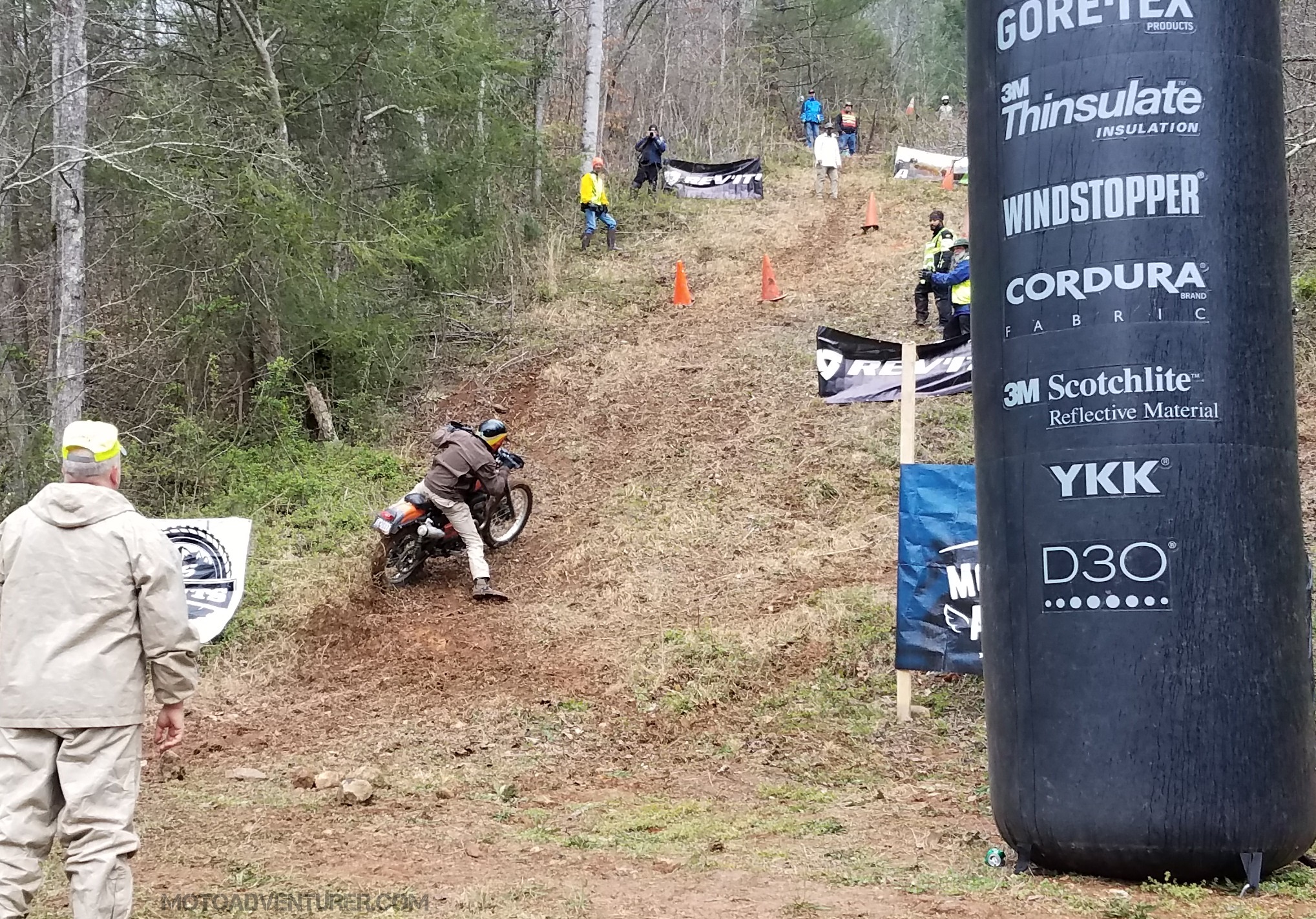
I get back to camp just in time to watch Jason from Hugo Moto participate in the heavy-weight hill climb. Turns out he’s one of only a few that made it to the top and I catch his first run-off attempt.

MMM Heavyweight Hillclimb MotoADVR


16:34 PM

Despite the “sketchy” first run, he made it to the top on his last two attempts, and it’s down to him and one BMW R1200GS for the win.


16:36 PM

The 1200 GS loses traction and takes a dirt nap… twice…

To his credit, the BMW rider was incredible, it was like watching moto-ballet, I have no idea how that bike ever made it up that hill. Nonetheless, a Harley wins the heavy-weight hill climb event… at a GS rally.


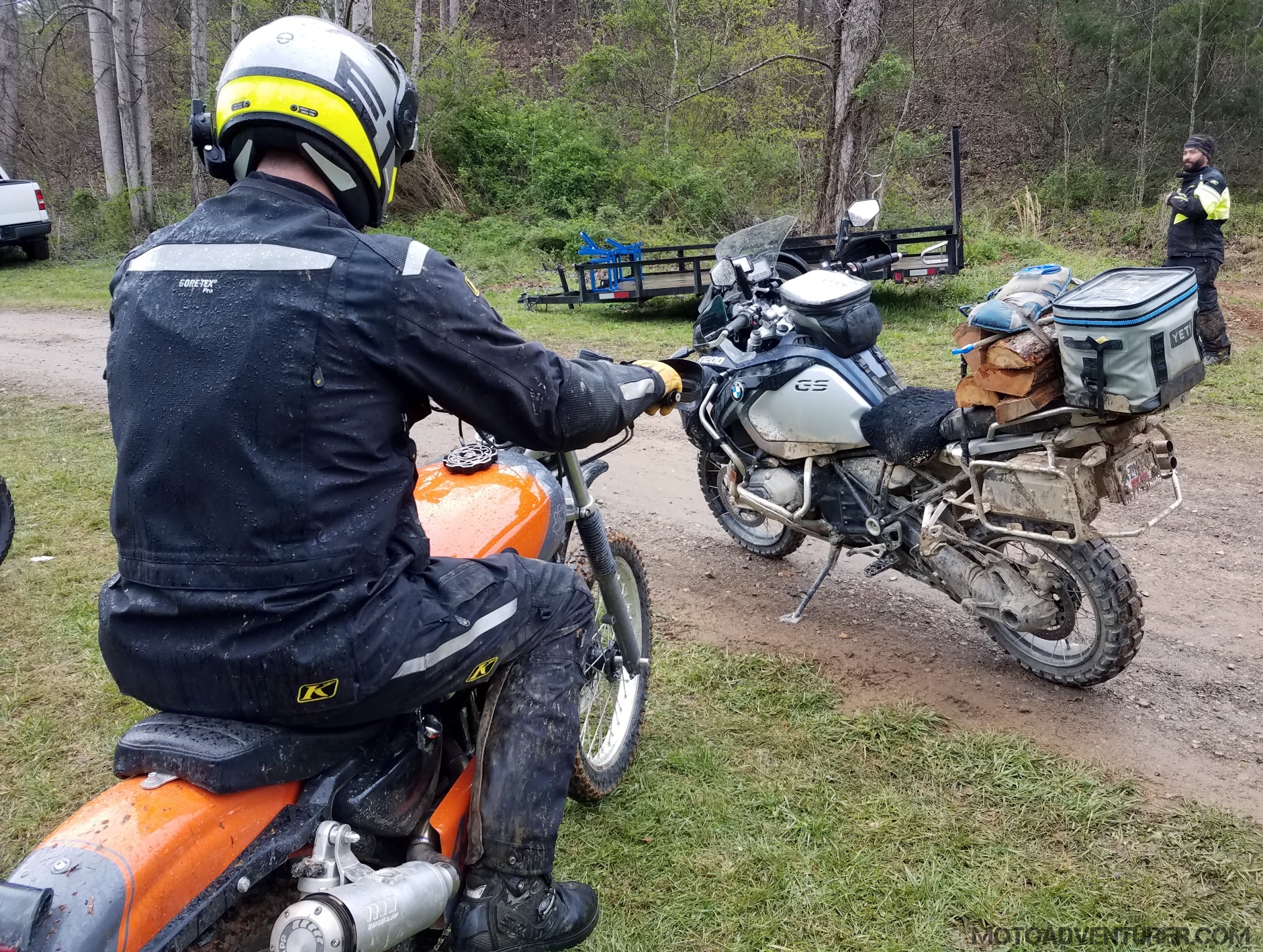
4:50 PM

BMW guys want to see this “Enduro” Harley up close

Harley inlieu of BMW MotoADVR


9:58 PM

I’m huddled under a pop-up tent holding a beer and trying to keep a cigar lit despite the (second) heaviest rain I’ve ever encountered while camping. That’ll make for a long night…


Sunday, March 25th

7:30 AM

Miraculously, the tent is still dry; apparently I learned something in the Army… Time to pack and go home… it’s going to be a muddy mess…


9:30 AM

I shake hands with Jeff and the guys from Hugo Moto, and start the long ride back to Dayton. The temperature hovers around the 40°F, and with my late start, that means spending more hours on the highway…


1:25 PM

Fed up with the interstate, I drop off onto the side roads in London, Kentucky, looking for the tail end of KY-89. With no specific route planned, neither my GPS nor Waze seem to want to take me to the starting point of 89 near Livingston. Despite my best attempts to manage two navigation devices without touchscreen gloves and otherwise trapped by hand mitts, the GPS directions seems to be sending me in a more “fun” direction.

DCIM101GOPROG0325914.


1:41 PM

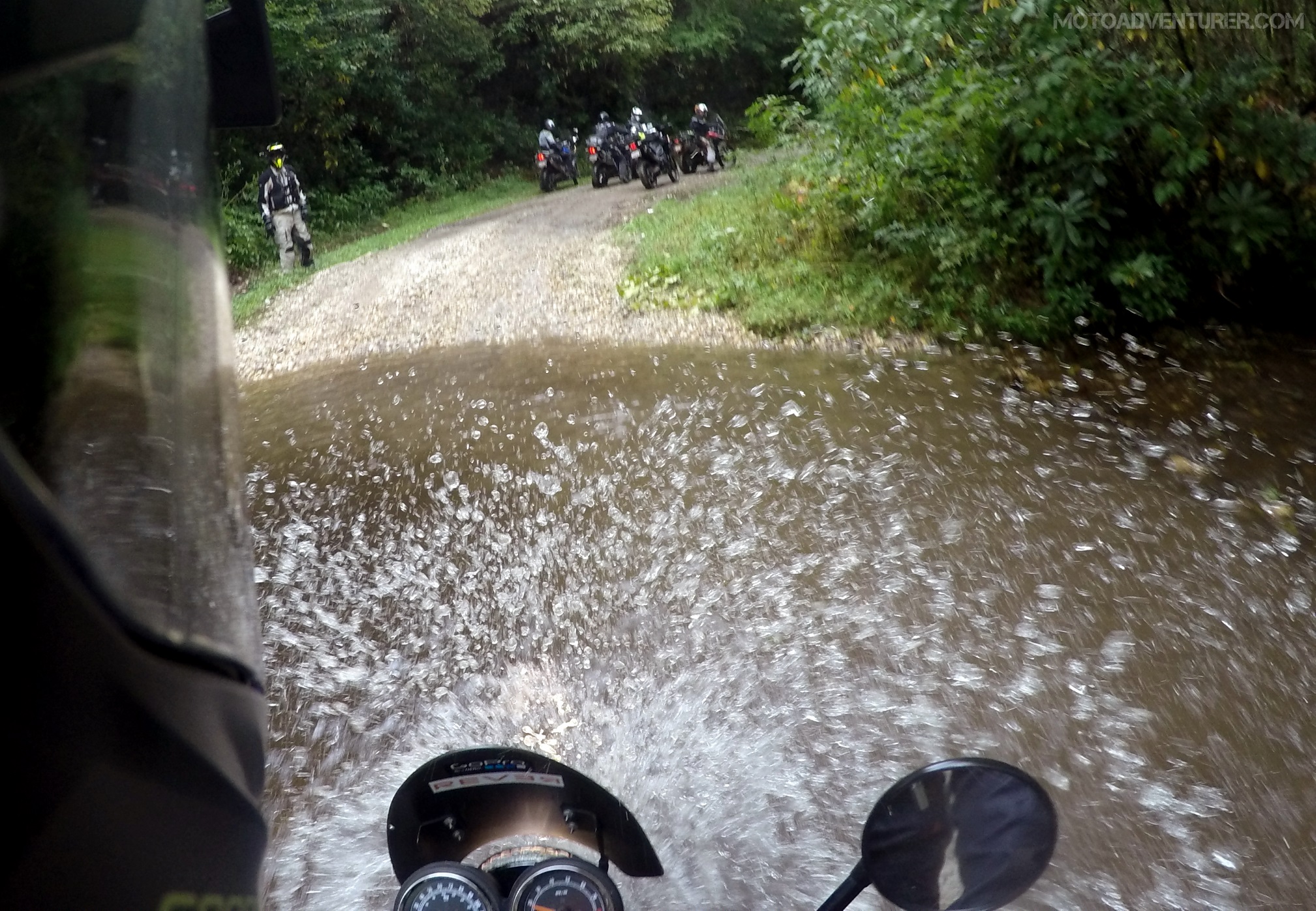
Apparently the GPS knows me better than I realized; cresting a hill I’m confronted with a creek crossing that I dare not attempt solo (if at all…).

DCIM101GOPROG0305668.


2:11 PM

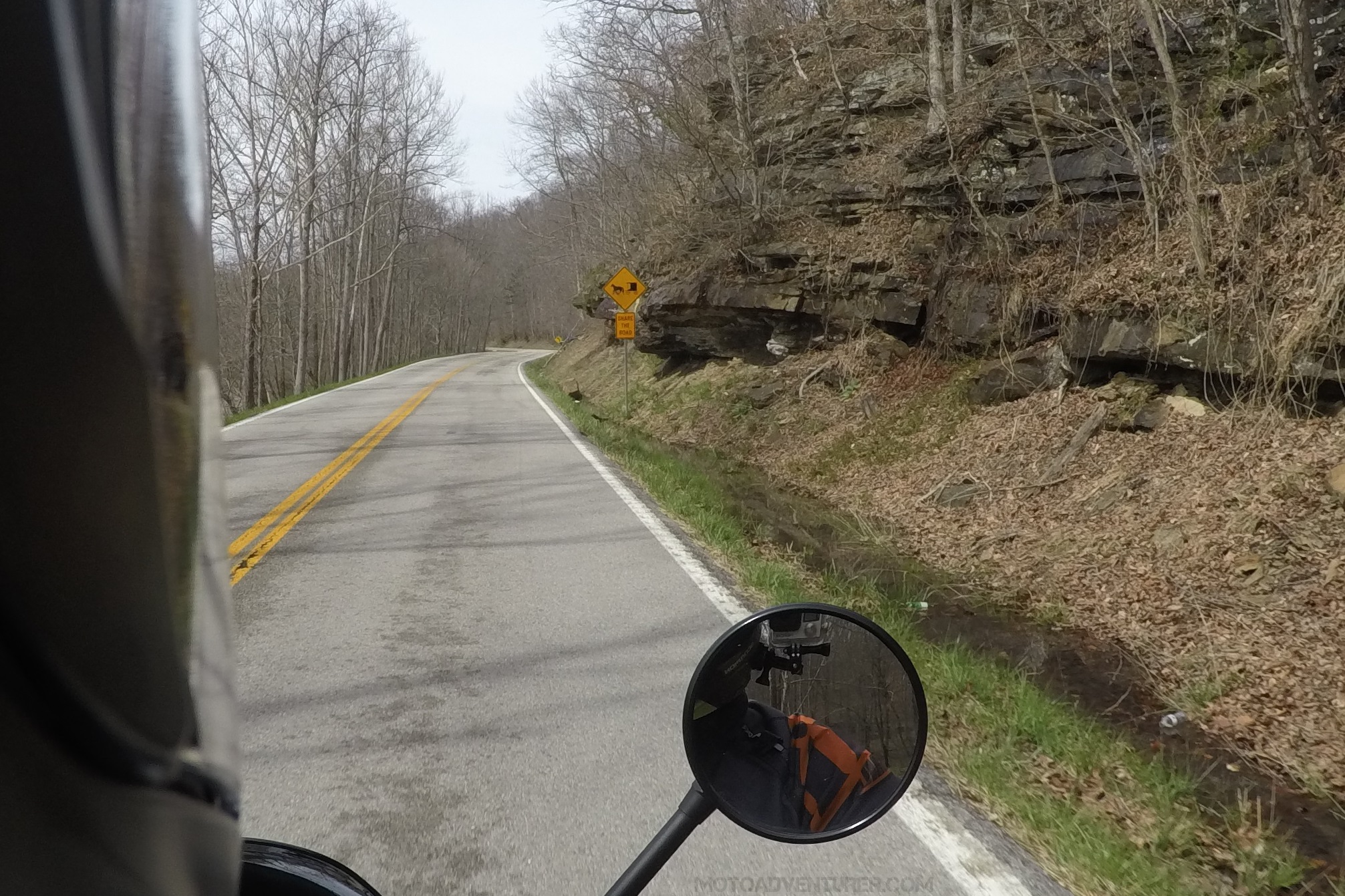
I finally hit KY-89; 47 miles of twisties, sweepers, and Appalachian bliss.


18:48 PM

Over a thousand miles later, I pull back into the driveway. Exhausted and coated with mud, sand, and road grime, it was an incredible un-planned adventure.

Rosie The Scrambler Home MotoADVR


Commentary on March Moto Madness

March Moto Madness MotoADVRI’ve never seen so many off-road enthusiasts in one place before. This year’s event had attendance somewhere around 700 people if I understand correctly. There were trucks, RVs, campers, trailers, jeeps, and tents of every variety packed into this campground. Every morning was a symphony of two-stroke dirt bikes and twin-cylinder adventure mammoths firing to life as folks set out for the day’s ride. Just an eclectic crowd of “adventurous” motorcyclists; I didn’t meet a stranger the entire weekend.

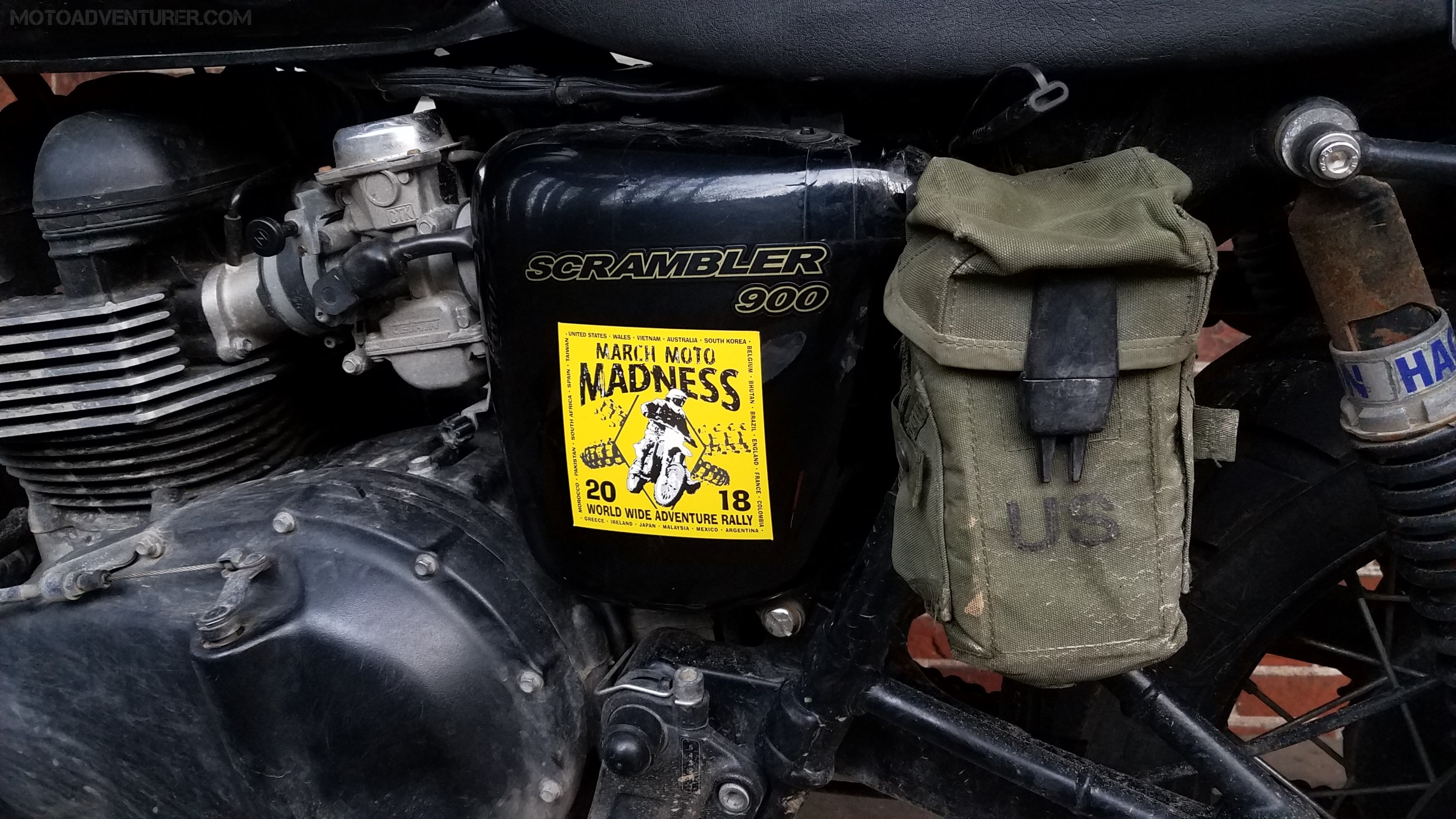
March Moto Madness Rally Sticker MotoADVRPer my previous comments, I knew I was going to attend the event way back before Christmas, but that was about the extent of my plans. Leaving the house Thursday morning, my extremely detailed route went right out the window, after which I was flying by the seat of my pants until I returned home on Sunday. As the perpetual planner, it was an odd feeling. The weather was “less than ideal” (it sucked… pretty bad), so I just went with it. Between that, the diverse crowd, the good company, and the endless miles of twisty Appalachian solitude, it was one of the best motorcycle trips I’ve ever been on.


Posted in Events & Rides | Tagged , , , , , , , , , , , , | 16 Comments

Triumph Scrambler Project: Removing the California Evaporative Loss Control System

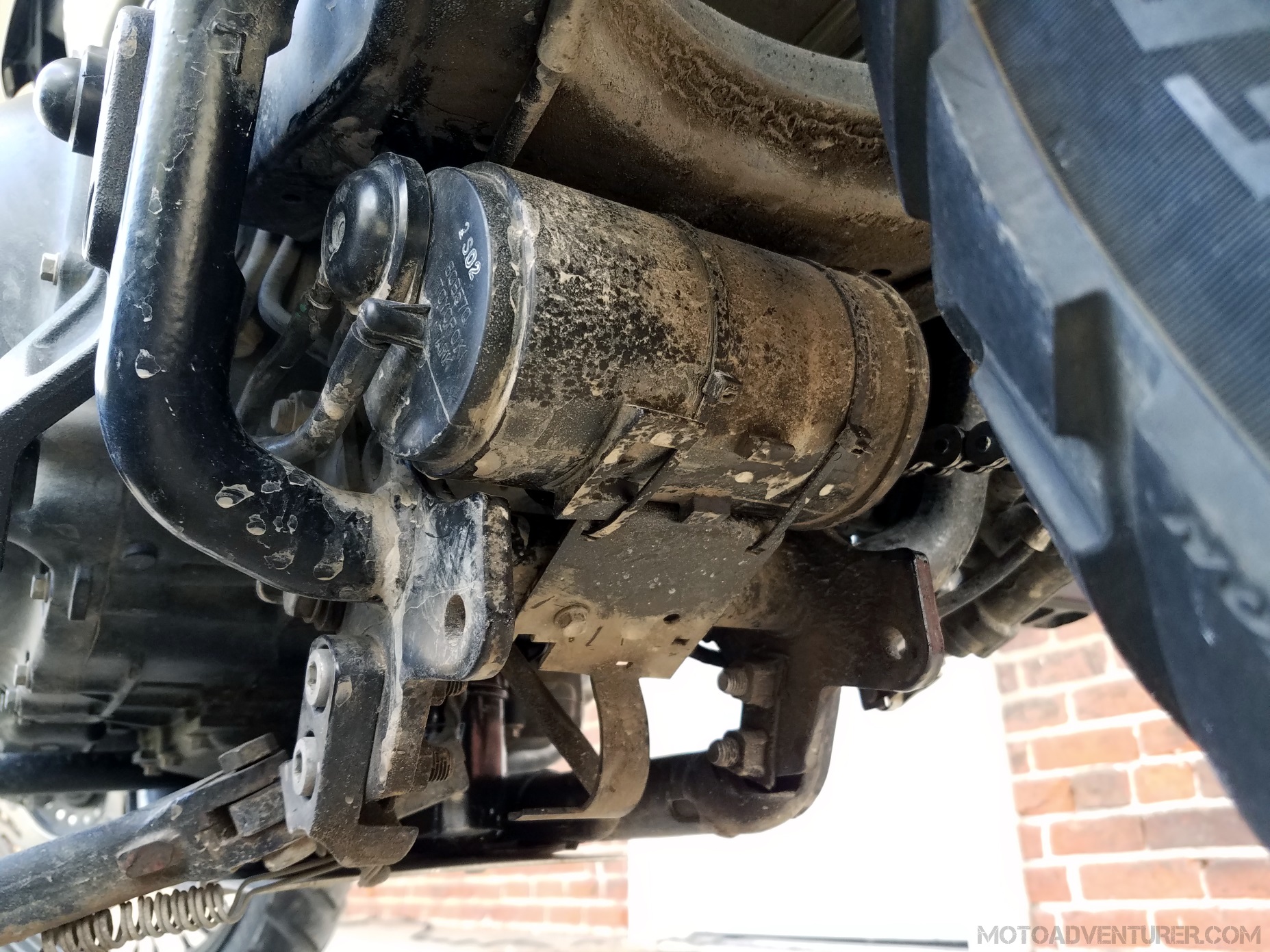
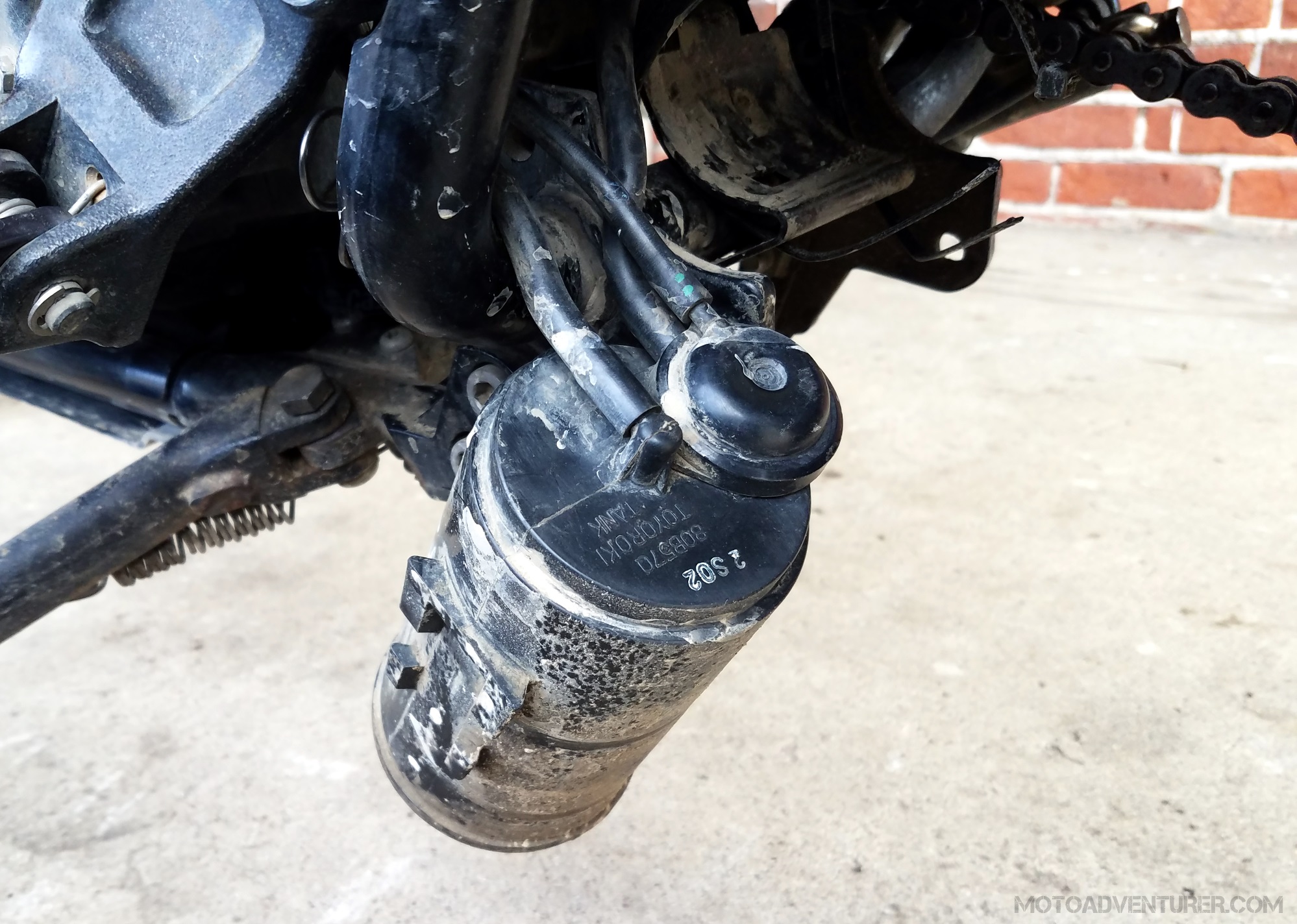
While in the process of installing the stage 3 upgrades to the Triumph Scrambler project (more on that soon), I suddenly found the “Charcoal Canister” under the swingarm to be problematic.

EVAP Delete Charcoal Canister MotoADVR

I suspected that the black cylinder hanging off the back of the frame was likely part of the California emissions package; after a Google search, that suspicion was confirmed. Unfortunately, no thanks to the Photo Bucket debacle, I found it significantly difficult to identify the steps and components necessary to remove the superfluous equipment from the motorcycle. After spending a few hours reading and exchanging information on the various forums and craning my head around in all the nooks and crannies on the bike, I put all the necessary pieces together to return the bike to the 49-State standard. For fellow Triumph twin owners, I figured it made sense to publish that process here, lest is be lost to another photographic hostage situation elsewhere.

What is an Evaporative Loss Control System?

As it is specifically related to motorcycles, the fuel tank is vented in order to equalize pressure and properly feed your carburetors or throttle bodies.

EVAP Delete Left Side Throttle Body MotoADVR

Naturally this means that gasoline fumes and potentially minuscule amounts of fuel could potentially make contact with the air, which is apparently extremely offensive to the state of California (after thinking about it, I guess that state does seem to be especially combustible). Thus a system was devised to capture any excess fuel or fumes in a “charcoal canister”, and even pump said fumes back into the intake to be burned off during normal operation.

Why would you remove the EVAP system?

I suspect there are no major side effects from leaving the evaporate system in place, at least for most motorcyclists.

EVAP Delete Charcoal Canister Hose connections MotoADVR

The weight of the system is pretty inconsequential, and for the most part it’s out of sight and out of the way for the average rider. Some folks on the interwebs have suggested that the system could potentially create a “hard running” condition if you’re in the habit of overfilling the gas tank. However, in my case, I’ve successfully submerged the canister on multiple occasions; which I suspect has potentially caused the evaporative system to run at less than peak performance. In short, it’s not required in 49 states and it’s in my way.

Where is the system installed on my motorcycle?

EVAP Delete Throttle Body connections MotoADVR

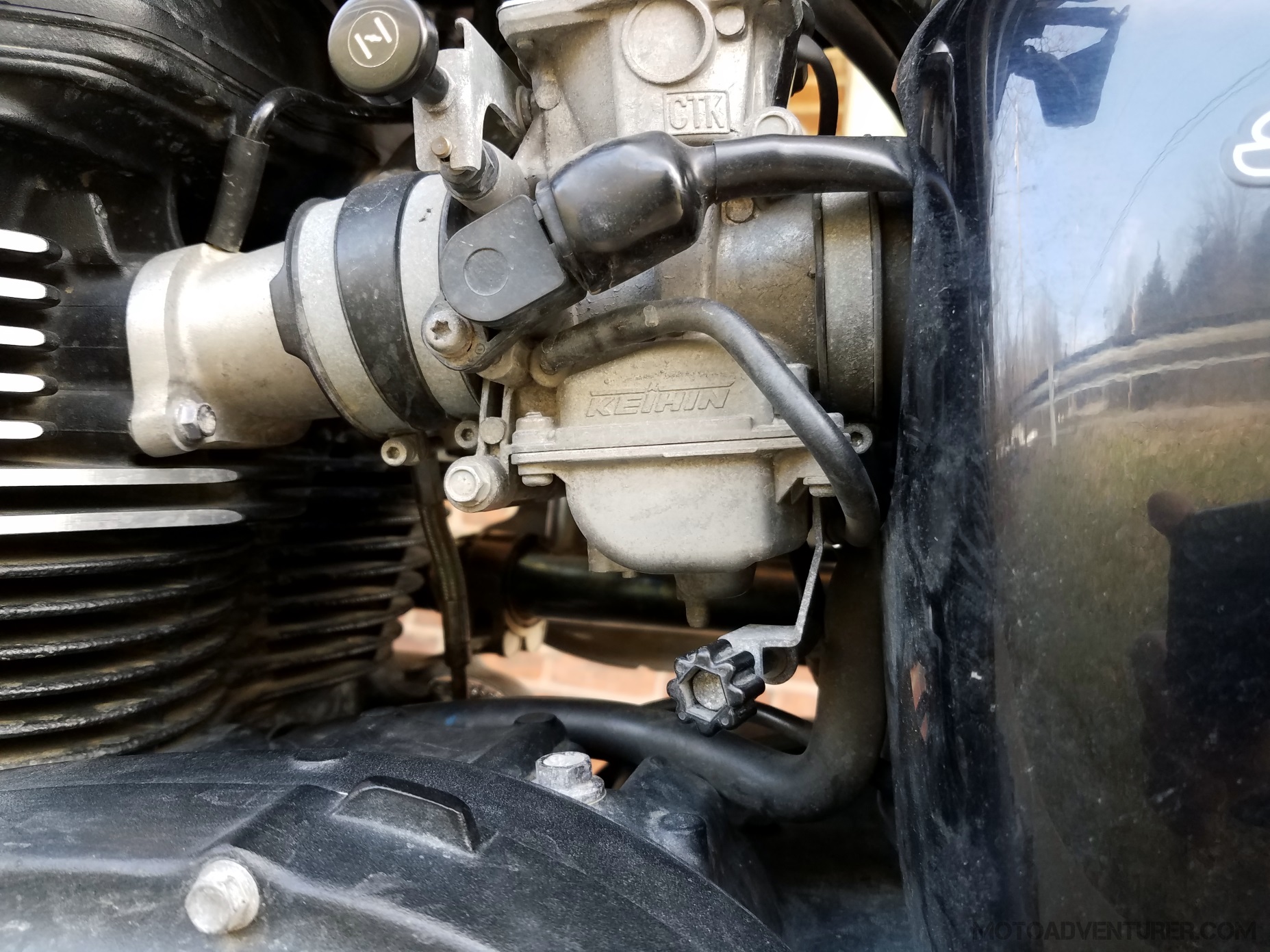
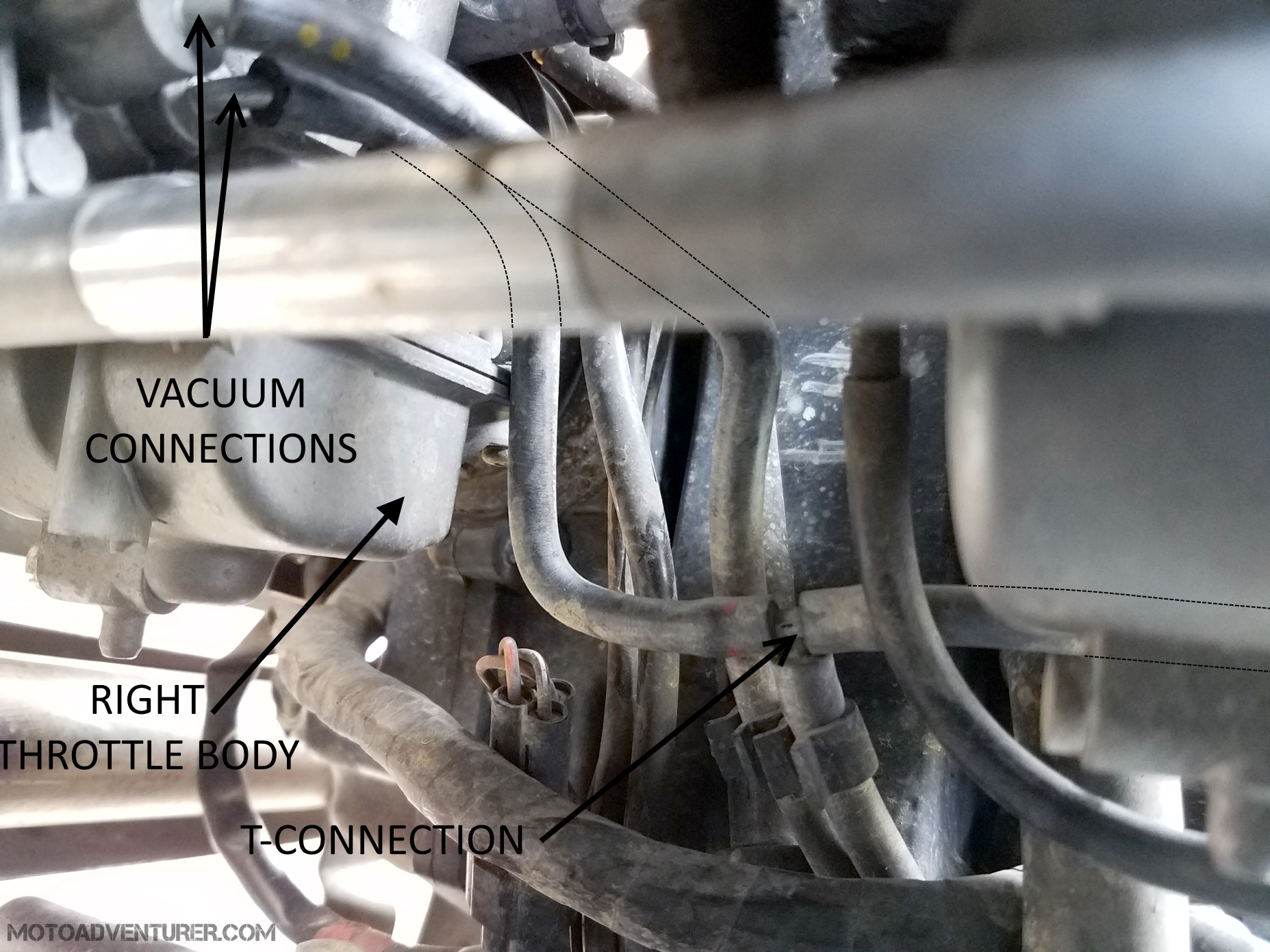
I am writing this specific to 2009-2016, 865cc, fuel injected, Triumph twin motorcycles, however I suspect you’ll find that this system is mirrored on various other motorcycles irrespective to brand or model. Per my comments above, a tube is run from the fuel “vent” down to the charcoal canister. Two more tubes are ran to a “T” from the throttle bodies and down as a single tube to an electronically controlled purge valve, and then into the canister. Lastly, there’s a additional, single tube run the from right throttle body down to the canister.

How do I remove the California Evap system?

EVAP Delete Vacuum Caps MotoADVR

First, to familiarize yourself with the following steps, I recommend you read the previous description of the system and attempt to identify each of the components I mentioned on your own bike.

EVAP Delete Hose Routing MotoADVR

Some of these items may be difficult to see, you’ll want to remove the seat, and the left side panel from your Triumph to properly follow the route the tubing follows through the bike’s components. Before you get started, I recommend you stop by the auto parts store and pick up at least three 5/32” vacuum caps, along with a few zip-ties.

EVAP Delete Canister cut loose MotoADVR

Once you’ve identified the three locations where each tube connects to the throttle bodies, look under the bike at where each of the tubes connects to the charcoal canister; be mindful that the solenoid valve is mounted above and behind the canister and may be out of sight. I would first start by cutting the two zip-ties that hold the canister to the mounting plate. Once the canister is out of the way, it’ll be easier to take an 8mm socket and remove the plate from the frame. Once the plate is off the bike frame, you can cut the solenoid valve loose from the plate, and disconnect the valve from the connector that runs from the main wire harness.

EVAP Delete Vacuum Hoses MotoADVR

With the solenoid valve loose, disconnect the three tubes from charcoal canister and set the canister and the valve aside. Look carefully at how the remaining vent tubes are run down the left side of the bike, under the frame and up to where the canister was previously positioned. There are likely brackets mounted to the frame to hold those tube in place; these can be removed or re-used if you plan on leaving the fuel tank vent tube in place (which is what I did).

EVAP Hose Connections Upper MotoADVR

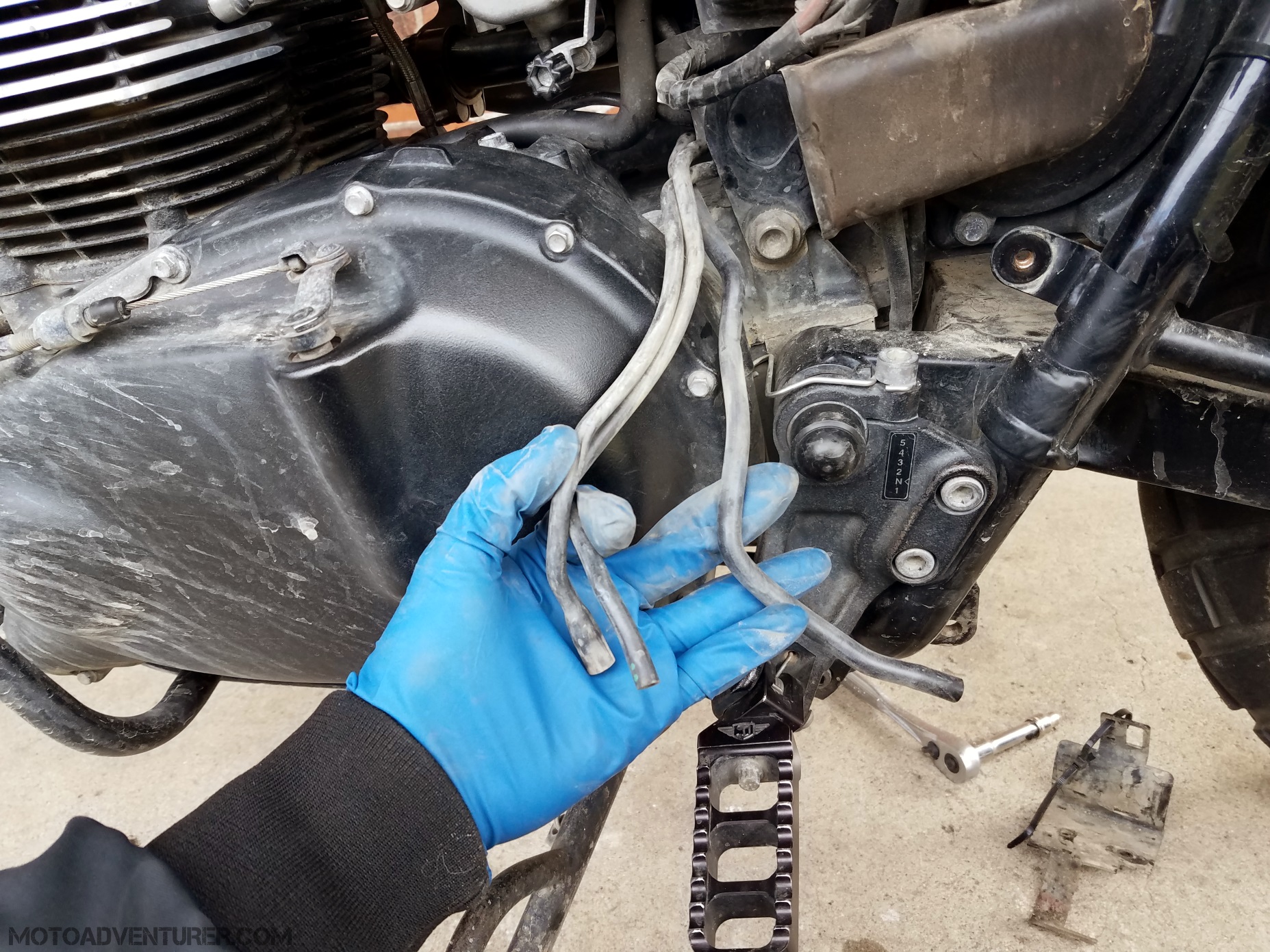
Next you’ll want to remove the vacuum tube from the left throttle body; this tube runs to the t-joint to the opposite throttle body. Disconnect the opposite tube from the right side throttle body, and pull the t-joint with all three tubes off the bike; you may need to carefully fish the lower tube from between the air box and the frame. Next you’ll want to remove the final vacuum tube from the right side throttle body; again fishing the tube out of the brackets between the frame and the air box. Having removed the throttle body vacuum tubes,

EVAP Delete Fuel Tank Vent Hose MotoADVR

there will be a larger diameter vent tube running from the fuel tank down to the bottom of the frame. I left this tube in place, as it is run in similar fashion to the way it was installed on my non-California compliant Speedmaster; you may want to zip-tie this tube to one of the routing brackets, just to make sure it stays in its desired location.

EVAP Delete Left side Throttle Body Capped MotoADVR

At this point you’ve removed the major components of the evaporative system. Next you need to cap each of the vacuum nozzles on the throttle bodies with the before mentioned 5/32” vacuum caps. With the throttle bodies properly capped, the bike is once again in proper running order, however I recommend you re-locate the power source for the EVAP system solenoid. I fished that electrical connection back up over the swing arm, and into the left side cover area behind the intake snorkel. Other owners have covered the connector in electrical tape and zip-tied it under the frame; it’s completely up to you.

California Emission Canister Removal MotoADVRAfter re-installing the left side cover and the seat, the bike is ready to ride. Cranking the engine for the first time after removing the EVAP system, you may find that the bike idles slightly differently and the throttle response may feel different. With the changes to the intake system, you may need to adjust the idle knob to get the engine back to the desired idle speed (I usually hover around 1000 RPMS). If you find the throttle response a little sluggish at first, take the bike out for a ride and get it up to proper running temperature. Afterword you’ll need to park the bike and let it cool back down to ambient temperature. California EVAP Delete Complete MotoADVRYou’ll need to do this “heat cycle” at least three times as the ECU is re-learning the throttle map based on the new operating conditions. After about three rides, the bike should perform just as it did prior to the canister delete. It was about 40°F when I did this modification, so that no doubt played a role in the engine being cranky; you may find that your bike behaves no different than it did before you removed the EVAP system. Also note, if you’re considering removing the Secondary Air Injection (SAI), I would recommend you perform the canister delete at the same time if you discover that you’ve purchased a California compliant model (and don’t live in CA).

Posted in Bikes, Gear - Maintenance - Safety | Tagged , , , , , | 12 Comments

Choosing Your First Motorcycle: Questions to Consider

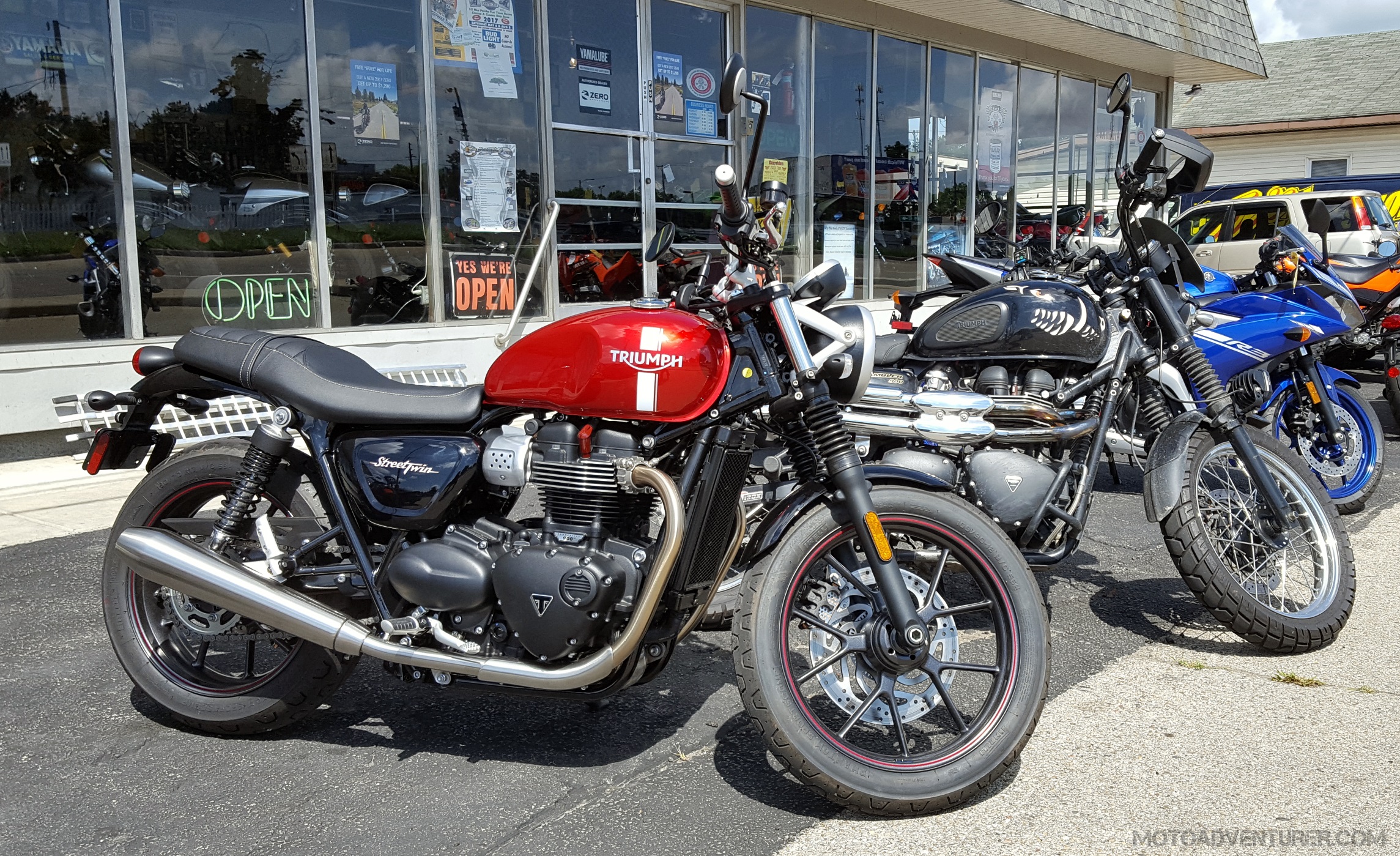
A couple days back I caught this write-up from Chris Cope where a prospective rider “wrote-in” asking for advice about purchasing a given bike as a first motorcycle. That article, combined with a series of other works from Lemmy and the boys over at Common Tread, have covered this topic in great detail. I take my hat off to each of them as they have hit a lot of the major issues involving making your first motorcycle purchase. Similar to the before mentioned article, I’ve also received a few random requests for advice on different “beginner” bikes, so I figured I had some beneficial advice worth adding to the wealth of knowledge I just mentioned.

Triumph Street Twin MotoADVR

There are a lot of things to consider when buying a motorcycle. Seating position, new versus used, brand, price, displacement, dealer network; all of those are important factors, but I want to delve a little bit deeper into the philosophy behind riding a motorcycle. If a new bike is just a toy, an image, or you’re simply convinced you can’t live without bike “X”; this advice is probably not for you (yet). However, if you’re the introspective, planning type, I recommend you think about the answers to the following questions and see if that helps you decide on where you fit in the vast breadth of the motorcycle world.
How do you picture yourself on a motorcycle?

Is it riding from cafe to cafe, dragging a knee, carving through the dirt, packing up and “heading west” on a haphazard adventure, commuting to work every day, or maybe even loading down the bike and riding through Mexico? Your vision may be one or all of these, and that answer is a big part of making this decision. To me, a motorcycle is a tool, and each tool has a different job. Some of the before mentioned sites go into greater detail about the specifics of each of these tools, but first I’m just suggesting you think about how you see yourself, and “where you want to be” before you look at bikes and decide what “looks” appropriate.

After that consideration, you may want to start asking around for advice about various bikes that suit that purpose (there’s also a comment section below).

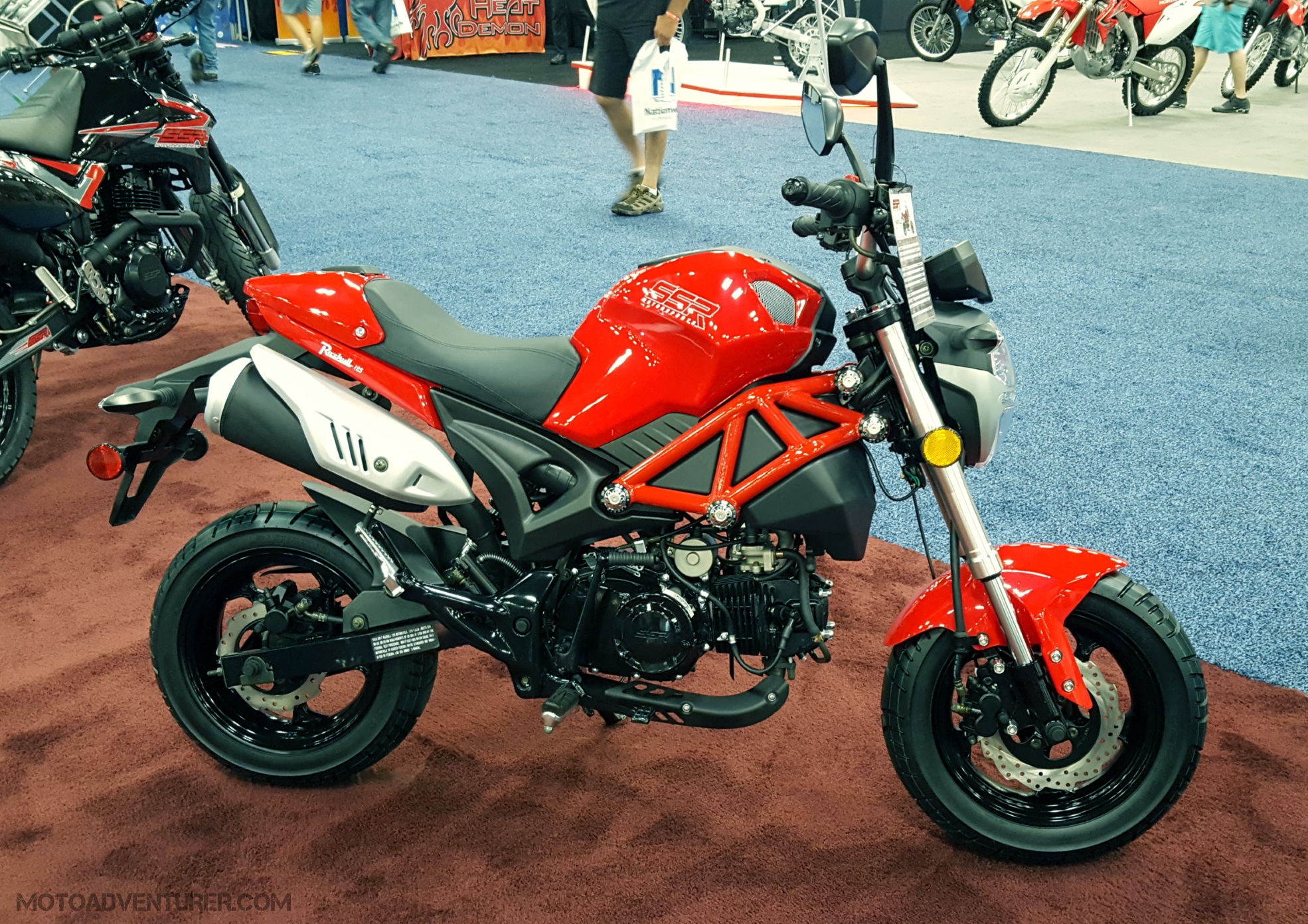
SSR Raskull MotoADVR

Per my comments to friends that are shopping for their first (or subsequent) bike, if you just want to cruise around town and commute to work; virtually any bike will do. Different bikes fit each rider differently, and many bikes can be slightly modified to fit you better, but I’ll talk more about that in a minute. That said, if you see yourself spending endless days on the motorcycle as your annual two-week vacation each year, you may want to consider something a bit more luggage friendly than the Ninja 250, or something a bit more reliable than a ’82 Honda Nighthawk. Not that those bikes are incapable of such a trip, in fact if you like challenge and adventure, those bikes may just be your fancy, but for most people, there’s usually a certain level of expected “comfort” and convenience.

Do you have an endorsement?

That’s a big deal. Some folks have purchased bikes and received their endorsement after the fact; it can be done. However, some folks have quickly discovered they don’t like riding and sold said bike not long after; thus I suggest you go get an endorsement beforehand.

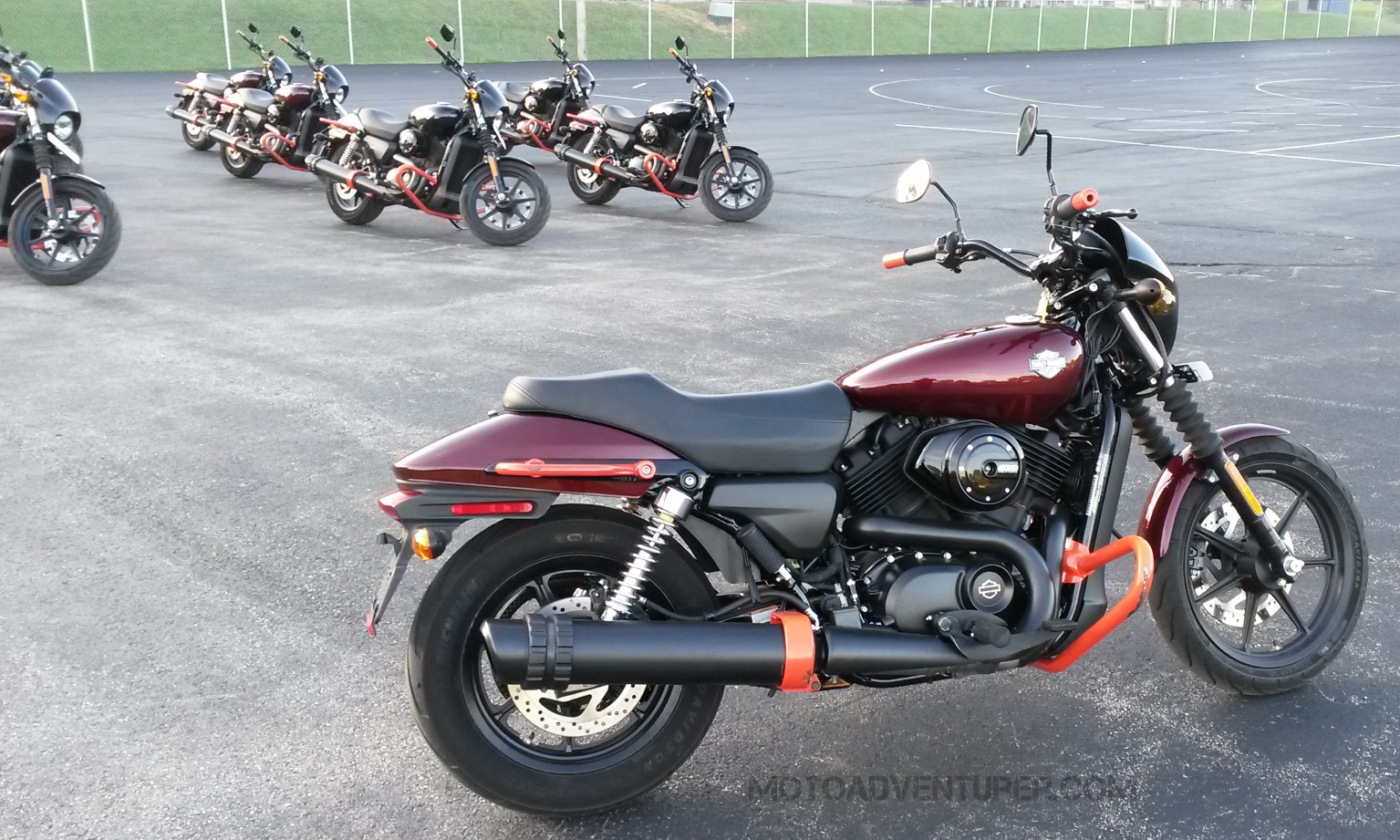
MotoADVR_HDstreet500

If you take your state safety course, it is likely going to cost you $50 to $100, plus another, let’s say $25 to get your learners permit, which is typically a requirement before taking the course (this all depends on your state). The safety course is going to provide you with a “ready to ride” motorcycle to use on the course, so you won’t have to provide your own. You’ll be responsible for wearing over-the-ankle boots, long pants, long sleeves, a helmet, and safety glasses, and full-finger gloves. The before mentioned helmet will need to be DOT approved, but you can usually find an affordable (cheap) half-helmet for $50 or less. The course will not only teach you “how” to ride a motorcycle, but they will also cover important safety tips; you’ll likely learn that “awareness” is every bit as important as understanding how to operate the bike. Knowing what to avoid is every bit as effective as knowing how to react when you’ve been caught by surprise. After three days of classroom and range time, assuming you pass the final skills test, the safety course will present you with a card to take to your local DMV, and you’ll be able to get your full endorsement (which will cost you another $25).

DCIM100GOPROG0101877.

Yes, you can do things the old fashioned way; get your permit, buy a helmet, ride a bike for a few weeks (daylight hours only, no passengers), go to the DMV, try your hand at the state administered skills test, on a street legal motorcycle you brought with you, and pay to get your endorsement. That’s how I did it… and I honestly don’t recommend that. Yes it is (marginally) “cheaper”, however it leaves you highly exposed to the “unknown” with literally no experience, and in the end, the safety course will only cost you an extra $100, at the most around $300 if you take it at a local motorcycle dealership, which is what I did later.

What’s the rider triangle?

Somewhere around 2004 the idea of owning a motorcycle entered my imagination. I remember looking at sport bikes thinking “I would never own a crotch rocket. That makes my back hurt just looking at it.”

2016 Triumph Speedmaster MotoADVR

Motorcycle ignorance at its finest. Now I’m considering rear-sets for the Scrambler in the event I find a dirt-fairing machine to park next to it. I rode a cruiser for almost three years and found it aggravated my back. Part of that was the rear shocks, and part of that was just how I fit on the bike. Had I invested some money in better shocks, a taller windshield, and/or a different set of bars, that bike may have been much more agreeable long-term.

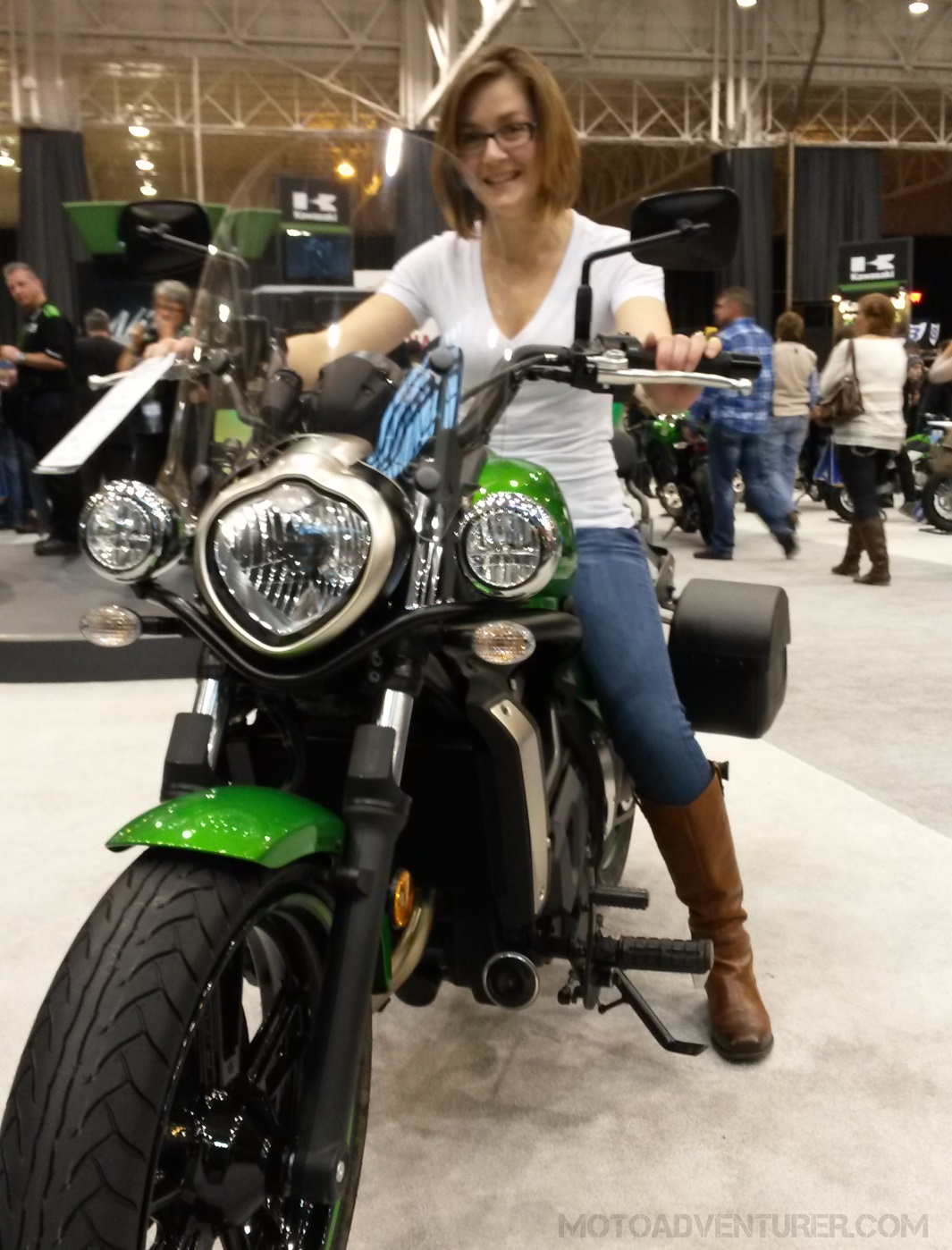
Kawasaki Vulcan S CM MotoADVR

The point here is that rider triangle is everything; where your hands, butt, and feet make contact with the machine are (semi) fixed on any given bike, but each person’s frame is different. What bike is comfortable for one person is diametrically different for another. Per my comments above, many of this can be adjusted; motorcycle seats are a dime a dozen (for popular models), bars and risers are cheap, and there are a myriad of aftermarket foot controls for most bikes. If you have your heart set on one bike, and you have deep enough pockets, there are usually ways to make that bike fit you.

There’s something else to consider here, there was a reason I asked “How do you picture yourself on a motorcycle?”

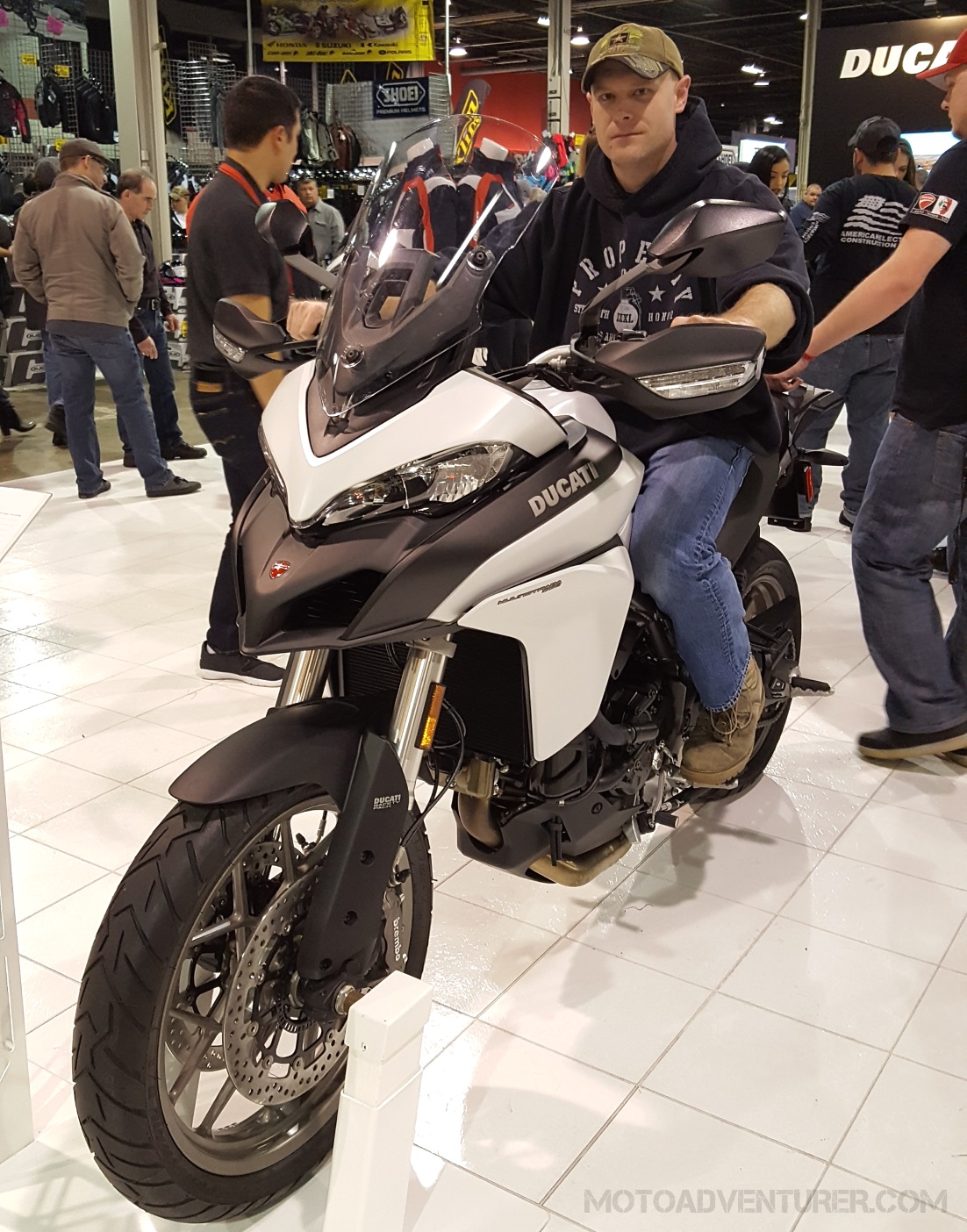
motoadvr-on-ducati-multi950

Some folks are convinced they love sport bikes, while others simply love cruisers. I can easily point out a dozen friends and associates that have moved from one end of the spectrum to the other. Yes, age is often factor (and the result may surprise you), however I go back to rider triangle. You may be convinced that a given cruiser is the most comfortable bike you’ve ever ridden. It might also surprise you when I have you climb up on a BMW R1200GS or plop down on a Bonneville T120. When choosing your first bike, unless you need a very specific tool, don’t be completely convinced that you absolutely need a certain type or brand of motorcycle. Sit on every bike you can park your keister on and see what fits, and absolutely do not buy any motorcycle until you’ve taken it for a test ride; the longer the better.

Who do you ride with?

Having never ridden a motorcycle, this may sound like a silly question, but I’m telling you, it will play a subconscious role in the bike you “want”. I feel safe saying that the majority of riders spend time riding with other motorcyclists. When writing my own iteration, I read an article about “things no one tells you about riding a motorcycle”, one of the items was “you join a club”; for many that’s literal, but in reality, motorcycling is small section of society, and as a result riders tend to stick together.

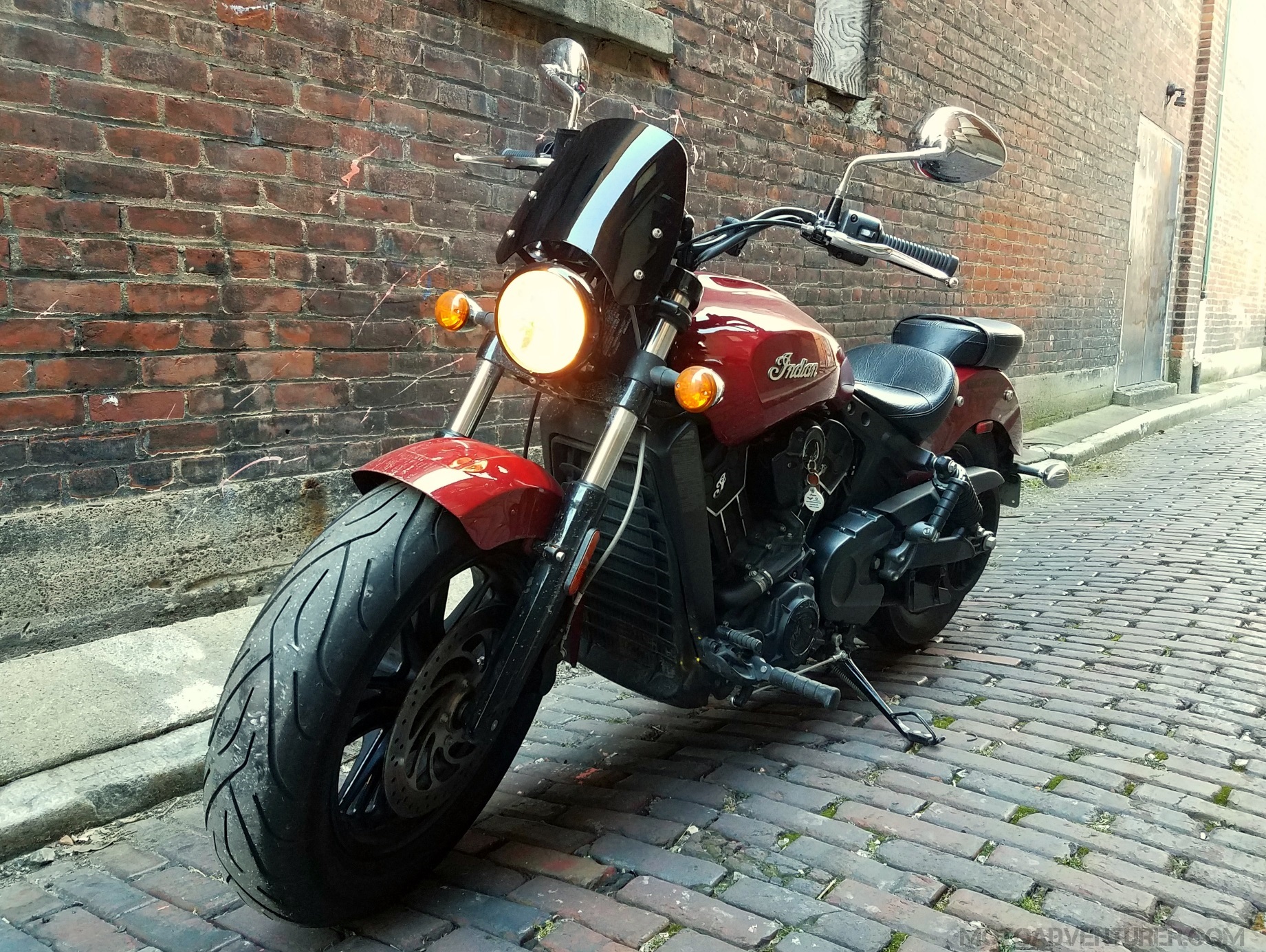
Indian Scout Sixty MotoADVR

If you’re just getting into motorcycles, odds are you know someone who rides. Do you plan on riding with folks you know? If so, what do they ride? Do you like the kinds of bikes your friends have? I’m not saying you can’t go against the grain, I see the lone cruiser chasing their sport bike buddies around town from time to time, as I see naked bikes sprinkled into poker run formations; it happens. That said, most folks tend to assimilate into the groups they like spending time with. I had a buddy swear up and down he didn’t want to buy a Harley. After a season or so on his Honda, he sold it to buy a big Harley, not all that different from his riding associates (there’s a reason you see Bat-wings flying together).

This question also has a second facet to consider, how do those people ride? Some riders are social animals; “Tavern-to-Tavern” is often a slur used to describe the cruiser crowd, but there are no doubt droves of riders that have little interest in racking up more than 100 miles in an outing.

2016 Harley Davidson Road Glide MotoADVR

Having not ridden at all, it’s tough to identify if that will be you, but it’s a valid question to ask your prospective riding buddies; what kind of miles do they lay down in a given weekend? You may also find out you rub elbows with some “hyper-milers” at the office. Again, if I grossly stereotype, these are generally the “Road Grimed Astronauts” wearing Aerostich riding suits, rocking the filthy ADV or touring bikes and prefer to cover more ground before breakfast than some riders do all weekend. Why is this important? Because if you’re the one with a hyperactive bladder and bike with a low capacity fuel tank, the hyper-milers are likely to get a bit impatient with all the frequent stops. Vice versa if you’re addicted to the “open road” and your buddies want to grab a cold one at every pub you pass. Again, you and your friends may absolutely be the exception, but this is still something to consider.

What bike speaks to your soul?

My buddy Jeff said this is the most important question… and he’s dead-on. Being the nerd that I am, I literally made a weighted pro/con matrix when selecting my replacement for the Speedmaster (to be fair, there was beer involved). I really wanted a Tiger 800 XCx, or perhaps the more economical Tiger 1050, but the Scrambler kept pulling at my heart strings. Both Tigers are better bikes than a Scrambler in every way… but we all know how that worked out. I regret nothing.

This question should be weighed heavily against “What’s your budget?” The bike you need, the bike you want, and the bike you can afford are likely very different things.

Yamaha XSR700 MotoADVR

It is wise to be mindful of each of them, and choose accordingly. If you can’t have the bike you want, it would be wise to choose the appropriate, utilitarian, machine that is the bike and can afford in the interim. It will still get you on two-wheels, put money in your pocket for respectable gear, and ideally help you save toward the bike you really want. For many, this bike is the Rebel 250, the beat up old dirt bike, or the vintage 80’s Honda. It’s not luxurious, but it gets you on the road and puts experience under you belt.

Wanting is sometimes better than having; saving up for the “next bike”,

2017-bmw-r-ninet-urban-enduro-1200-motoadvr

the bike you “want”, may also help prevent you from blowing cash on a bike that, in the end, you don’t really “love”. If budget is of less concern, then the bike you “want” is more likely in your grasp. The danger in that being, if you can buy (or finance) the bike today, there’s little forcing you to think it over. In this case, per previous comments, I positively insist you ride the bike before buying. The heart is a fickle thing, motorcycles are gorgeous machines, blocking rational thought from you mind; once the bike is ridden off the lot, it’s difficult to recoup that instantaneous depreciation in the event you change your mind.

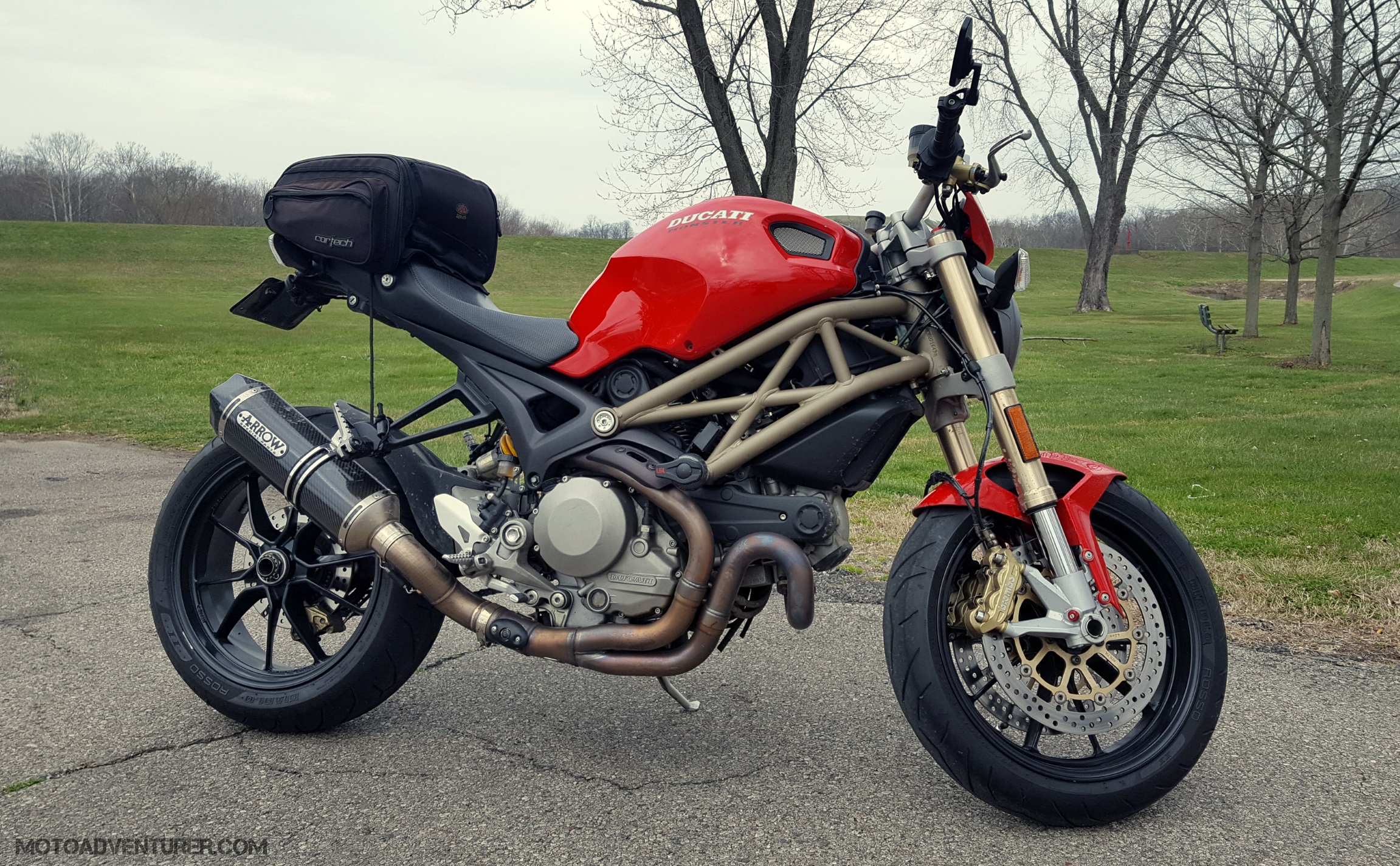
On the other hand, if you “settle”, you may be left with that insufferable “itch” that you simply cannot scratch. Ducati Monster 1100 Evo MotoADVRFor some, it’s buying the sensible Asian cruiser when you truly want the rumble of the American V-twin. For others, it’s lust for the redheaded Italian supermodel with all the Swedish trimmings. Again, if it’s in your means, sometimes you just have to go for it. It would be wise to be mindful of the likelihood that this bike may spend a very short time in your stable, along with the associated complications, but if you ignore the motorcycle that speaks to your soul, you’ll always have eyes for a machine other than your own.

Posted in Gear - Maintenance - Safety | Tagged , , , | 14 Comments

Harley Dirtster Project: Planning

Way back in the days of Lola the Speedmaster, my buddy Jeff told me that he wanted to convert a Harley Davidson Sportster into a dirt bike. OLYMPUS DIGITAL CAMERAHaving not yet been bit by the off-road bug, and being the (arguably) anti-Harley guy I was, my reaction was an overwhelming, “Why the hell would you do that?” A much more seasoned rider than myself, he asked me how many Harley Dealerships were in Ohio, the United States, moreover around the world. It turns out, there are actually 40 dealerships in Ohio. While I don’t know the actual world number, it’s pretty safe to say that Harley Davidson has a massive presence all over planet. That revelation was impressive, but I still wasn’t putting two and two together.

“Think about it…” he said, “If you truly wanted to tour around the world on a motorcycle, what better bike than a Harley? They’re easy to work on, and parts (Should be) readily available.” It was a novel concept, and if nothing else, it did have the looks of all those custom scramblers I kept seeing on the internet, but the idea still needed to fester for a bit longer.
Years went by; I bought a Scrambler and I dipped my toe in the “adventure” scene. Riding in the dirt proved to be more exciting than I could have imagined; it opened my eyes to the possibilities of motorcycles. The Scrambler turned out to be surprisingly capable, but there’s no question that it’s still a bit lacking, especially at higher speeds.Harley Scrambler Black Dragon MotoADVR At the same time, while I have a lot of experience working on the 865 engine, unfortunately it still involves routinely poking around in the valve train. Even before I laid down 1,000 miles in one day, I had dreams of an Alaskan adventure; while routine maintenance can be planned as part of that trip, not having to stop to wrench on a bike is a lot better. The ease of maintenance and simplicity of the Harley Evolution engine is its hallmark, if nothing else. Suddenly the idea of a scrambled Harley took root.
OLYMPUS DIGITAL CAMERALast summer my buddy Jeff tagged along for Red River Scramble and then the Dragon Raid. Needless to say, some beers were involved, and under the cover of cigar smoke, there was a lot of discussion about building a bike. Jeff mentioned he had a line on used Sportster, a bike he’d previously turned wrenches on; it was merely a matter of agreeing on a price. Before I knew it, the “Dirtster” project was born.


Short Term Goals

Turn a Harley into a 500-pound dirt bike… seems simple enough right? In the end, the engine is the most important part of the equation, keep the torquey, push-rod, v-twin intact, spare the frame if at all possible, and upgrade the rest of the bike until it’s a proper dirt machine. This endeavor will unquestionably call for upgraded suspension; “adventure” appropriate wheels, considering the 16-inch rear rim makes no sense in the world of knobby tires; suitable handle bars, some sort of skid plate, and ideally repositioning of the pegs. A properly routed exhaust has potential to present somewhat of a challenge; however, with the frequency in which Harley pipes are replaced, I suspect someone on the aftermarket has us covered.
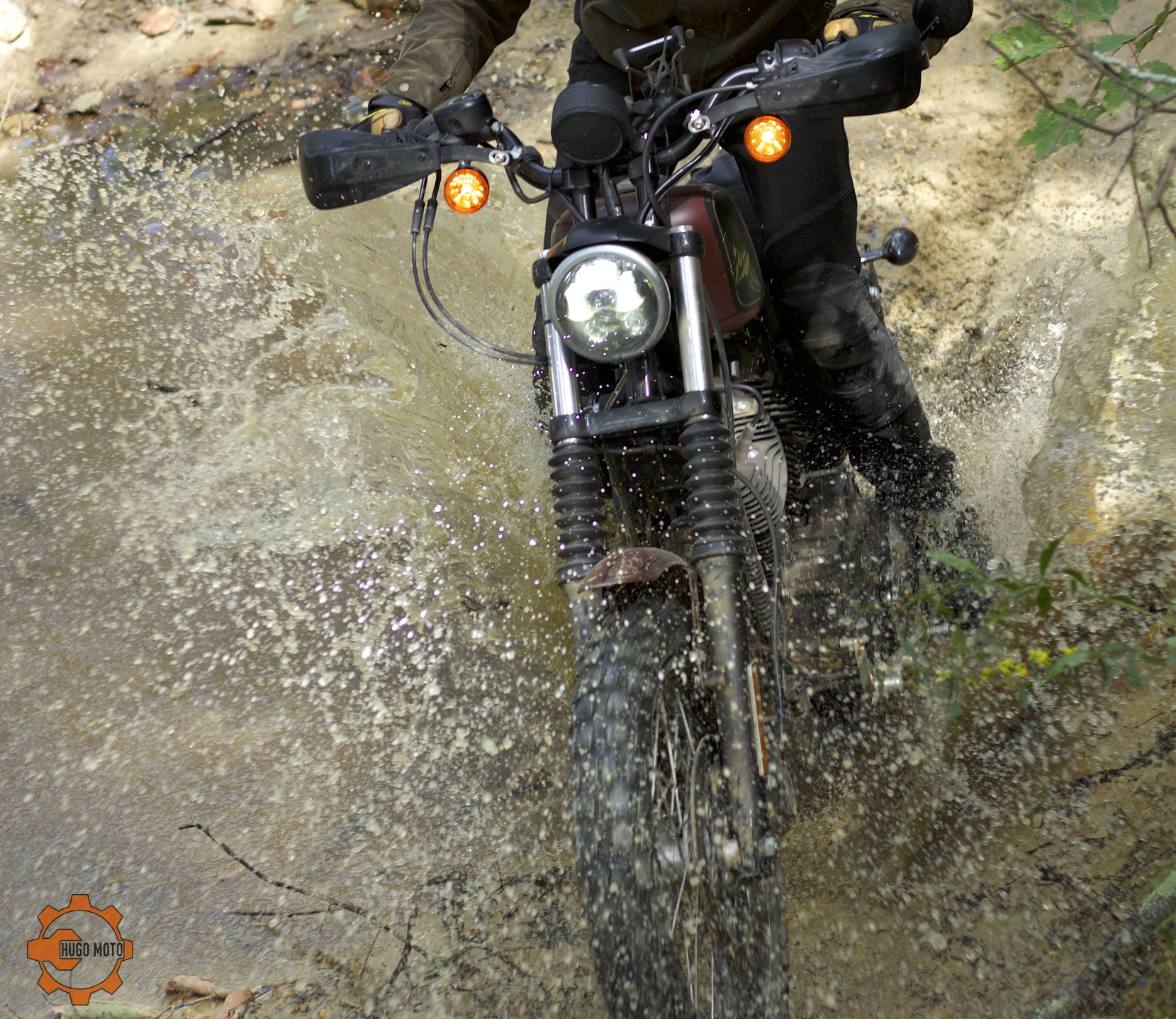
Having spent countless hours looking over suspension options for the Scrambler, I want to be certain to get the springs tuned-in right out of the gate. The scrambler has a lot of unique challenges because of its existing geometry and height. Hugo Scrambler in MudFortunately, the Sportster swing-arm is already at a negative attitude in relation to the frame, adding longer springs to the Sporty to gain that much needed rear travel should be relatively easy. On the flip-side, it will be a matter of what to do with the front. Considering the Sportster has been in its current form since about the mid-eighties, lots of folks have toyed around with the front suspension. I’m under the impression that certain dirt bike front ends are simple bolt-on affairs with the Sportster frame; albeit I’m not sure if we want to get that crazy… yet.


Enter Hugo Moto

I mentioned just days ago that Harley is missing something specific from their line up; it’s almost like Hugo Moto was reading my mind.Hugo Moto Turquoister In actuality, I caught wind of Hugo Moto’s Sportster kit early last year. The idea of building a Dirtster was still a bit of a pipe dream at that point, but when it came time to talk turkey, it seems that Hugo has figured out the solution to most of the challenges ahead. With the stock engine and frame intact, Hugo Moto has already sorted out how to get 7 inches of suspension travel out of the front forks (with some slick cartridge inserts), pinned down a supplier for custom long-travel rear springs, a set of 18 and 21 inch wheels, a beefy skid plate, off-road pegs, and pretty much everything else from stage one of the “to-do” list. At this point, I think it’s merely a matter of getting my hands on the hardware.


Long-term Goals

With the Hugo Moto “World Tour Kit” I expect the Sportster can successfully be converted to “Dirtster” over a long weekend, which will cover all the off-road basics and then some. That said, Jeff and I want to shave weight off this “hog” so it can be shamelessly loaded down for the long-haul; Hugo Moto Kitsliterally living off the bike in third world countries. Like the Scrambler, long-term the 5-inch headlight isn’t going to cut mustard; an LED replacement and/or auxiliary lights are a must, especially for venturing outside Harley’s home turf. Fenders are another topic of discussion; while Sportster “tins” are easily attained and easily modified, something less ferrous may be in order if we want to shed more “el-bees”. I’m debating if it makes the most sense to rob a high fender off a dirt bike for the front end, whilst taking a cutting wheel to the rear skirt. That said, I’d really like to find a complete plastic replacement for the rear; while plastic on a Harley may be a bit sacrilegious… lighter is faster y’all. Luggage will also present another challenge; while I’ve seen some nice Giant Loop luggage strapped over the high-pipes of the Hugo kit, Jeff and I have discussed a suitable luggage rack for the rear; something that will keep the bike narrow, but also provide good tie down points when packed for the long-ride. Fuel is also a big concern; generous fuel tanks are not something that Sportsters are known for, this donor bike is no exception. Putting more fuel on the bike is likely to be one of the greatest challenges; there are a lot of aftermarket tanks for the Sportster, unfortunately, most of those tanks assume that the rider will always be seated on the bike.
As crazy as it sounds, I actually think this dream is easier than “adventurizing” a Triumph Scrambler. I have a feeling that idea will be tested sooner rather than later. Now the question is… what are we going to name this bike?

OLYMPUS DIGITAL CAMERA

Posted in Bikes | Tagged , , , , , , | 9 Comments

What’s a Good Motorcycle “Day Ride”?

DCIM103GOPROG0804301.I’m starting to feel like a good day’s ride is ten miles and not two feet further. While things have been a shade easier, Mother Nature really hasn’t let up since my recent recount of winter weather. As painful as it is now, it’s merely a matter of time before a series of 50°F days finally arrive here in the Midwest. As such, I’m getting anxious to put together a few new adventures, including a covered bridge route in northern Kentucky.  Considering that route planning has been on my mind as of late, I figured it’s a good time to ask the question, what’s makes for a good “Day Ride”?

US129 Gravity Cavity MotoADVRI wrote in detail a few months back, describing “The Perfect Ride”, but in this case, I’m more interested in how far, and what kind of riding do you consider for “a day ride”. While I have lofty goals for 2018, including four rallies while also “building” a very special adventure bike (stay tuned), I also want to focus more on ride reports this year. I want to continue to tell stories about the struggles of everyday motorcycling, drop notes about the gear and equipment I like to use, but I also want to show the readers where my favorite out-of-the-way roads lead. That of course led me back to the same question, how far does the readership like to go in a day?

DCIM105GOPROG1175886.

I’m becoming the worst judge of other people’s taste. I fear my fixation with time in the saddle has warped my impression of how much riding my fellow motorcyclists enjoy. Despite my early feelings that riders are somewhat “cliquish”, or finding many motorcycle topics polarizing, after making so many new acquaintances last year, I’ve begun to realize that tastes in motorcycling vary in as many degrees as there are motorcyclists. That’s a good thing, it’s unfortunate that Hollywood and modern “marketing” has galvanized the images of the leather-clad chopper rider and the Starbucks sipping Beemer owner.

The Hub Robbinsville NC MotoADVRThis year I want to visit Pennsylvania, South Carolina, and explore more of Tennessee and Kentucky. At the Triumph Rally, the day’s route is typically determined by the best road or the best place to go find lunch. In my travels this year, I’m hoping to land in a few backcountry Mom & Pop stores and hear stories from the locals. Hopefully a notebook and pile of photos with keep my memory fresh so I can somehow put words to all the miles and smiles. But, before we get to those adventures, I want to hear from you. Triumph Scrambler Battery Dead MotoADVRHow far is a good day ride? How many hours in the saddle is “just right”? Is it about the roads, or is it about the stops along the way? Which is a better story, the awesome things you saw, or the unscheduled road-side repair you had to make on the way? Is it the photos, the smells of the countryside, the flavor of local food, or the good company that joins you on the journey? Exactly what do you look for in a “day ride”?

Posted in Opinion | Tagged , , , , | 24 Comments

What do you want from Harley-Davidson?

Early this week I caught this news snippet regarding Harley-Davidson’s announcement about the closure of the Kansas City manufacturing plant. Harley Davidson Museum MotoADVRThat news, while tragic, is unfortunately not particularly surprising after so many recent articles have been written about declining sales from the Motor-Company. Similar to when Polaris shuttered Victory’s doors, social media platforms are on the verge of a full-blown meltdown from the sheer volume of comments on the subject. Many folks see the recent news as chickens coming home to roost, others echo the sentiments that millennials don’t understand the value of the American motorcycle, while others suggest it’s merely the ebb and flow of the market. I’m of course not innocent in all this; I’m sucked into the Harley discussion the same as the next “biker”. I admit, I don’t know what’s going on, I don’t know what’s going to happen, and I can’t help but offer my two cents. Thus, I ask the question, what do we want from Harley-Davidson?

When I first started “shopping” for a new motorcycle, I won’t say that I eliminated Harley-Davidson from the search, but it quickly became evident that there were other options available. Price was a large factor, but I admit, I was also looking for something “different” than what a lot of other motorcyclists were riding. As an opinionated, “rebellious”, new rider that knew everything, I once thought I needed to defend this “anti-Harley” stance, yet in recent days, I’ve actually come to terms with reality, and recognize what Harley has to offer, even if, perhaps, they have not.

After rubbing elbows with a wider, more obscure portion of the motorcycling community, Harley Davidson Roadster MotoADVRI have begun to appreciate that each motorcycle is a tool, and in turn different tools have different jobs. Despite the polarizing nature of the “Bar & Shield” label, I believe that cruisers, and more specifically, Harley-Davidson has its place in the market. That said, current market trends seem to suggest that Harley is either not delivering what new buyers want, or has perhaps over saturated the market. I’ll admit, I’m no economist, for all I know this news is simply the first of many sad stories for all the manufacturers as the motorcycle market is contracting as a result of stagnant wages and disinterested buyers. That said, I feel it’s worth throwing the “Home Team” a bone and at least telling Harley-Davidson what we’re looking for from their brand.

Some will say they want to see Harley-Davidson launch a sport-naked (despite that whole Buell thing), design a new engine, and in a resounding voice, ditch all the excess steel. Whereas I would applaud such an effort, Harley Davidson Evolution Engine MotoADVRI actually think Harley has the all the tools, and the DNA to deliver an adversely different product, while only making minor changes. While dual overhead cams, liquid cooling, and over-square engine architecture are often thrown in the face of the low horsepower “Harley crowd”, I personally think that many dismiss the convenience of maintenance simplicity offered by the modern Harley engine. As I found myself poking around in the Scrambler’s valve train on three occasions in a year’s time, let me tell you, the concept of self-adjusting hydraulic tappets starts to sound a pretty appealing; at least for the daily commuter. Beyond maintenance and engine simplicity, and despite the unending jokes of American V-twins “marking their territory”, I consider the modern Harley engine to be relatively reliable. There is no question, modern bikes of all makes have fallen prey to a myriad of recalls in recent years, but where the power plant is concerned, I suspect and Evo engine will treat you right. Look, I don’t want this to sound like a cheerleading bit for Harley-Davidson, I merely want to set the stage for the changes I want to see going forward. Thus, without further ado…


Diversity…

No seriously, I want to see real diversity. When I first started seriously looking at buying a motorcycle, Harley-Davidson sold five motorcycles; the Sportster, the Dyna, the Softail, the Electra Glide, and depending on who you ask, the V-Rod. With the advent of the XG series “Street” models, that expanded to six, only to be rescinded to four with the retirement of both the V-Rod and the Dyna. Late last year Harley was pushing the #FreedomMachine “What’s In the Box” campaign. 2018 Harley Davidson Fat Bob MotoADVRI was really excited, with the promise of releasing 100 new models over the next 10 years and considering that the Milwaukee 8 was already “a thing”, I assumed Harley had finally revamped the Evolution engine and we were finally going to see a new Sporty. Instead, we received EIGHT Softail models… with a ninth that followed shortly thereafter. Don’t get me wrong, I welcome the new Softail models, especially the new Fat Bob, but nine flavors of essentially the same bike is downright ridiculous. In a world where a new Harley is viewed as a “blank canvas” for customization; were exhaust, bars, and leather seats are throw-away items that are expected to be replaced at the parts counter, I fail to understand the need for nine iterations of the same chassis straight from the factory. The Softail Slim, Lowrider, and Street Bob are now essentially the same bike with marginal differences. I full well understand that engineering takes time, and that there’s a flavor of motorcycle for every motorcyclist, but considering the availability of OEM and aftermarket parts for Harley, why do we need to slice the pie so thin?


Redefine “Heritage”

In recent years I feel like Harley-Davidson advertising is borderline mocking itself. “Feel the Freedom”, while not a true Harley tagline, seems like the quintessential Harley advertisement. Harley Davidson 1937 Flathead MotoADVRMeanwhile, “Freedom Machine”, “Resistance is Futile”, “Don’t Wannabe”, and “Roll Your Own” are actual H-D slogans. A while back I caught this satirical bit about the MoCo; “Heritage” and “Tradition” are used excessively to mock the brand. From the 90’s up until very recently, marketing has successfully lifted Harley to the powerhouse it is today; essentially selling “toys” to droves of consumers. I do not begrudge Harley-Davidson their success (nor the customers who love their motorcycles); I do however think they have another card in their hand to play. Here in America, there was a point in time where Harley was synonymous with rugged machines and equally self-reliant, adventurous customers. Harley Davidson Shed MotoADVROver the holiday break I finally caught “Harley and the Davidsons”; while fictional, I couldn’t help but be nostalgic about the competitive and “independent” beginnings of motorcycling in this country. I think the Motor-Company needs to leverage that idea to market and sell a bike that is properly suited more toward those interests as “Adventure” seems to be the portion of the motorcycle market that has expanded in recent years. The Milwaukee V-twins sold today are still easy to maintain, but the overall structure of the bike is a little less inviting when the pavement becomes less than ideal. I believe Harley has the tools to remedy this situation, with merely subtle changes.


Build a Standard

In recent years, Harley has edged closer and closer to selling a neutral seating position “standard” motorcycle. The new Roadster, which I’ve discussed at length, and the new Street Rod are welcome steps in that direction, but both seem to lack full commitment. Harley Davidson Street Rod MotoADVRBe it poor positioning of controls, or just poorly executed rider triangle, both bikes are on the verge of offering riders an alternative to the typical laid-back Harley ergos, but fall just short. Per my previous comments about “minor tweaks”, the Sportster frame with minimal “massaging” could easily give birth to a factory standard, if only the auxiliary parts would follow suit. With regard to the Roadster, I mentioned this directly to the dealer when they were pushing the sale; ultimately I simply think it’s bad business to sell a bike to someone and immediately turn around and charge them for extra parts to “finish” what the brand started. While I understand each rider’s comfort and stature are different, at 5’10”, 185, I view myself as the “Average Joe”, and I’m unquestionably not the first to comment on the “odd” ergonomics of both of the before mentioned models.
 

What I’m trying to say is… I want a Harley Scrambler

Harley has heritage in spades; bring back that dirt legacy to the showroom floor. Way back when (…way back), motorcycles were once the only means of transportation for some folks. Harley Scrambler MotoADVRNeedless to say, a lot of dirt roads were involved, which I suspect probably has a few things to do with the continuation of modern hill climb and dirt track racing. Despite that rich history, Harley really doesn’t sell a dirt worthy motorcycle. Don’t get me wrong, I don’t expect the Milwaukee marque to up and build a modern dirt bike with twelve inches of suspension travel; nor do I expect them to throw their hat into the ring with a large displacement Adventure bike; especially considering BMW’s level of wiz-bang-ery. No, not at all; but in an era where virtually every manufacturer is selling a factory scrambler, I think Harley has the tools to beat them at their own game, as the original “retro” and the most rugged dirt machine.


2016 Harley Davidson Road Glide MotoADVRThis may be a pipe dream. This may be the musings of a millennial without a clue. However I still say it’s worth a shot. I don’t want Harley to stop selling the Heritage Softail, the Road Glide, or cruisers in general. I don’t want the Motor Company reduce its quality and emphasis on fit and finish. I do however want the strongest American Motorcycle brand to continue to produce motorcycles. I especially want them to sell motorcycles that I want to own, not when I’m 50, a motorcycle I want to own right now.

The future is obviously uncertain, and this is only one man’s opinion. So…

What do you want see from Harley-Davidson?


Posted in Opinion | Tagged , , , , , , | 33 Comments

Ride Every Day: Reflections On 180 Days in the Saddle

Tuesday, July 25th, 10:46 PM

After hours of farting around in the headlight bowl, I successfully spliced over a burnt connection and Rosie the Scrambler fired to life. Having sat out the previous day, the riding streak was reborn.

Wednesday, July 26th, 7:37 AM

Day 2: The morning commute.

DCIM134GOPRO

The Challenge

For newcomers to the blog, early last year we caught an unseasonable break in the weather in early February which led to an impressive number of winter riding days. That streak of riding gave birth to the suspicion that I may indeed be able to ride a motorcycle for 365 consecutive days in Dayton, Ohio. Following similar rules that Blaine Paulus Jr. set for himself, I ride a motorcycle for 10 miles or more each day. Having successfully patched the bike back together following a “minor” electrical hiccup on July 23rd, I saw no reason to back down from the challenge in the heart of riding season, thus “I got back on the horse.” In the back of my mind, I still assumed life or other maintenance frustrations would intervene long before December, nonetheless, “Ride 365” was added to the Moto Bucket List.

Saturday, January 6th, 9:03 AM

Day 166: I pull in the clutch, close my eyes, and bite my lip as I press and hold the starter button. The engine cranks and cranks for what feels like an eternity.
“Is this the day… is this the day the bike doesn’t start?” I think to myself…

Greatest Fears

As Thanksgiving gave way to Christmas, I knew the brutal winter months were upon me. In recent years I’ve been pretty successful riding deep into December on both the Speedmaster and the Scrambler. Christmas Day Snow Triumph Scrambler MotoADVRI’ve even rode on New Year’s Day a few times, but there’s almost always a two week stretch shortly thereafter that is absolutely bitter. While not the worst I’ve seen since getting my endorsement, Old Man Winter still managed to dump a good dusting of snow on us in early December, and then a good two to three inches right before Christmas. The Christmas snow was also followed by a deep freeze that lasted well into the new year; it was teens for days, with many nights below zero.

When this crazy idea was first hatched, riding in the snow itself was probably my greatest fear. DCIM101GOPROG0129920.Right around Christmas I took a ride around the neighborhood in some excessively sub-freezing temperatures. With a good dusting of snow in the intersection, I realized the tires had more traction than I expected. It was not plentiful, that is for certain, but I would equate it to riding in mud, without the “sinking” sensation. As time went on, my fear of the snow conceded to fear of killing the battery or worse the starter. Each weather cycle seemed to bring a dusting of snow, some flurries, and then a hard freeze into the single digits for several days. If memory serves, the temperature didn’t reach freezing from December 26th until something like January 10th. I full well recognize that folks in Michigan and Minnesota are probably laughing at that comment, but that’s somewhat of an oddity in Southern Ohio. It may freeze, it may well be ten below zero, but that trend seldom lasts for more than two or three days. By the first couple days in January, I was really concerned that the hard starts would eventually overtax the bike.

Beyond truncating the life of the starter, I was also apprehensive about the corrosive effects of the salt. December 31s Triumph Scrambler Snow MotoADVRMany folks have echoed those concerns on Instagram, to which I’ve replied “Fortunately I have a protective coating of dirt!” While that is true, there’s only so much mud on the bike after it gets rinsed off in the rain, and even while typing this, I am indeed concerned about the health of the chain and the fasteners. The chain, while vital, can be replaced, and the paint can washed; unfortunately only time will tell how the fasteners “weather the storm”.

Saturday, January 6th, 9:03 AM

Day 166 continued: After the engine turned over for about the fifth time, I heard a “spud”. It turned over at least two more times, “spud-spud”, and finally fired to life. Turning up the heated grips, I went back inside to put on my gear while the engine warmed up. Zero Degrees Triumph Scrambler MotoADVRCarefully backing out of the snow covered driveway, I headed down the street to one of the neighborhood churches. One of the local police officers was actually sitting in the parking lot next door. As I pulled up in front of the digital billboard, I noticed the officer craning his head around to look at me. I’m not sure if he was curious who was parking in his blind spot or trying to confirm he just saw a motorcycle. I stepped off the bike to snap the obligatory photo of the current temperature. Zero degrees, a new personal record.

Going Toe-to-Toe with Old Man Winter

After pushing the limit last winter, I discovered traditional hand guards, heated gloves, Hand Mitts 1 MotoADVRand even the old rubber glove “trick” wasn’t enough to keep the feeling in your fingers for more than a few moments when riding in single-digit temperatures. Fortunately, this December I got my hands on a couple sets of riding “mitts”. I’ve suggested in the past that a set of “Hippo Hands” might be mandatory equipment for riding year-round; I will not only confirm that suspicion has proved to be true, but I also have no idea why I didn’t try it sooner.

While that lazy start on January 6th made me a bit nervous, it actually wasn’t the worst. On New Year’s Day the air temperature was hovering in the low single-digits; the bike really did crank for what seemed like forever before it finally started. I texted a buddy about my concerns with the cold starts killing my starter.Kats Sump Heater MotoADVR He told me I should put a heating pad on the engine, or perhaps buy a sump heater. I couldn’t believe that idea never occurred to me; way back in high school I can remember someone telling me that northerners actually plug their cars in so they will start. At the time that seemed like the craziest thing. I’m here to tell you, when it’s below 20°F, your bike is unhappy, and it does not want to start. After putting the engine on a sump heater for about half an hour, she cranks twice and fires; life is good.

Miami River Frozen MotoADVR

That fine zero-degree morning I wasn’t in a hurry so I actually went down to the river to take a few photos. The river access road was completely covered in snow. To make matters worse, the snow was also packed down from car traffic. While not the first time, that morning was one of my best lessons on riding through snow; when it’s hard packed, you’re riding on it, and the slightest imbalance can cause a tire to “break loose”. The rear tire spun up quite a few times on the way down to the low damn. Short of idling, it took a lot of finesse to hold the throttle light enough to prevent wheel spin. My advice: embrace the fishtail.

Frosty Visor MotoADVR

Approaching the parking lot a little further down, I was surprised to find the Great Miami River completely frozen. I’ve seen it before, but it’s probably been more than a decade since it’s been frozen solid in that spot. After snapping a few photos I flipped down my visor to discover that it was frosting up, rather significantly. At zero, there’s apparently no avoiding it, even with a double pane shield. I suspect that “cracking” the visor to let in more air actually expedited the frost. It’s apparent that if I want to extend my winter rides beyond ten miles under similar conditions, I’m going to have to invest in a heated visor.

Around the 11th of January we finally received a reprieve; DCIM100GOPROG0050526.the temperatures came out of the deep freeze as a heavy storm front came through and dumped some significant rain on the Midwest. Well above freezing, I naturally rode to work, despite the rain. The run-off on the commute home was pretty substantial, but it’s what happened in the following day that was more concerning. After the bike spent most of the day in the rain, the temperatures again plummeted back below freezing. Stepping out to warm up the bike the next morning, I struggled to push the bike over to the door so I could plug in the sump heater. All that wonderful rain water had successfully frozen the brake levers on both the front and rear. Take my word for it, rubbing alcohol is a much better de-icer than WD-40.

Monday, January 15th, 6:09 PM

Day 175: It snowed most of the day. While not the most accumulation we’d seen this winter, it was at least a couple inches. When I decided I was riding through the winter, I knew there would come a day where I would be riding on a completely covered roadway. While still at the office, I suspect this was that day. To my surprise, when I got home it was evident that the road crews had done a pretty good job of getting things cleared up. At only twenty-something outside, I fired up the bike and got dressed for battle. While out on one of my 10 mile loops, I passed a completely snow covered side street. It was time to test the limits of the Scrambler.

Facing Fears

I’ve never really taken notice of the little “dip” in that side street. It’s amazing what a little elevation will do to reduce traction. Somewhere under that snow was a layer of frozen rain, probably sitting on top of a hard packed layer of snow from the last storm we had. While it’s obvious I’m crawling in the video, the rear wheel never “caught” the whole way up that tiny hill, it was one continuous fishtail.

Miami River Sunset Snow MotoADVRIn the end, something I was convinced would be hair raising two years ago, actually turned out to be a lot of fun. I’m sure riding down the highway, white-knuckled in a snow storm is not something I’m going to enjoy, but a little snow riding here and there hasn’t been too bad. I’m pretty confident that last year’s off-road riding made this possible. I’m hopeful that “snow riding” will translate into more confident dirt riding this year. There’s also no question, I would not have been able to ride over that snow on street tires; knobbies for the winter was definitely the way to go. Which makes me wonder, what would studded tires be like?
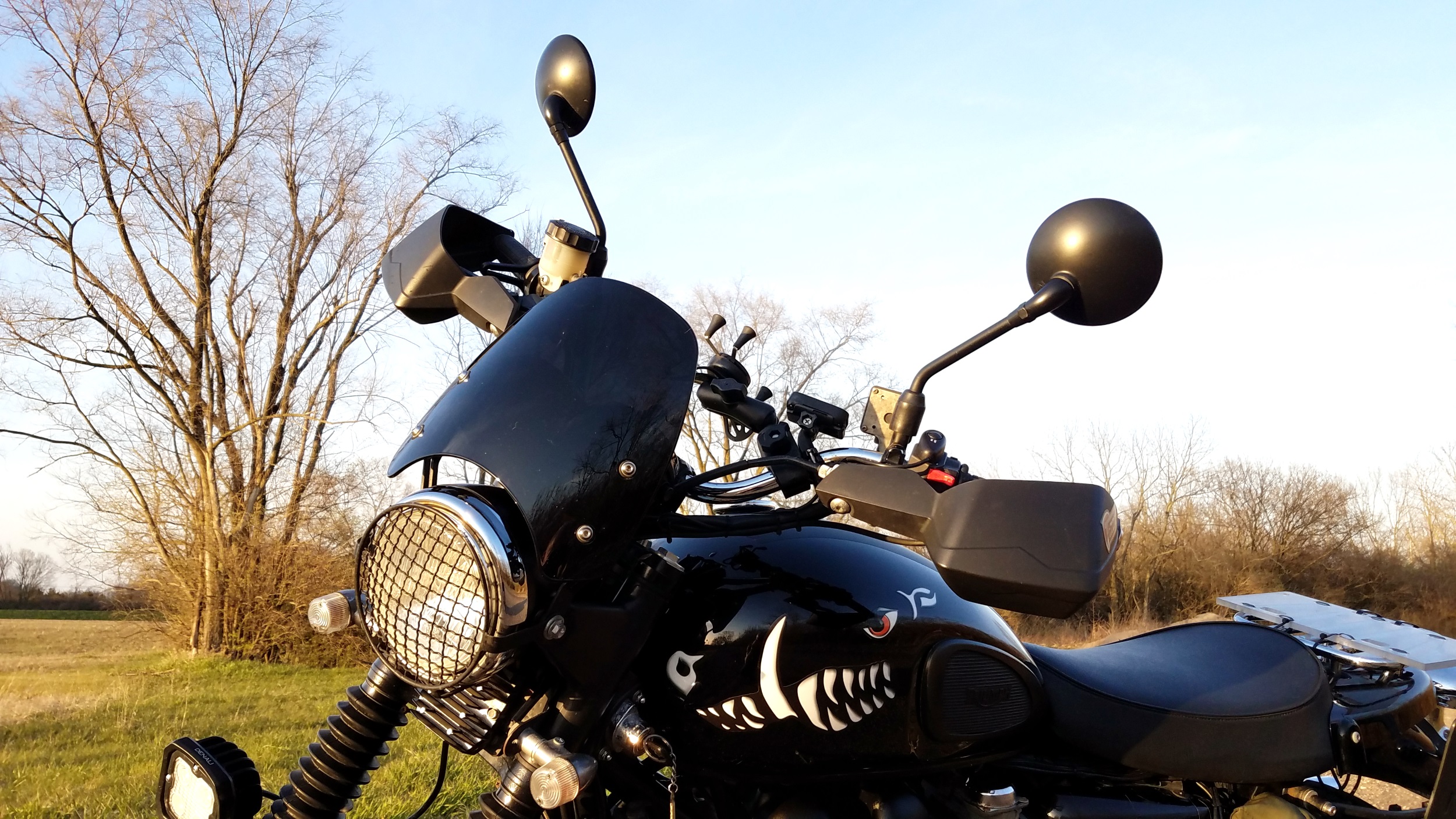
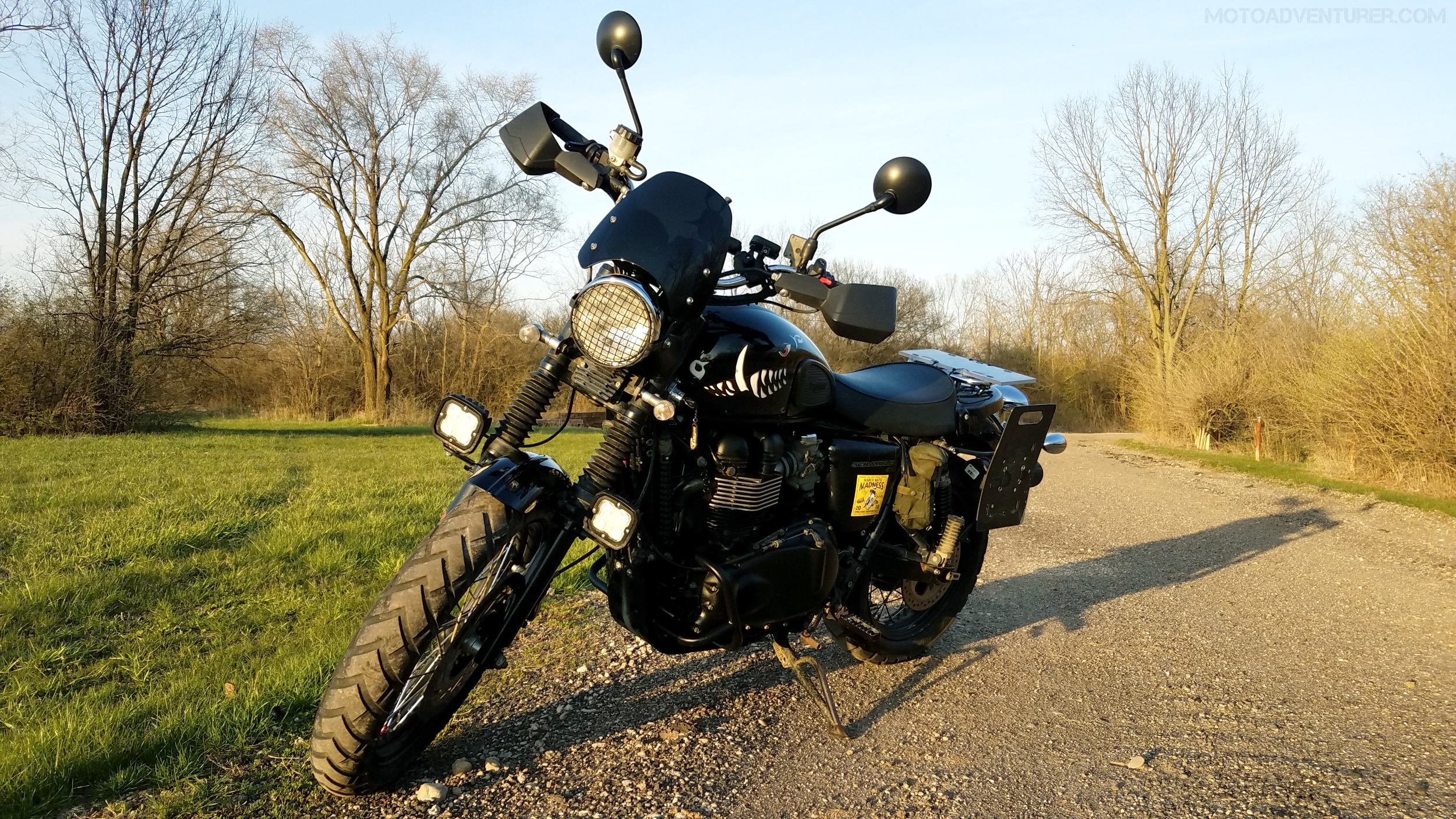
The Road Ahead

Looking back through the photos, I barely recognize summer. It’s been cold, dark, and “salty-grey” for what seems like forever. In reality I rode to Kentucky in November to see Grandma; the leaves had barely fallen off the trees at that point. I suppose that just goes to show how “sunlight starvation” can get to you.
DCIM100GOPROG0040880.Tuesday was day 183, the “halfway point”. The days are getting longer and the temperatures, at least for now, appear to be trending up. That said, it’s still early; flurries are falling outside as I type this, and February could easily dump a foot of snow on us. I expect the weather will start to warm up, marginally, but I’m still anxious about keeping the bike running. Right now I’m staring down a new chain and a new rear tire, meanwhile I’m still working toward having the bike ready to “rallycome March. Between weather, work, and my mechanic skills, 182 more days is still a long way off. Despite standing in the shadow of a mountain, I’m still proud to have made it 180 straight days, especially through the heart of January. Hopefully February delivers an early birthday present again this year.

More of the Ride 365 Challenge

Posted in Opinion | Tagged , , , , , | 11 Comments

Auxier Ridge Trail: Red River Gorge

While this is not a motorcycle adventure, considering the time I’ve spend there, I can’t help but feel compelled to share the awesome natural beauty of eastern Kentucky. Auxier Ridge Trail Sign MotoADVROver the Christmas-New Year holiday, I caught a brief respite of remotely warm weather, so I snuck in my 10 mile ride around the neighborhood at dawn and then booked it down to the gorge in the Jeep. I had this hike planned as a motorcycle adventure way back in the fall, but when my Shepherd fell ill, I had no choice but to delay. With morning temperatures starting in the upper teens, it was forecast to reach the freezing point in the gorge, while never reaching the mid-twenties in Dayton. Photos of Auxier ridge have so often caught my attention on Instagram, I had to see it for myself.

Parking the Jeep at the end of Tunnel Ridge road, I pulled on another sweatshirt, a neck gaiter, and grabbed my backpack for a 4 mile, round-trip hike out to Courthouse Rock and back. Auxier Ridge Rolling Cliffs MotoADVRStepping out onto the trail, the fire damage from recent years was ever so present. From photos I’ve taken from down on KY-77, I was aware that fire had recently taken down large sections of the forest around Nada tunnel, but until writing this, I had no idea it had destroyed nearly 3,000 acres. While unquestionably unfortunate for the local ecosystem, the 2010 fire cleared large sections of foliage that has in turn revealed majestic vistas of the surrounding cliffs, rock shelters, and sandstone monoliths.

When I set out on my hike, my goal was to see Haystack Rock, and the Wizard’s Backbone. From satellite photos, the prominence of Auxier Ridge is unmistakable, but the ground level photos are extraordinary. Raven Rock MotoADVRFinally reaching the inner depths of the trail, I was inexplicably drawn to a singular peak off in the distance to the east. Taking a side path off the main trail, I realized I was looking at the backside of Raven Rock. I’ve often been caught by surprise by a brief glimpse of the sheer face of Raven Rock peeking out between the trees along KY-77, seeing it at elevation is equally impressive. Having seen it from that distance, I’m now laying plans for a more intimate view on a future visit.

Breaking through the trees on the west side the ridge, Double Arch slowly began to reveal itself as I approached an opening around Haystack Rock. Double Arch Ridge MotoADVRThe unobstructed 180 degree view near Haystack rock is one of the best I’ve seen in the gorge. While I absolutely love the vista from atop Half Moon Rock, Double Arch in the distance, dotted with splashes of evergreen, pushing up from the gray, leafless, tree canopy, makes Auxier Ridge a solid competitor.

Having scrambled around the cliffs at my Grandmother’s house, hiking and climbing around the gorge has always been somewhat of a test of wits against the fear of heights. Auxier Ridge Wizards Backbone MotoADVRWhile I don’t normally feel the perilous “falling” sensation in the pit of my stomach at elevation, I admit peering over the edge at Haystack Rock was a stark reminder of mortality. Conversely, shuffling along the rolling edge of Wizards Backbone, it was a much different experience; it felt more like an amphitheater hidden of the gorge, than a menacing fall hazard. While I had different lunch plans, some cold cut sandwiches and a six-pack of Ale-8 would make for a fantastic summer picnic on the western slopes of the Wizards Backbone.

Looking back east across the ridgeline, I noticed the gravel roadway in the distance. Tarr Ridge KY-613 MotoADVRTurning from gravel to asphalt just before a sharp bend in the road, I recognized it as KY-613 from my first off-road adventure in the gorge. I never noticed how prominent the Tarr Ridge cliff lines were from the ground; again, a testament to Auxier Ridge trail, but more so visiting the gorge during the winter months.

Finding my way back into the trees, I stumbled upon a series of staircases lagged into the sandstone rocks. Auxier Ridge Courthouse Rock Stairs MotoADVRIn the distance Courthouse rock stood alone, surrounded by boulders, rock shelters, and tenacious pine trees. Treading down something like four flights of stairs, I made my way to the base of Courthouse Rock, in search of the climbing route along the east side of the cliff. As I suspected, there was no way I was going to scale the “gully” along the side of the cliff solo. While I suspect it is highly doable, the thought of re-enacting “127 hours” wasn’t leaving my imagination. At that point, it seemed like a good time to head back up the stairs and enjoy my gas station lunch, and then finally backtracking to the trailhead.


Once back to the Jeep in the parking lot, I had about an hour to kill before I needed to head home to beat the impending snow. Considering my locale, I figured it was worth a try to attempt to steal an aerial photo of Nada Tunnel. Tracing along the end of Tunnel Ridge Road, I glanced at the GPS on my phone, to see if I was near the ridge that runs along the north face of KY-77, I looked over to find a sparsely traveled trail. Kentucky Highway 77 Nada Tunnel MotoADVRPushing through some pervasive rose bushes and fallen trees from the 2010 fire, I finally made my way out onto the point to snag a photo of 77 bending along the cliff faces. Unable to make out the mouth of the tunnel through the trees, I waited for a moment to hear a car pass by, that way I could follow the car to the tunnel. Despite the cold weather, the wait wasn’t long before a van came along. I snapped photo of what little I could make out of the tunnel, just as I noticed a hand emerge from the driver’s side window as the van pilot took the obligatory photo of the icicles lining the opening of the tunnel; only to find themselves momentarily stuck on the ice. In a really bizarre coincidence, it turns out I actually knew the driver of the before mentioned van; in this case, the roadside photo proved to be much better than the aerial view. Its days like this one, I wish I had a drone; maybe next time.


With the alarm going off on my phone, I trekked my way back through the brush to the Jeep and headed home. Auxier Ridge was everything I hoped it would be; majestic views, winter wildlife, and a quiet walk in the woods. A six hour drive for five hours of hiking in solitude, time well spent. Photos simply don’t do the gorge justice; I hope that yet another preview persuades more folks to visit this part of the Bluegrass State.

Posted in Opinion | Tagged , , , , , , , , | 5 Comments