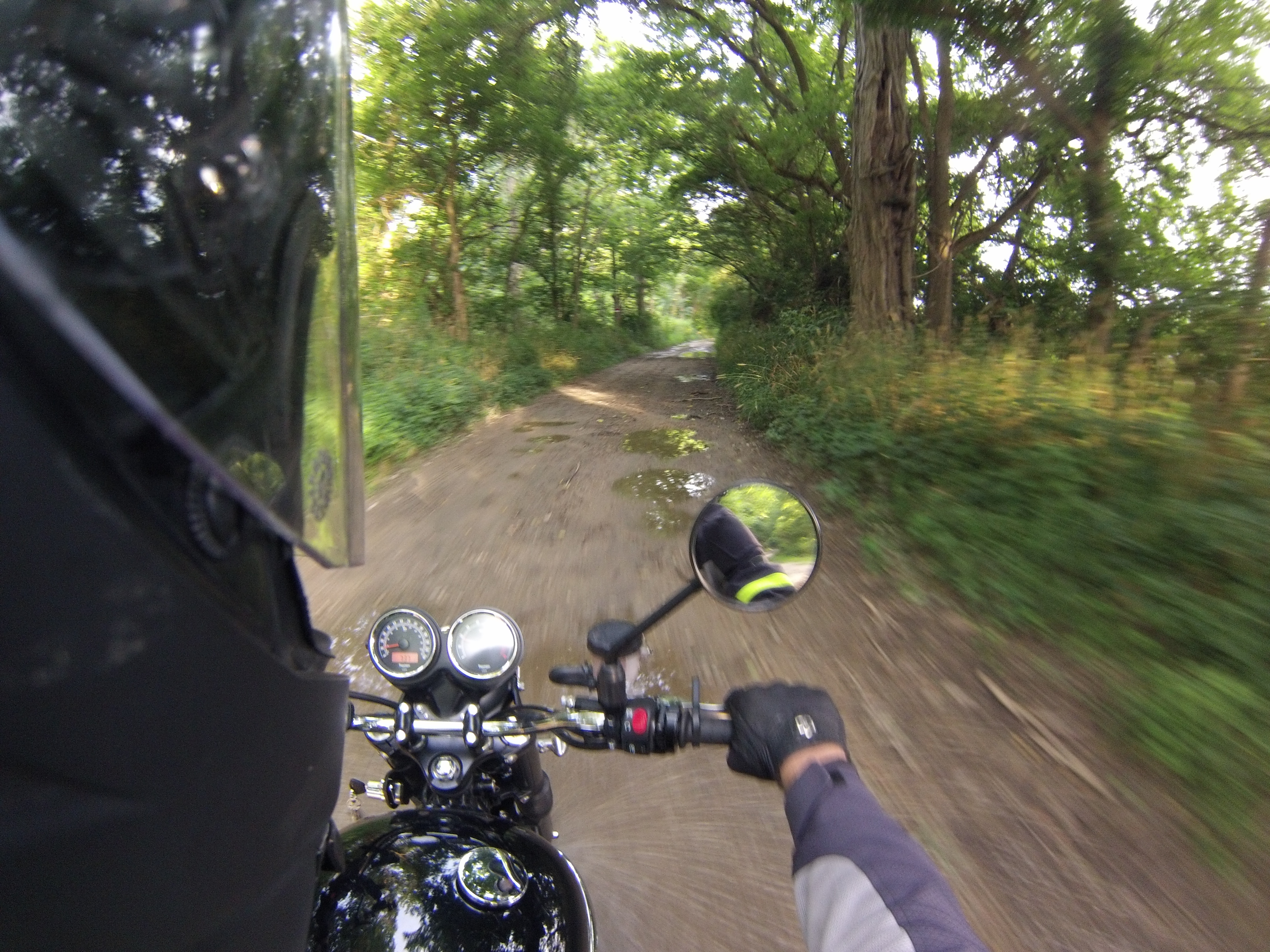
I wouldn’t go as far as to say I’m terrified of riding in the rain… but close. One of my goals with “the new bike” is to ride, rain or shine, whenever possible. The “rubber met the road”, as they say, yesterday on my way home.
I stand firm, if you want to conquer your fear of riding in the rain… you must ride in the rain.
With the right gear, mid-controls, good rubber, and a positive attitude, things are going well so far!
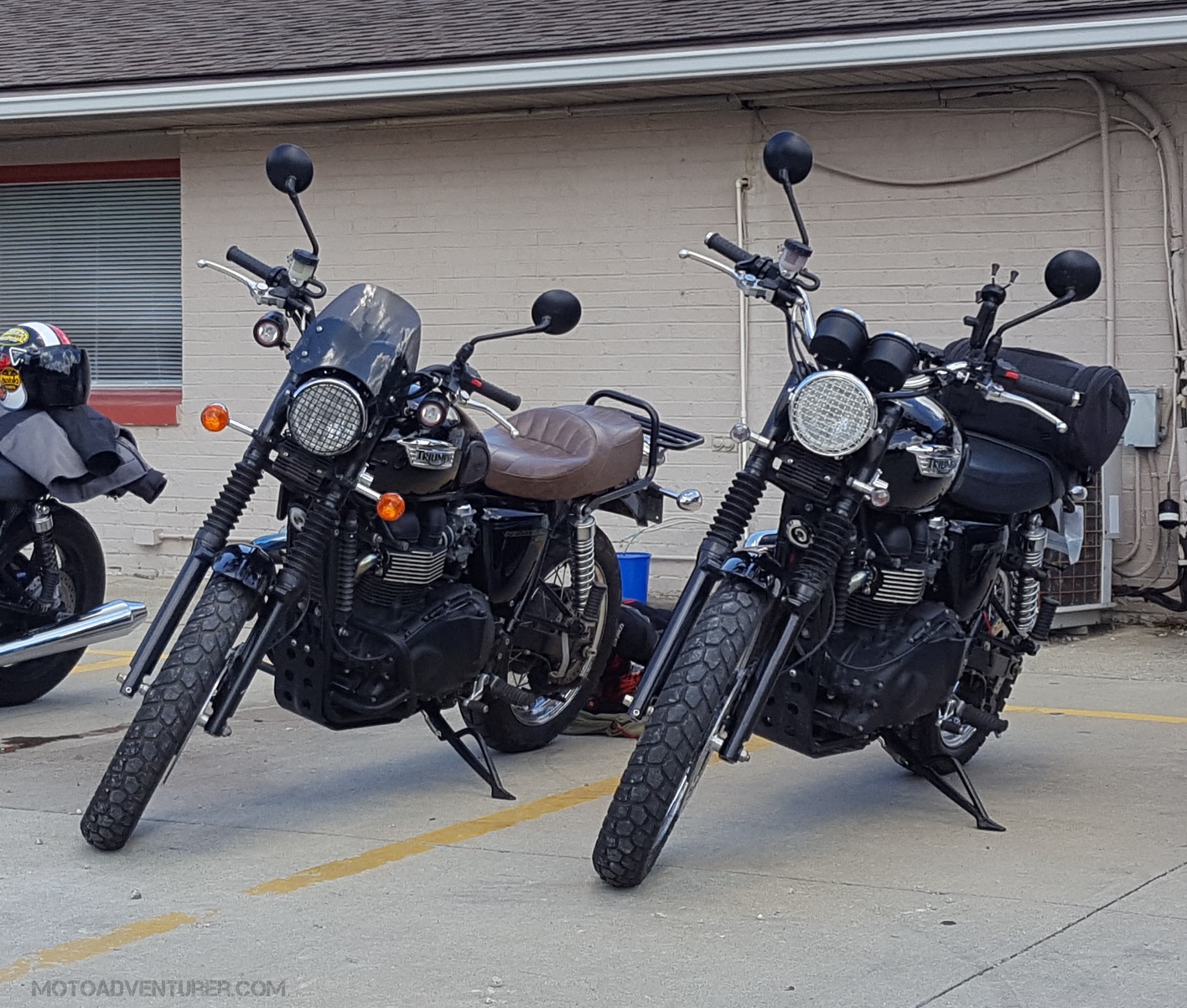
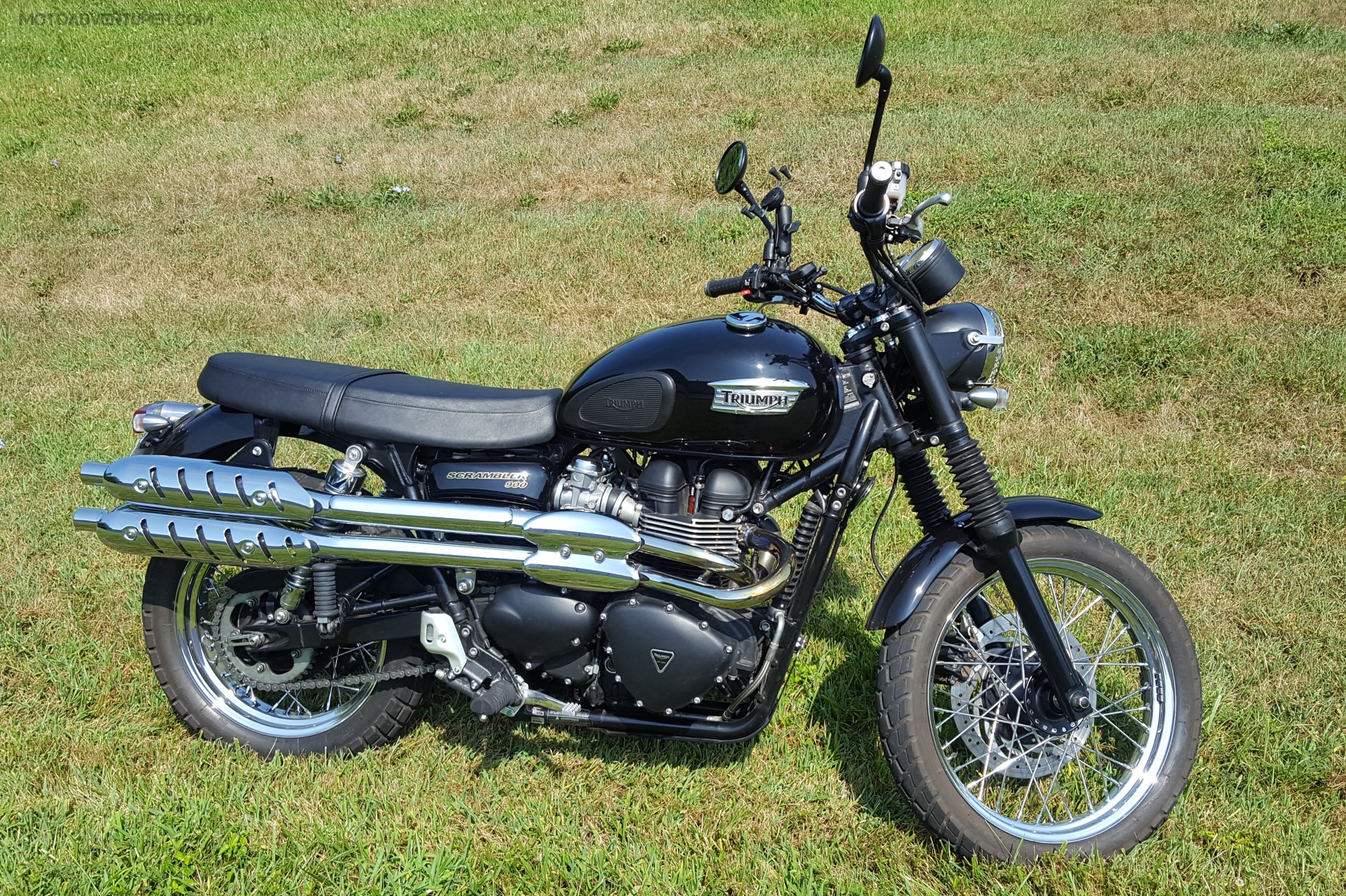
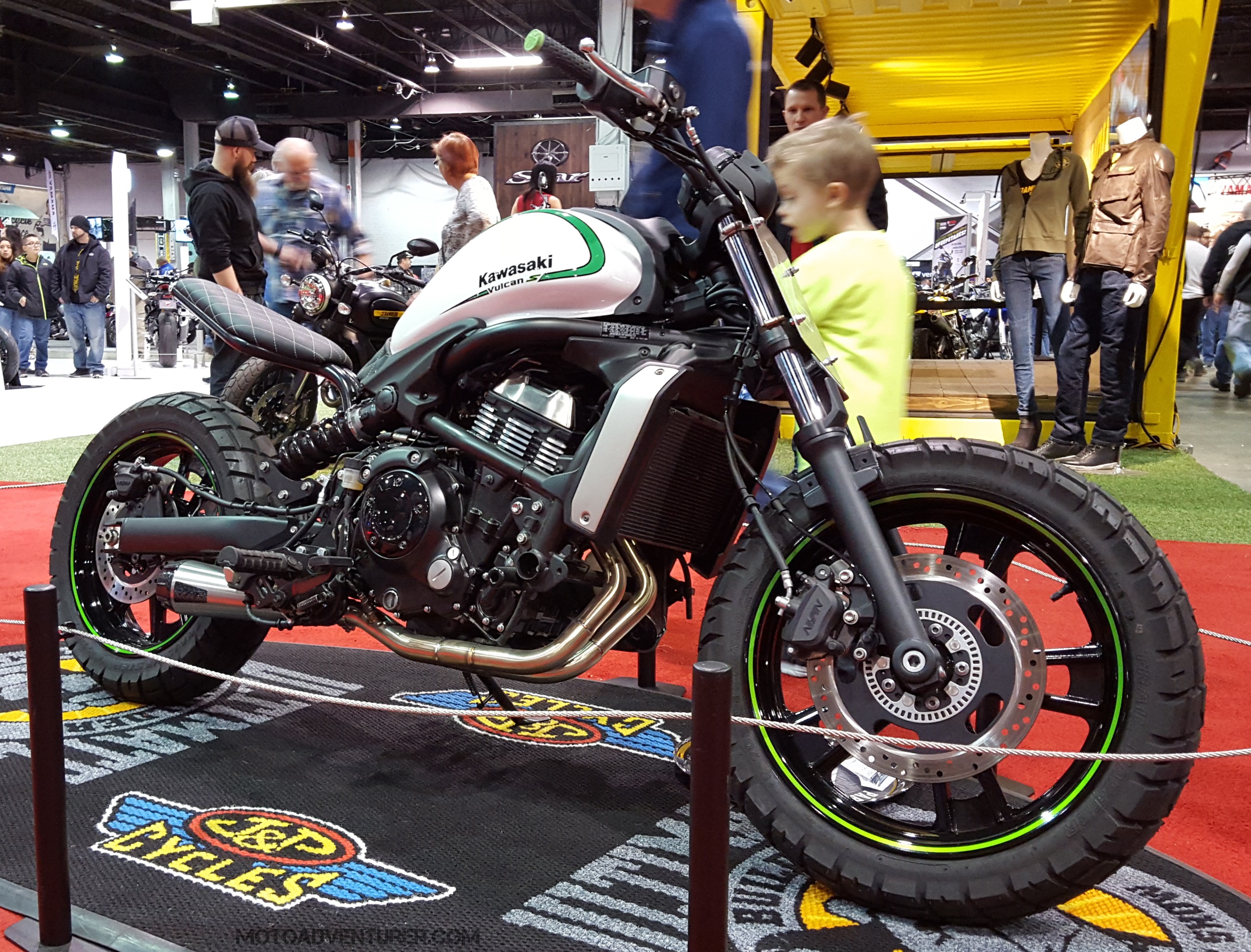
Right up until the last minute, I actually thought I was going to lean toward the tiger, but as I mentioned, in the end it just wasn’t meant to be. That’s not to say I’m disappointed, I knew going in that the Scrambler would do the job, and do it with “soul”, it just meant putting in a little extra work and throwing a little more money at it over time… enter the Scrambler Project.
Short-term Goals
There’s no denying that a stock Triumph Scrambler is a street bike. Not unlike the other Triumph modern classics and cruisers, it also comes shod with some pretty “budget” suspension. If I plan on turning this street bike into an adventure machine… a suspension upgrade is certainly high on the “to-do” list. For folks that haven’t heard me talk about it before, the folks at Canyon Motorcycles in California have a setup with Works Suspension to give the Scrambler (exclusively) a full 6” travel, front and rear, suspension upgrade. That’s going to be on the order of about $1,250 plus installation, but that’ll make for a good project in January.
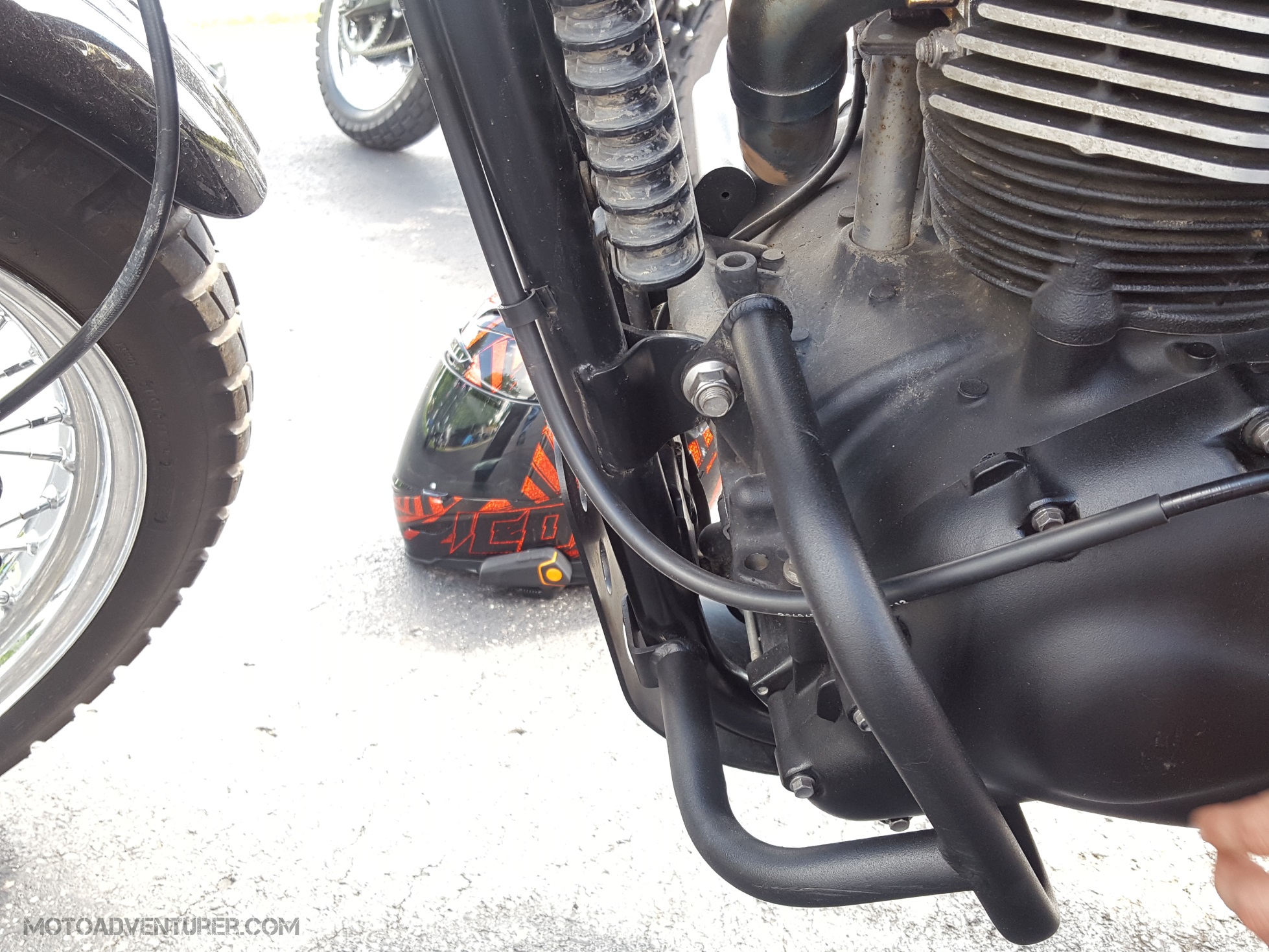
Aside from the “big ticket” suspension upgrade, engine protection is an absolute must. Triumph does fortunately make a (relatively) sturdy set of engine guards for the Scram, but based on what I’ve read (there’s a cult following on ADVrider.com), a minor modification may be in order to make them truly hardy enough to stand up to dirt riding. I’ve debated working on my fabrication skills with the help of a knowledgeable friend, but I may leave that for later down the road once I’ve got a few more dirt road miles under my belt (which is about 2 miles as of today…).
Having ridden the Speedmaster for such a long time, let me tell you, the stock headlight sucks… and the Scrambler’s isn’t impressing me thus far. With the goal of “rain or shine” in mind, visibility is also near the top of the list. From what I’ve seen thus far, I have healthy list of Denali products in mind to bolt onto the new Scram. If all goes well, I hope to have a two-wheeled zombie apocalypse assault vehicle; mounted with Denali D4 auxiliary lights and possibly the Dual DR1 headlight replacement kit.
The old-school Triumph Bonneville summer screen was included with the bike when I bought it. That was a nice freebie, but frankly it looked horrid on the Scrambler, and I felt like I was riding behind a barn door! As of now I’m going to hold on to it for a few and decide if I prefer a new flyscreen (buy or build, that is the question…) and sell the summer screen, or keep it for a really, really, long haul. I expect this year’s Dragon Raid will probably help me figure that out.
Luggage is a whole new conversation now; considering my Mad Maxian goals, aesthetics be damned at this point. That high pipe on the right side does add unique challenges, fortunately there are a few, relatively affordable, aftermarket racks available. Per my comments about ADVrider, there are some very impressive luggage solutions that folks have come up with, so it’s really a matter of build, buy, or both at this point. In the long run I think I want to have the option of hard cases (maybe some sweet ammo cans!?!?) and soft luggage. Thus far I’ve seen that the Kreiga Overlander 60 setup is ideal as it lets you mix and match 15 Liter dry bags with RotopaX fuel cans to extend the range (I found out about them in a good adventure story). I have big dreams of taking this bike to Alaska at some point; fuel and storage will be a “must”.
Heated grips are pretty much a given. I had Bike Master heated grips on the Speedmaster which were great until about freezing, at which point they couldn’t quite keep up. I’m hoping what I’ve read about Oxford Heaterz rings true and I can get a wee bit deeper in the cold range. At any rate, installing aftermarket heated grips is pretty easy, so it’s just a matter of putting them in the budget and spending an hour installing them.
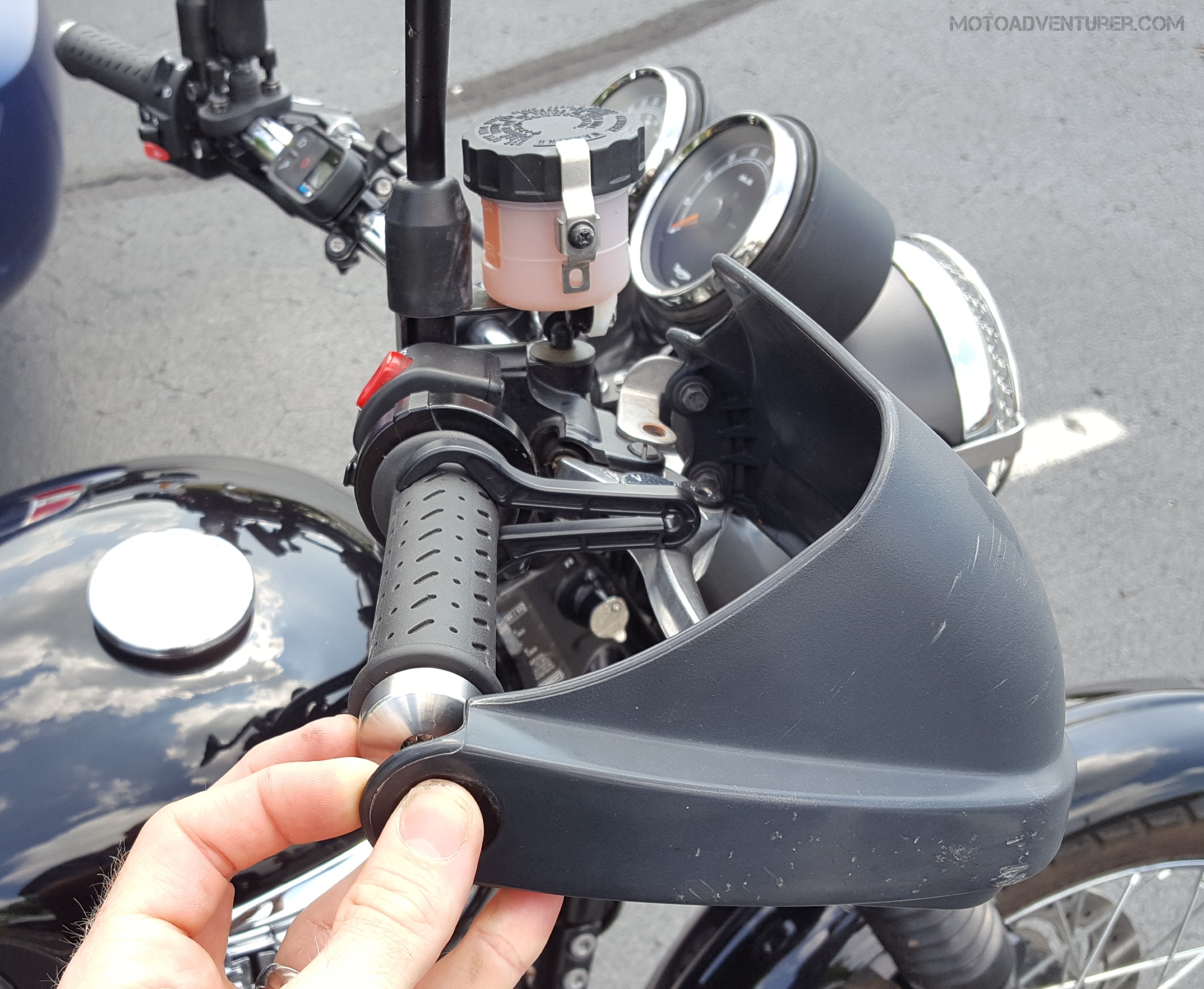
Along with heated grips, I also want to address the hand guards issue. A buddy actually lent me his hand guards off his Tiger 1050 for a few; I may draw them up and take a stab at having a custom set 3D printed, but we’ll see how that shakes out. There are actually a lot of affordable retail options out there, including turn signals, so I could potentially see myself getting lazy and going that route, but I expect I won’t get to hungry for that project until after it snows a few times.
I was actually impressed with the reach to the handle bars from day one, mostly that I can comfortably ride standing up (mandatory requirement for the “new” bike). That said, on the freeway the riding position does get a bit tiring, thus I’m going to hunt down a set of 1” bar risers. There are many solutions available commercially, including ROX risers that would permit pivoting the bars back a bit as well. This is a pretty small change, but a necessary part of the project.
Long-term vision
My end goal is obviously to build a low budget “Adventure” bike. The Scrambler is also a “classy” platform to build my Mad Max war machine… so there are some small aesthetic and some otherwise pricey items I would also want to bolt on long-term. At some point the rear fender needs to go; props to Rosie’s previous owner, the Lucas tail light replacement with solid indicators was a nice upgrade, but I’m looking to shed weight in the long run. I may also decide replace the stock mirrors with some lower profile bar end mirrors, at least for the summer; however I admit the longer I ride the Scrambler, the more that the taller mirrors are growing on me. Despite putting nearly 50k on the Speedmaster mill, I never fussed with new pipes or other engine upgrades; the Scrambler did fortunately came with Triumph Off-road Pipes (which sound fantastic), and long-term I can definitely see myself removing the air injection, and possibly upgrading to an Arrow exhaust. At minimum, the exhaust needs to find itself “de-chromed”; that’s happening one way or another. In line with making this Scram a dirt worthy steed, the rear brake caliper needs to find its way up on top of the swing arm, instead of hanging down in harm’s way as it is now. On the same note I also want to get some serrated pegs mounted; the rubber clad pegs are comfortable on the freeway, but I’ve already slipped off of them once in the rain. Really long term I’d like to fit some lighter weight alloy rims. Spoked wheels are a plus for the dirt, but having replaced a tube already, I’ve discovered these rims are bloody heavy. A tubeless spoked rim would really be choice!
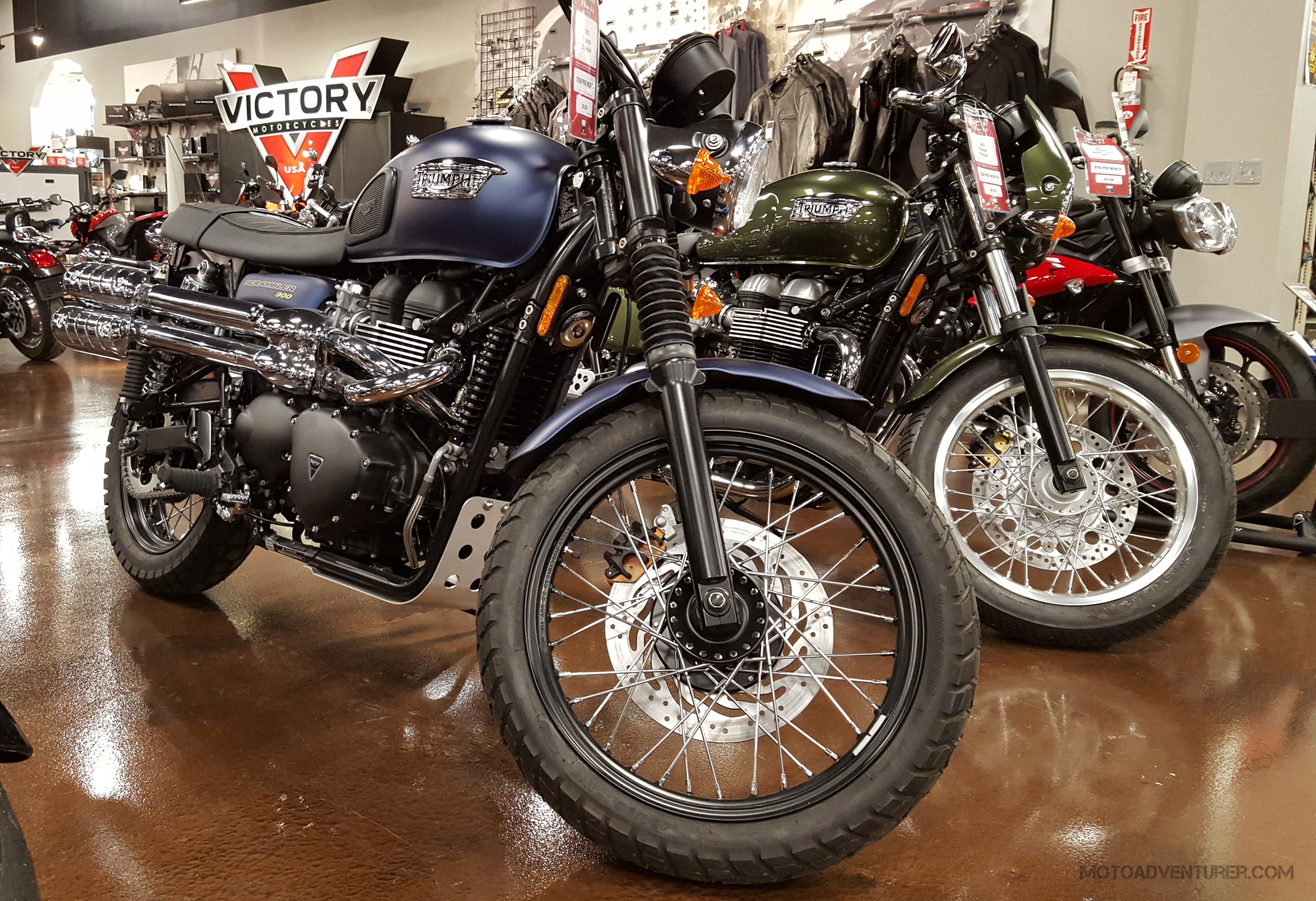
The day finally arrived. I asked for a few favors, stopped by the bank, and I bought a new motorcycle. I was on the fence for quite a while, but when the chips were down, I knew I wanted a multipurpose machine, and I needed a long term view on what would be the best tool for the job considering I have a one-horse stable. The Tiger 800 XCx (or XRx) would have done the job marvelously but that meant a commitment on my part that I was simply not okay with. Moreover, I have an unrelenting rebellious streak that answers “you can’t do that on a Scrambler…” with “watch me!”; so on Friday, Rosie followed me home.
15,000 annual miles means changing the oil at least twice and a valve clearance check. Obviously with a little practice, that task can be accomplished on the Tiger 800, but I already know the maintenance requirements, have all the tools, and trust the 865 mill. I’ve heard horror stories about the time needed to complete simple maintenance tasks on the Tiger (i.e. air filter change), which may just be hearsay, but I frankly don’t want to fart around with wrenching when I know I can be riding. In the end, the sheer stature of the challenge at hand (make a Scrambler dirt worthy), my concerns about reliability, and flat-out passion for the 865 twin carried the day, and 3 days in, I regret nothing.
If I hadn’t mentioned already, my cousin bought a Scrambler (not all that different from mine) this spring so I had a chance to ride it. My initial impression was that it was similar to my Speedmaster, but rode like a Bonneville, which is exactly what I was looking for. First day on the road (Saturday), the Scrambler brought torque in spades. Not all that different from the FZ-07 (obviously heavier…), the Scrambler does NOT have the top end power of a triple (or a four for that matter), but it packs a hearty kick in the ass through the twisties; so much so my face still hurts from grinning ear to ear all weekend.
Again, the Scrambler is by no means a sport bike, but the ground clearance is by far superior to the Speedmaster, so it’ll jump the curb and it leans over just the same. I can’t hang with supersports or enduros by and means, but I have a thing for underdogs, so the challenge of “keeping up” suits me just fine. One of my favorite movie lines is “I don’t care what anything was designed to do, I care about what it can do!” (Apollo 13). I assume it’s two years in the “sandbox” but I get guilty pleasure out of doing more with less; glutton for punishment I suppose.
How does that saying go; “Adventure is taking inappropriate equipment to out-of-the-way places”?
At some point I’ve heard most of my fellow bloggers talk about it; you’re absolutely drowning at your day job and in the struggle to tread water, the blog takes a backseat to life. A year and a half later… that moment has arrived. As of late I’m still slammed at the office, meanwhile I’m putting in a lot of overtime toward my charity of choice, along with trying to sell my bike. Considering the bike is for sale, I’m obviously not putting a lot of miles on it, and therefore not keeping up with my random roadside “foodie” responsibilities, but I think there’s hope on the horizon, for at least one of these commitments.
In the meantime, I figured I’d at least offer some candids from some recent stuff. A little moto-porn never hurt anyone…
A couple weeks back I stumbled across a random ad on social media about a Yamaha demo event in south Cincinnati. Considering my wife has also been putting in the overtime as of late, I decided to get up early and get down to the Queen City to test out some of Yamaha’s wares (6/25/16). More than anything I was stoked about finally getting the opportunity to ride the new XSR900, but after getting “signed-in” the Yamaha rep informed me that I was going to need to wait for a couple hours before a time slot was open for the XSR900. I wasn’t about to pass up a chance to ride Yamaha’s new modern throwback, but asked the gentleman if I could ride something else in the interim. As luck would have it, I was able nab a ride on the FZ-07, a bike that surpassed expectations.
I’ve covered a few bike reviews up to this point; as awesome as life must be as a professional moto-journalist, I’m beginning to understand how difficult it is to review a given bike, and not overuse words like “fast!”, “tractable”, and “Torquey”. I also think it’s very important to understand where the writer’s views are coming from. Obviously, my riding experience is more limited than most of the mainstream moto-media, so I tend to compare a given bike to my current ride, and to similar bikes I’ve ridden. I wish that concept was apparent with more of the media outlets, it’s a lot easier to tell you’re reading a puff piece when a given writer’s daily rider is a sister bike from the same stable (1200 GS…), or that a score of writers spend more time at track days than I do commuting to work (I mean, why else is the Panigale the greatest thing since sliced bread?). That said, this is coming from an entrenched Triumph guy on a parallel twin cruiser writing about a Yamaha sport bike; so… on with the review.
First Impressions
I’ve actually been eyeing the new FZ-07 for a while now, but until that Saturday, I had only appreciated the bike as another extension in the Yamaha range. At first glance, the FZ-07 seems a bit futuristic, with “stealthy” hard lines and modern styling. I assume all the aesthetics are run-of-the-mill with regard to naked bikes, so I take that in stride, especially since I’m a sucker for throwback, but my opinion, overall performance and function is what rules the day among modern naked bikes. I actually like the bright colors; while I normally prefer black and anything matte, the flagrant paint suits the FZ-07. Looking the bike over further, the dash display looks, like the rest of the bike, modern, and impressively large from what I could tell. The bike in general appears a bit tall, especially considering its 689 cc stature (more on that in a minute); when I think 700 I think 650 (ish) sport bikes and the Savage 650 (which is anything but tall). The seat at first glance was certainly on the “thin side”, with the pillion pad even more so; while I imagined ripping around corners on this lightweight machine, I did have some concerns about comfort on long days in the saddle. Throwing a leg over the bike as we readied for departure, I honestly didn’t know entirely what to expect in the coming moments. I knew the FZ-07 was a parallel twin, just like my current ride, but I had no expectations for road manners, electronics, or general “character” of the bike. At a minimum I had no doubt that the FZ-07 would feel lighter and stop faster considering its smaller displacement, naked bike status, and twin binders up front; all of which I was looking forward to.
The Ride
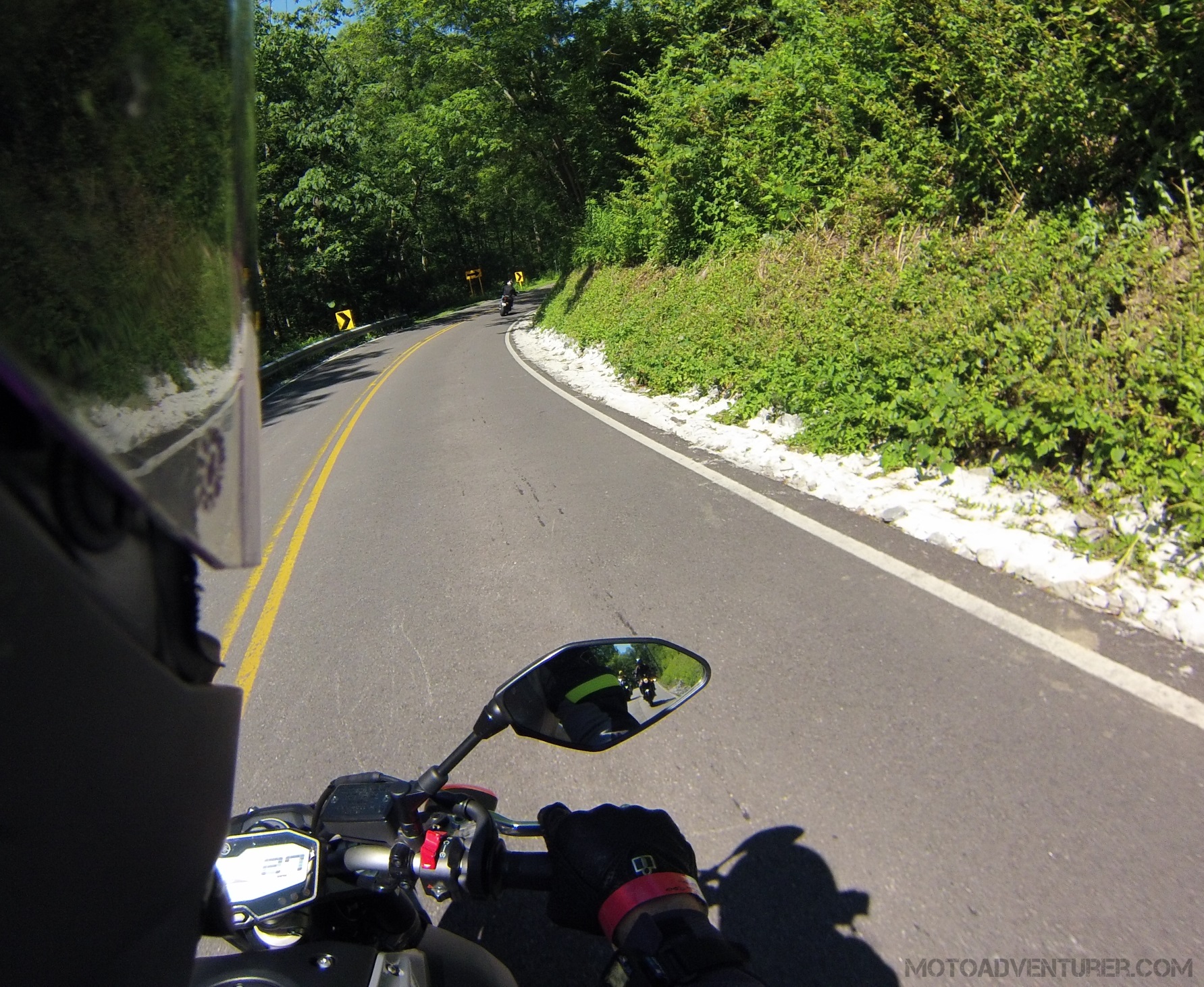
Leaving from the lot it was I rapidly discovered that the FZ-07 was significantly lighter than I expected; along with the upright riding position, it felt far more nimble than my current steed. I was immediately impressed with the clutch friction zone and overall balance of the bike; it was also impressively easy to drag the rear brake to pause at a stop without putting a foot down and not waver from the “heft” that you experience on heavy cruisers. In general, it was clear from the onset that the FZ-07 is just an easy bike to ride. What seemed like an enormous display proved to be quite agreeable once underway; the screen was very easy to read at speed, and included a large amount of information; speed, tachometer, MPG, gear indicator (nice touch as it’s cheaper than my current ride that lacks this feature), among others. Considering I was riding a twin with less displacement than I’m accustomed to, I was impressed by the mill’s rev happy nature, with a redline beyond my Triumph twin. As the ride progressed, I began to notice the distinct similarity in character between the Yamaha twin and that of my Speedmaster; albeit with better power to weight ratio. Acclimating to the cockpit, it became obvious that I’ve been accustomed to clunky cruiser controls for a years now. It was a somewhat difficult to adjust to what felt like microscopic controls on the FZ-07; I found myself honking the horn at least twice in attempt to cancel the turn signal. I assume that goes away with time, but this is also a preference thing; I’ve read other reviews complain about “clunky” controls. It’s a fine line I’d say; I prefer controls that I can actuate without taking my eyes of the road while not overly cumbersome.
As I mentioned, the FZ-07 “CP2” mill has more horsepower and revs higher than my 865 Triumph Twin (67 vs. 60 HP & 10k vs. 8k RPM). I consider my Triumph quite rev happy, and without fail the Yamaha mill delivers more of the same. The 07’s power plant also delivers a reasonable amount of torque considering its displacement; it also arrives early and in linear fashion as us road faring riders prefer. As the ride progressed I felt myself more and more impressed with the power delivery that you can really “feel” as bike surged out of the corners. I never felt like I was on the verge of a power wheelie, but I was quite subdued considering I was on a demo ride (where wheelies were strictly verboten). Just like the engine, the transmission was also on par with my Triumph. While I did miss an up-shift from 2nd to 3rd gear when we first set off, after that the transmission was very agreeable; I never found myself searching for a gear, including neutral. If I’ve not mentioned before, I tend to engine brake given the opportunity; again the CP2 mill obliged without protest and delivered predictable slowing power that I would expect. The FZ-07 is not sold with throttle by wire “ride modes” or a slipper clutch that are more available on some of its stable mates. This is non-issue in my eyes (again, considering price point), but as I attempted to “blip” the throttle to rev match when engine braking, I found it to be somewhat of a tough task to master in 20 minutes; I assume because of the overly lean throttle map, but I’m sure that skill would eventually be mastered with time. I imagine it would get even easier with an aftermarket exhaust and revised throttle map (sorry EPA…).
Considering I prefer engine braking, I wouldn’t be fair to say, in the interest of an honest review, that I truly tested the brakes . I can say that the overall stopping ability of the bike is better than my current ride, and undoubtedly takes less effort. I would need another look to feel comfortable saying that the sport bike, “two finger” braking method is possible, but it was definitely a lighter touch than I’m accustomed to.
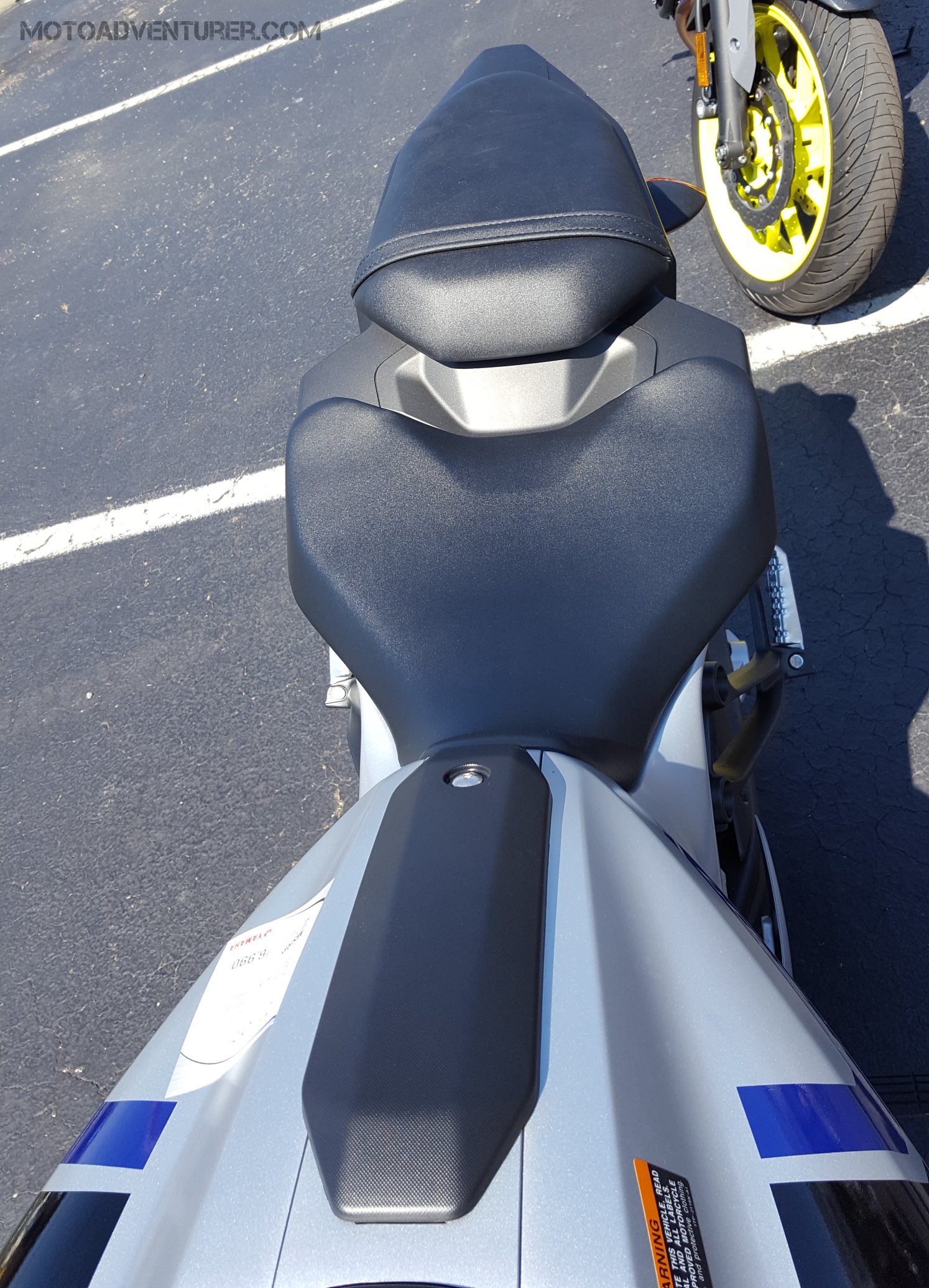
The seat proved to be a bit more comfortable than I expected, however it was only a twenty minute ride. Having a ridiculous amount of space on my stock Speedmaster seat, I didn’t quite know what to expect when riding the FZ-07. The seat is quite narrow on the front end and broadens significantly toward the back. On the road that translated to comfortably flat-footing the bike at stops, but I can see concern about getting uncomfortable in long stretches of hugging the tank when things gets sporty. I pushed back in the seat on the downhill sections of the ride; with the balls of my feet on the pegs, the riding position was comfortable, especially with the wider, more spacious section of the seat. The pillion seat didn’t seem to “arrive” too seen when scooting back, while it also served as a good support as I rolled on the throttle at the apex. At the same time, if my wife thinks she’s got a Spartan seat now, I can only imagine her response to the FZ-07 pillion pad. Beyond just the seat, I really liked how narrow the chassis felt overall; great for street riding and carving canyons, and probably even lane splitting in California, but I’m still curious how the narrow, lightweight frame handles the freeway on a windy day. In general I was really happy with all the ergos, especially considering I’m looking for more upright seating on my next bike, the FZ-07 has the leg room I prefer with the neutral mid-controls I’m looking for. Unlike the Roadster I rode a few weeks back, the Yamaha’s mid controls aren’t positioned exactly where you want to plant your feet at a stop, but a bit forward so it’s not awkward pulling up to a light. The bar height also felt ideal, but as the ride went on I did start to think like they were a bit narrow for city riding. I can see the narrow bars advantageous in the twisties, but long-term I would imagine I’d prefer slightly wider hand placement if I intended to use this bike as a daily rider.
There’s one serious advantage to test riding bikes in Cincinnati versus Dayton; in Cincinnati there’s actually some topography. After we escaped the straight stop and go city roads I began to notice that the FZ-07 suspension is far superior to my current ride. The 5 inch suspension travel could easily soak up the urban bumps but also felt very stable in the curves. I could potentially see the suspension feeling a bit plush for more aggressive riders or on track days, but it’s spot on for the average street rider, especially for the price point. The demo model was also fitted with Michelin Pilot Road 3 tires. Admittedly, I can’t currently mount sport rubber, but I have some friends that do, thus far I’ve heard positive things about the PR3s. Considering the limited riding we did, I certainly had no complaints about the tires, including how they handled some tiny spots of gravel in the road.
On the flipside, the mirrors were simply terrible; before we made the first turn I was trying to adjust the mirrors so I could actually see the riders behind me (it was a demo event after all…), to no avail. After twisting the mirror in every direction, I still had to lean over to see past my shoulder; No Bueno. I’ve seen countless comments about stock mirrors being crap on all kinds of new motorcycles, the FZ-07 is more of the same it seems.
It also wasn’t long into the ride before I noticed my ankles were getting a generous waft of engine heat (I also had armored, mesh, pants on). The more demo rides and whatnot I do, the more I realize I’m completely spoiled on my Triumph Twin; where I experience virtually no engine heat except on the hottest days. The FZ-07 is at least the second, liquid cooled, bike I’ve ridden that felt significantly “warmer” than my air cooled twin, but still nothing like a Victory. I realize this is all a fact of ergonomics and aerodynamics; it wasn’t especially bad, I just noticed it… and it’s really tough to fault this bike.
Gripes
Back at the dealer I stepped off the bike, snapped a few more photos, and started taking some notes. While not really a gripe, I do have concern about the 3.7 gallon gas tank I see on the stat sheet. Mind you, Yamaha claims this bike gets 58 MPG, which doesn’t seem too bad, but obviously I have no idea if that’s legit. I do however know that the heads up display tells you when you’re in “ECO” mode, hopefully sipping the petrol as advertised. Without question, the mirrors desperately need attention. I also have no doubt I’m not the first person to notice the dragline the FZ-07 is pulling behind it; I can’t tell if that tail-light-indicator-license-plate-bracket “thing” was designed that way on purpose or some sort of engineering afterthought. I suppose if it didn’t overtly draw attention to itself it wouldn’t be all that bad, however the indicators bounce all over the place once underway, and it just looks awful (I was also following an FZ-07 on the ride). The Headlight also appears a bit anemic… to say the least. Obviously it was daylight during the ride, so I have no idea what kind of light it throws down the road, but it’s a concern I have. I realize this is not Yamaha’s fault, but there’s a massive catalytic converter hiding under the frame; I imagine that would be quick weight savings when you switch to an aftermarket exhaust. I also find the lack of ABS to be somewhat a disappointment; I have a suspicion it’s standard on the bikes in Europe, but a cost savings here in the U.S. It’s not a deal breaker, but for any every day, rain or shine, commuter, it would be a nice addition. Lastly I have some concern about adjusting the chain. Obviously, I haven’t owned a fleet of motorcycles, but I’m no stranger to adjusting chains and belts; something about this adjuster set up seems “new” or cheap… I’m not sure which. Why would it be any different than the FZ-09 setup?
The Competition
I’m not going to claim to be some expert in the mid-range naked bike field. That said, I suspect that the FZ-07 is probably in direct competition with every mid-range naked bike, and pretty much every mid-range bike a prospective “new rider” is looking at in order to avoid purchasing a Rebel 250 that they’re just going to sell next year. As a guy currently riding a 900 cc cruiser, the FZ-07 brings enough grunt to the table I could foresee it making a direct replacement for my current ride. I would probably need to figure out some gear for a touring setup, but with bags, fly screen, and comfy seat, I think it’s up to the task for anyone looking at middle weight bikes. I’ll even go out on a limb and suggest the FZ-07 is indirectly competing against the new Street Twin, Ducati Scrambler, and their ilk; assuming that “retro styling” is not a box on the buyers checklist. I’m also sure I’m not the first to say, for guys like me, the FZ-07 is competing against its sister the FZ-09; bang for buck matters.
Closing thoughts
Pulling back into the lot I was disappointed the ride was over. For an “entry level” bike… I hate that expression… Considering it’s displacement, I was really impressed. I initially suspected that I might find the bike a bit boring and under powered, especially after I rode the XSR900; far from it. In general, the FZ-07 was pleasantly light weight, nimble, surprisingly torquey (yes I said that, but it’s true), and had very manageable throttle response. It also had “character” that grabbed me, something I can’t say about at least one of the other bikes I rode that day. Undoubtedly the bike lacks considerable creature comforts available on its larger stable mates (ride modes, ABS, etc.), but again, considering the price (under $7k), there’s plenty of room for customization and superior aftermarket parts, like new front fork springs and emulators if that’s your thing.
If it hasn’t been overly obvious, I am absolutely slammed at the office and at home right now. I’ve unfortunately not been able to spend nearly enough time “adventuring” as I would normally. Along with that, I also suspect that the time has come that my trusty Speedmaster (Lola) and I part ways. Under different circumstances, I would probably keep her, but as I’ve mentioned, I have a one horse stable at the moment, so any inkling to keep the Speedmaster simply gets trumped by lack of real estate.
That said, at what point does a rider make the decision to switch? I find myself as somewhat of a non-traditional motorcyclist (in so many ways…), I didn’t start riding until I was almost 30, never rode a dirt bike, and I also started out on a 150 cc scooter so my first motorcycle was technically a 900 cc two-cylinder. I won’t say that “most riders” start out on 250 cc bikes, but I’m sure a fair number do. Similar to the scooter, I imagine most folks are ready to jump ship off their “learner” bike in about a year. My non-traditional story includes the caveat that my scooter couldn’t do freeway speeds, so my riding habits were severely limited by capability. That considered, moving to a manageable 900 cc bike was a no-brainer at the time, considering I spent two years (and about 3,000 miles) on my first ride. I guess the first to second bike transition is pretty cut and dry (for many), but what about “the next bike”?
Undoubtedly, many prospective buyers probably make the switch when financially prudent, especially in the U.S. considering that motorcycles are viewed as toys. The financial side is obviously a private ordeal, but that topic also spurs the whole “new vs. used” argument. Similar to deciding what and when, new bikes vs. used bikes is heavily debated. Some folks just love the “new car” smell, while others are frugal and recognize the premium you pay for a “new” motorcycle and its warranty. Without getting into a dissertation about “opportunity cost”, I see pros and cons to each, so it’s really about what you’re shopping for. In my case, I have somewhat a “niche” taste; which means that sometimes new and used prices aren’t that far apart, so paying a bit extra to avoid inheriting someone else’s “problems” has value. At the same time, purchasing used typically means you’ll have more cash in your wallet to spend on all the fancy farkles you may want. As it stands right now, both offers are on the table, but that means doing a lot of homework, potentially traveling to buy a bike, dealing with out of state titles, and in all likelihood, some haggling.
When the time is right (and there’s cash burning a hole in your pocket), are you “upgrading” to a “bigger” bike? If someone told me that they love riding motorcycles, but didn’t really enjoy the “power” I would be stunned. “Power” is not everything, it’s not hard to ride beyond your ability on a 600 cc 4-cylinder, but there’s no denying I love the feeling of being pushed back in the saddle when I roll on the throttle. I However, assume I’m getting old, I don’t lust after a liter bike or a big bore “Bagger”; in my case I assume I’ll either be in jail riding a Panigale (if not dead), and just don’t feel the allure of the big bore V-twins (there’s a lot more to that, maybe I’ll explain some other time). At an rate, in recent days I’ve been asked if I plan on “upgrading”; I’ve told most people that I’m “transitioning” to a different kind of bike, not necessarily “upgrading”. Again, this may be an American thing (is bigger really better?), but it seems to be a given folks get larger bikes as they gain experience.
At some point, do you just get bored with your current ride? I’ve been debating another motorcycle for probably the past year. I can think of many reasons why “it’s time”, but initially I didn’t consider “boredom” a reason. I suppose that after putting thousands upon thousands of miles on a bike, you feel as though you’ve mastered it. That’s probably why you sold the first bike right? Writing this, thinking about it just now, yeah, boredom probably does play a small role. I do however, have a healthy fear of the “grass is always greener” effect, so I like to think that boredom alone is not a prudent reason to buy a new bike, but I have a strange feeling it happens every day.
Do you ever just see a bike you “have to have”? Passion is, without fail, a concept that motorcyclists understand. I don’t think that, at least in first world countries, riders would be riders if not for passion. What sane individual would forego safety for the open-air thrill of riding an internal combustion engine with wheels? Despite all other logical reasons to switch bikes (or purchase another), at some point a given machine speaks to your soul. Like a true engineer, I even plotted out a pro-con matrix on the back of a napkin for what bike I really need. Over some beers my buddy Jeff, we considered maintenance, brakes, performance, and he says, “don’t forget a category for soul”, and “that category will probably carry the most weight”. The engineer in my head says that’s silly, just buy a motorcycle like you would buy a tool, every bike has a job. Easier said than done; meanwhile I’m plagued with the fear that sometimes “wanting is better than having”.
Do you find that your taste in riding changes over time? “It’s a great bike, you’ve just outgrown it”, I honestly never believed I would hear those words. In the beginning I lusted after the matte black paint and the subtle chrome effects. My wife says the Speedmaster is simply “voluptuous”, I couldn’t agree more. To this day I am undeniably in love with the way my bike looks, I still stare at it parked in the lot. I am not however in love with its lack of ground clearance and lean angle; therein lies the rub, form and function are almost diametric opposed. What did you learn from selling your first bike and buying your second? Never in a million years would I have imagined putting over twelve-thousand miles on a motorcycle in one year; if it’s your first motorcycle, knowing nothing about your taste, how do you plan for that?
I guess in the end, I’m fishing for wisdom from the masses, when is it time to move on? What did you learn from your first (ish) motorcycle? How did that effect what you chose as a replacement? And lastly, do you wish you still had a certain bike?
At some point you’ve walked out to the bike, turned the key, thumbed the starter button, only to be met with the dreaded “click click click” of a dead battery. I actually went through this several times before I started the blog last year, but that was before I kept photographic evidence of my maintenance habits. A while back, a buddy sent me a text, asking for a quick run-down on the best way to replace the battery on his ride. He has one of Lola’s sisters, the Triumph America, so I only felt it right to head over there and give him a hand.
For experienced folks, a detailed narrative on changing a battery is probably a snooze, but I figured it would be a service to the Triumph masses to offer up a few photos and whatnot because there are a couple nuances to the Triumph cruisers. On the flip side, for folks that want to save a couple bucks, changing a battery comes right after adjusting a chain as far as “entry level” Do-It-Yourself Moto-Maintenance.
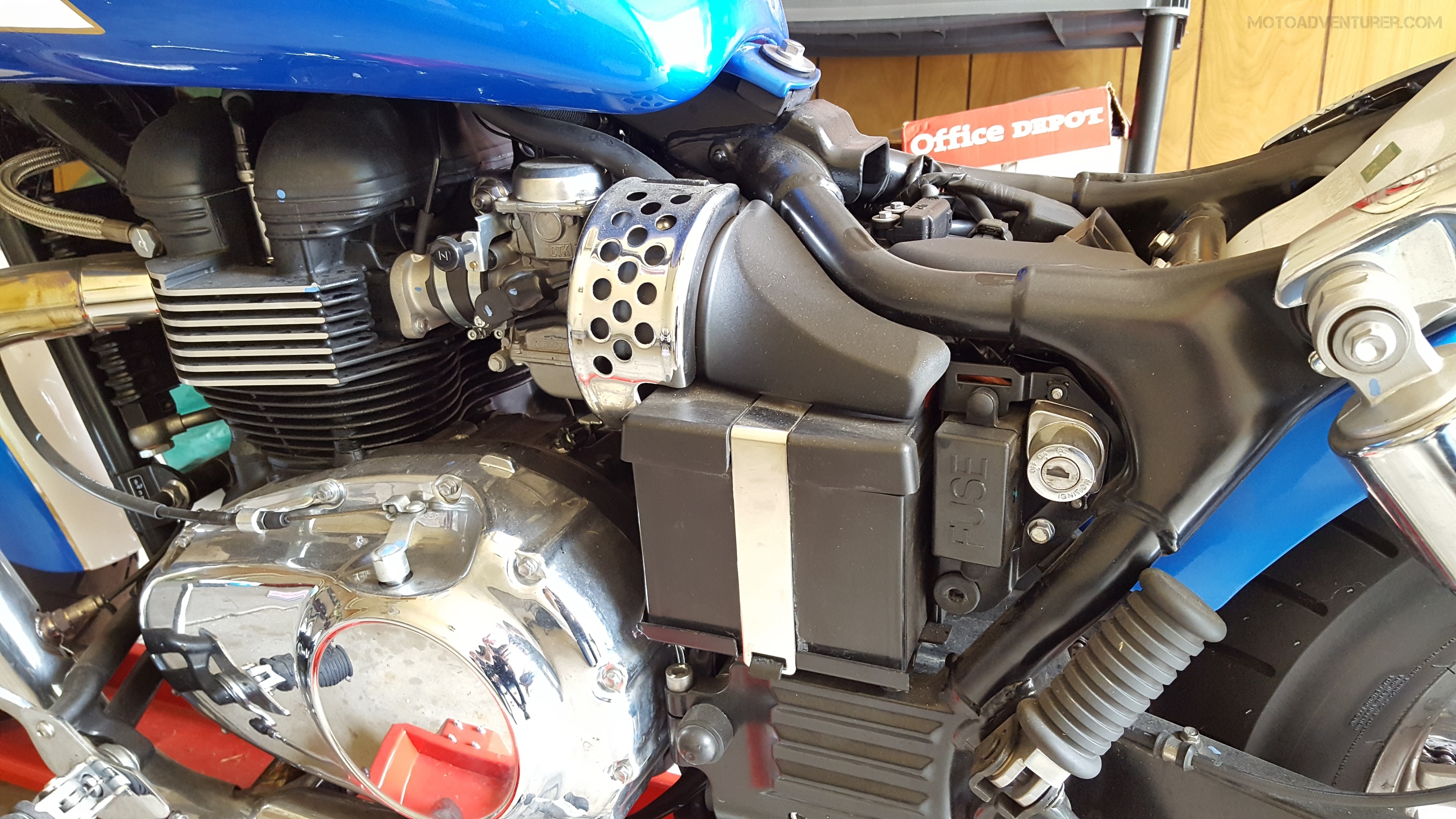
For whatever reason, Triumph decided to hang the battery off the left side of the America and Speedmaster models, instead of under the seat like the Bonneville (I suspect that helped make the seat lower?). At the same time, Triumph covered up the battery terminals with not one, but four covers. While installing my heated grips a couple years back I got a crash course in what it means to get a battery out of its cozy cradle.
There are a couple ways to skin this cat. Provided the battery is actually dead (i.e. you have proven it’s not the “alternator” and it won’t hold a charge), I’m of the mindset it makes the most sense to remove the battery, toss it in the trunk (riding in a car… snooze), and go find a suitable replacement battery. You can also stop by a local dealer and take home a new battery on your way home from work. There are perks to both ways, but I’ll come back to that.
Getting started I recommend taking off the seat, you don’t really need to, but it’s one bolt, and it’s easy. For folks unfamiliar, underneath the fuse/ignition cover there’s a hex-key that can disassemble half of your Triumph. To remove the ignition cover, gently pull the bottom of the cover toward you. The cover it held in place by a knobbed post and rubber grommet on the bottom and a tab and slot on the top. I say “gently” with emphasis, I broke my first one pulling it from the top, not realizing it pulls loose from the bottom ($14… it wouldn’t hurt to have a replacement on hand, more on that later). As I mentioned, on the back side of the cover you’ll find a hex key that fits most of the button head screws on the bike. Use the hex key to remove the retaining bolt on the rear fender that holds the seat down. With the bolt removed there is a pull string hiding on the bottom side of the seat the releases the seat lock so you can pull up on the seat. The tongue of the seat sits just under the gas tank, so pull slightly up and out to remove the seat.
With the seat out of the way you need to remove the “faux” carb intake cover. With that same hex key, you need to remove the button head screw on the bottom of the chrome cover. The cover also has a tab and slot mounting arrangement, so lift up gently to remove. If you like to keep your chrome shiny, I recommend setting these covers aside in a bin or on a soft cloth. This is also a good time to shine them up; some of the surfaces are tough to get to when they’re on the bike. With the chrome cover removed, there’s an additional plastic cover that needs to be removed to get access to the battery “strap”. This cover has two button head screws on the left side that were concealed by the chrome cover. Once removed, there is also a post and grommet attachment on the right side above the battery. Like the ignition cover, a firm but delicate pull should pop that cover off the bike and expose the battery retainer (“strap”).
With the last faux-carb cover out of the way, dig around in your tool box for the dreaded “Torx” wrench. I suspect it is a T27 or T30 Torx bit, but since I don’t have one, I don’t actually know. I have (thus far) successfully applied the proper force and torque with a conveniently sized screw driver and removed the battery without stripping the Torx screw. Why manufacturers insist on having three and four different types of fasteners is still beyond me, especially for something as “routine” as changing a battery. At any rate, once you’ve backed out that Torx head screw, you can remove the chrome “strap” and subsequent black plastic battery cover.
Completely uncovered, from here you can jostle the battery part way out of its cradle to remove the leads. A couple of Philips screws (or 10mm socket) and you’re home free. Be advised, by what seems to be “manufacturer standard operating procedure”, the positive (red) battery lead is just barely long enough to reach the battery once you start to remove it from the cradle. If you have big plans of installing any other electrical bits, it’s going to be a bear to get the battery settled back into the cradle. That said, this is probably an ideal time to install a pigtail for a battery tender since you’ve already got the battery out of the way. My buddy and I both experienced what I consider premature battery failure because they weren’t properly maintained while the bikes sat idle. Considering my car sits outside all winter and runs just fine, I never thought about keeping the bike on a tender year-round; I’ve been harshly converted after spending $100 on a new battery. Fully charged motorcycle batteries are happy batteries.
At any rate, if you decide to hook up a battery tender or a fused electrical junction box etc., as I mentioned, this is a prime time for that. You’ll also need to remove an EFI sensor and cover that are next to the air intake (under the seat) to make space for additional wires etc. I have my heated grips and battery tender both wired in and tucked in under the seat. If you’re tackling this task, you’ll need to disconnect an EFI sensor to remove the cover; make sure you have the bike ignition off before messing with any of the EFI connections. If the ECU is on and a sensor is unplugged the bike will throw a check engine light for three engine heat cycles until the sensor is “replaced” (the bike must be cold, then up to operating temperature and cold again three times).
Regarding battery selection, as I said, I prefer to take the old battery with me and go shopping. When I replaced my old battery, I found a compatible Duracell battery with increased cold crank amps (those come in handy during the winter). That wonderful Duracell battery was not only just a hair larger than the stock cell, but it was also gray instead of black. If you hadn’t noticed before now, the outside of the battery is exposed to the elements, a gray battery on my flat black ride was less than ideal. I dealt with it for a few and found a cheap piece of black automotive vinyl on amazon; problem solved. As I said, there are perks to each method (shop vs. buying from the dealer), the dealer will probably get you a black replacement that you know will fit; that said, I did have a little trouble getting the new battery settled into its harness, I suspect there was still a subtle size difference between the factory original and the OEM replacement.
Depending on where you get a battery it may or may not be fully charged. In this case, the OEM recommended battery requires installation of the electrolytes and charging before you can get back on the road. It would behoove of you to get a replacement battery on hand, pour in the electrolytes, and then charge the battery overnight if you decide to go this route. That route was the way I went with my scooter way back when, but when Lola’s battery gave up the ghost, the place I bought the battery from actually pre-charged the Duracell I bought so I was back on the road the same day; just one more thing to keep in mind.
At any rate, with a fully charged new battery back in place, the covers obviously go back on in reverse order. I’ve spent significant amounts of time, not only on my bike, but also on my buddy’s bike getting the battery to sit properly in its home. Based on the warping I’ve seen on the backside of the original battery, I suspect the plastic “gives” a bit overtime; you just have to fuss with all the short cables and fight the screw back into place. Once all the covers are reinstalled and the seat’s back on, you can put that trusty hex key back in its home behind the ignition cover. As I mentioned earlier, be careful removing and reinstalling that hex key, after a while the plastic “keepers” wear out and the hex key won’t stay on the cover anymore.
For folks that follow me on Instagram, it’s probably no secret that I have numerous hobbies and dabble in a few… “gentlemanly” things. I’m by no means an expert on these topics (few are from my perspective), but I obviously love craft beer and a fine wine. I’m currently developing the taste for a good bourbon (getting in touch with my Kentucky roots), and I occasionally enjoy a good cigar. Alcohol and tobacco can be a sticky subject for some, if that’s not something that strikes your fancy, I’m sure I’ll be returning to your regularly scheduled moto-media in short order. For those of you that partake in the “finer things in life” here’s my two cents.
A few days back Anthony, from Cigarscity, contacted me and asked if I would be interested in offering my opinion on a few cigars. As a guy who like to try new things, I wasn’t about to pass up the opportunity. While I have smoked cigars for over a decade, (I took a little hiatus after being overseas) more recently social occasions, and shockingly motorcycles, have spiked the interest considerably.
The Stick
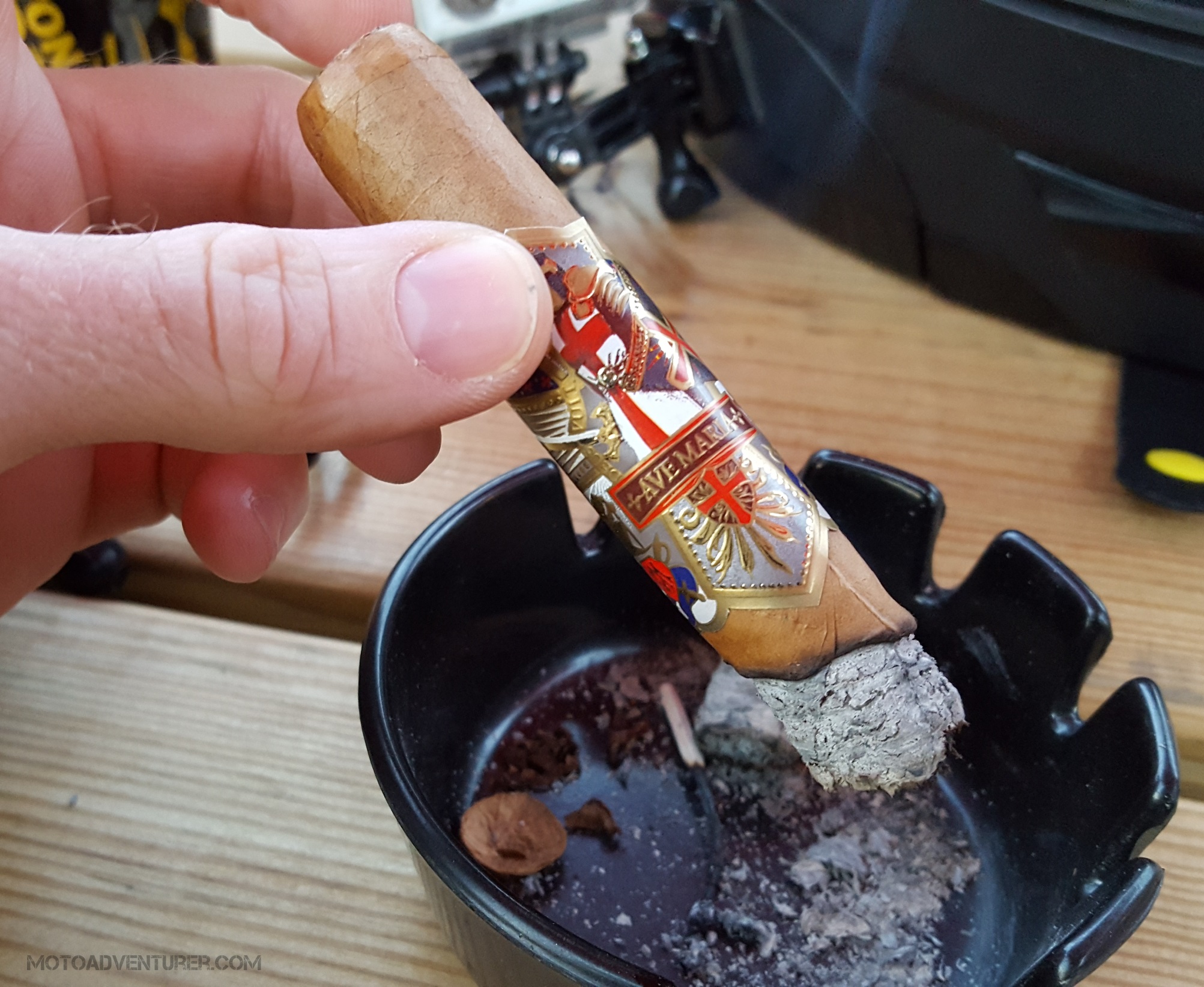
The first cigar on tap was the Ave Maria Immaculata (Toro, 6” x 50). The Immaculata, from the Tabacalera Fernandez factory (A.J. Fernandez Cigars) in Nicaragua, is made with Nicarguan fillers, Nicaraguan Habano binder, and is wrapped with an Ecuadorian Connecticut wrapper.
First Impressions
The Immaculata is a two banded cigar, with really catchy branding. Like wine, in my opinion, cigar labels don’t tell the whole story, but the Ave Maria logos and embossed bands are really classy. The cigar felt pretty light in my hand and unlit I detected mostly mild aromas of straw, otherwise “grassy” scents. The wrapper quality was well done, with the veins very clearly seen in the Connecticut wrapper. After cutting, the pre-light draw was very smooth; I actually cut this cigar, whereas I typically use a punch. For whatever reason, I actually prefer a slightly tighter draw, but there’s give and take with that depending on the cigar and your own personal preference.
The Toast
The Immaculata was really easy to get lit and started out very mild. The first few puffs offered mild to bordering on medium “body” tastes and flavors. Initially I did detect a very subtle “pepper” flavor, but still subdued. The smoke was light and very inoffensive. To me, the first third of the cigar was mostly more of the same “grassy” tones related to the pre-light impressions, not bad, but somewhat unremarkable.
Considering the easy draw and otherwise mildness of the cigar, I was impressed that the ash held on for about an inch and a half before falling off. Moving into the second third I began to catch a very subtle vanilla taste for just a short second. Midway through the second third I began to feel the heat start to build with each draw. For me, one of the best parts of a cigar is the smoke aroma and the crisp sound of tobacco as it burns with each puff. I personally don’t enjoy the taste (especially after) so much as the olfactory stimulation (acquired taste I’m sure). That said, as the heat starts to become more prevalent, I find that starts to heavily impact the taste, and often in a negative way, but that’s just me.
Through the second third I began to notice the first tingle of nicotine emerge, nothing obtrusive, just a mild pleasant experience. Along with the heat the draw started to open up more and more as the cigar burned down. About halfway through I noticed the burn line was getting a little un-even, but the cigar had no problem staying lit, so no issue there. Into the last third the body started to pick up some; the overall aroma was still very good, but the taste started to get a bit “ashy”, as I said, probably correlated with the heat.
Closing Thoughts
Start to finish the Immaculata lasted for over an hour and a half; significantly longer than I expected, especially after noticing the light weight, Connecticut wrapper, and easy draw. Overall I didn’t feel that the Immaculata was particularly complex; simply mild, consistent, and in no way offensive. Throughout the smoke I had a tough time putting my finger on a distinctive taste & scent, after the fact I think a detected a subtle “nutty” trace. At the same time others have described tastes of wood, leather, cream, and nutmeg. Admittedly my palate is simply not that refined, but all in all it was an excellent mild smoke for folks leaning in that direction. I think my personal preference would have me searching for something a little darker with a bit more complexity, but for anyone just getting into cigars or just looking for a mild mid-afternoon cigar the Immaculata is an excellent choice.
I bet it doesn’t take five minutes for motorcycles to come up in conversation between me and a stranger. As many readers here probably know firsthand, after discovering that I’m a motorcycle enthusiast, I’m often met with comments like “I just don’t think I could ever ride a motorcycle; with everyone texting and driving, drivers are too distracted and motorcycles are already dangerous”. I’m not going to discount that many drivers are less than attentive to the road, and while motorcycles are inherently more challenging than cars, I don’t think prospective riders should sell themselves short, motorcycles may not be as dangerous as you think.
Someone right now just read that last sentence and said “What do you mean they’re not dangerous!?!!?” followed by “statistics show that you’re 30% more likely to die riding a motorcycle than riding in a car”. Statistics are fun things to discuss, and the discussion can have merit, assuming you understand what conclusions you can draw from statistics, and what is still undetermined. Let’s talk about a few (United States) National Highway Traffic Safety Administration statistics for 2013 shall we?
Of registered Non-Motorcycles, there were 28,051 fatalities and 2.2 million (reported) injuries.
Of those 8.4 million bikes (3% of all registered vehicles), the NHTSA claims that only 20.3 trillion miles were traveled on those motorcycles (2,423 miles on average; 0.7% of total miles traveled by all registered vehicles).
4,668 motorcyclists were killed on 2013, while an estimated 88,000 were injured.
Of the 4,668 motorcyclists killed, 269 were passengers.
That year motorcyclists made up 14% of all traffic fatalities, 4% of (reported) traffic injuries, while only 3% of all registered vehicles.
Of 2013 motorcycle incidents, there were 2,182 two-vehicle fatal crashes involving a motorcycle and another type of vehicle (47%).
In 42% (922) of these (2,182) crashes, the other vehicles were turning left while the motorcycles were going straight, passing, or overtaking other vehicles. Both vehicles were going straight in 456 crashes (21%).
In 2013, 34% of all motorcycle riders involved in fatal crashes were speeding. (Note: The NHTSA considers a crash to be “speeding-related” if the driver was charged with a speeding-related offense or if an investigating police officer indicated that racing, driving too fast for conditions, or exceeding the posted speed limit was a contributing factor in the crash.)
25% of motorcycle fatalities were unlicensed riders.
19.6% of motorcyclists killed had prior speeding convictions.
17.9% of motorcyclists killed had prior license suspensions or revocations.
55% of motorcyclists killed were over age 40 (42 was the average age of all riders involved in fatal accidents).
California, North Carolina, and New York rank 3rd, 4th, and 6th (respectively) among states with the most motorcycle fatalities in 2013, all three of which have universal (mandatory) helmet laws.
Lastly, in 2013, 4,735 Pedestrians were killed, vs. 4,668 motorcyclists.
Based on these statistics it seems very clear that if you don’t have a license you’ll most certainly be killed while riding a motorcycle… and it should also be illegal to purchase a motorcycle after your 40th birthday…
I think it’s apparent that the above statistics have led people to some less than accurate conclusions. Per miles traveled and as a percentage of overall “highway” fatalities, it is true that motorcyclists make up a disproportionate part of overall fatalities, however there are points ignored by simple numbers and other data that is not collected. I understand the intended premise of comparing motorcycles to cars based on average mileage, however I think that ignores that fact that in the United States motorcycles are essentially treated as toys. A large proportion of the U.S. population commutes to work every day in a car (about 10,000 miles annually for me, just going to work), while some riders only get the bike out on Sunday, and only when it’s sunny and 70. My point is merely that the statistics are ignoring the personality characteristics of who is riding a motorcycle, and who is frankly being killed on a motorcycle (same goes for cars honestly). The statistics also show that drugs, alcohol, and otherwise risky behaviors contribute to motorcycle fatalities (injury rates are similar); dare I suggest that these people behave the same way in cars, but survive crashes? On the same note, would it be plausible to believe that people who disregard their own safety gravitate toward motorcycles and therefore skew the statistics? A lot of people, including many motorcyclists, focus on other cars being the greatest threat, however the majority of accidents involve no other vehicles, only the motorcycle. That’s kind of the subtle irony that many people don’t realize, while traffic and conditions play a role in some fatalities, more often than not, the skill or choices of the rider have the largest impact on the fatal outcome. Ultimately I don’t see how motorcyclists, as such a small sample size, can be judged accurately, just by numbers, against such a large pool of drivers.
Beyond my anecdotal comments, and what the statistics do show, there is information that is clearly lacking. The NHTSA stats don’t delineate (exactly) which riders are wearing helmets, wearing safety gear, and have had rider safety training. The statistics do discuss day or night (and the coincidental connection with alcohol…), but they do not describe the weather conditions. I’m curious how many fatal accidents happen in the rain, and general time of year; like what’s the accident frequency in January? I assume summer time is the “deadliest” time for motorcyclists, certainly there are more bikes on the road, but how does it affect survivability? Considering that many riders won’t brave the rain, I suspect that statics will show that most accidents occur during bright sunny days (or drunk evenings…); if so, does that mean that skilled pilots riding in inclement weather are underrepresented in statistical data? I’m also curious how many motorcycle fatalities are a result of motorcycle on motorcycle collisions, or “chain reaction” crashes where several bikes blow a curve following the lead bike, all riding beyond their ability. Similar to bikers demonizing “cagers”, I think many riders don’t realize the threats of group riding. Groups of motorcycles are certainly more noticeable to drivers, but I find that many riders begin riding in groups before they’re truly ready, and find themselves sucked in by the “I have to keep up” mentality, or “it’s just a couple beers”, which is even worse. Considering my car insurance went down after age 25, I’m forced to assume that with age comes experience and experience tends to thwart accidents. Naturally the statistics can only tell us the average miles traveled per motorcycle (assuming it’s accurate), but the statistics do not tell us how many motorcycles a given rider owns, or how many miles that rider puts on a bike annually. While American motorcyclists don’t ride enough in general, I suspect there is a correlation between annual mileage and (relative) rider safety. They say “with age comes experience” (and wisdom) but that may a misnomer with regard to motorcycles considering that the majority of fatalities happen in the 40 plus age group, however I think there’s a generational factor there; again, the stats can’t explain that.
Statistics are one thing, but many people don’t realize that becoming a motorcyclist changes the way you traverse the roads. It goes without saying, I’ll ride ten minutes out of my way if that means I avoid traffic lights or simply get a few more twisties. I have a feeling most riders “take the back way” more often when riding; my uncle used to say “on a motorcycle, everything is on-the-way.” Now, taking the back-way is actually a double edged sword, while on the backroads you may have reduced the amount of traffic you compete with, intersections are virtually the most dangerous place for a motorcycle. Unlike the freeway, where we’re all going the same way, the backroads have more intersections, increased road debris, and hidden driveways. I also don’t think people realize how mentally demanding riding a motorcycle is. I suspect that many people are flat out bored when riding in the car (maybe it’s just me?); I can only assume this is true considering all the stereos, DVD players, and cell phones used while driving. On a motorcycle I’m so focused on what’s happening all around me, time goes by very quickly, and I don’t feel distracted by the mundane activity of commuting (another reason I avoid the freeway, it lends itself to distraction of all parties involved). Beyond the feeling of the roadway ripping past your feet, many motorcyclists I’ve spoken with talk about a heightened sense of awareness or “being in the zone”. I don’t think that motorcyclists have super powers (or do I?…), but it’s merely that motorcyclists by the nature of the activity are almost completely engaged in the ride, feeling the engine, the road, the smell of burning brakes emanating from that car just ahead, and so on. Generally I believe this focus on survival forces many riders to notice subtle changes in traffic behavior, noticing pattern changes much further ahead, watching not only the car in front of them, but the two cars on front of that one. Obviously not every rider’s experience is the same, but I suspect the NHTSA might want to look into the overall habits of riders, not just the dead and injured. On a similar note, I also suspect that an increasing number of riders are getting their endorsement through the Basic Rider Course (BRC) vs. taking the old school BMV exam. At the same time, I also suspect that more and more drivers are doing just the opposite, especially considering I paid $200 to go to driver’s education in 1999, but these days BRC in Ohio is only $50. In twenty years it will be interesting to see if the accident statistics are at all related as a result of training, and the lack thereof.
Despite all of my previous points, I suspect prospective new riders will be met with comments about the inherent dangers of motorcycles, simply considering the lack of protection. While it is true that motorcyclists are harshly exposed to the elements (and potentially the pavement…), the “anti-motorcyclist” may be discounting the maneuverability and power to weight advantages of the motorcycle. While cars are forced to slam on the brakes and potentially skid into an object, motorcycles may have opportunities to swerve or split lanes to avoid a crash. At the same time, Motorcycles have the ability to accelerate away from danger in a way that few cars can; it may be overly idealistic, but I suspect that sharp riders have huge advantages over cars in many situations. Beyond lack of protection, I suspect some will say the in inclement weather, two wheels is simply not as good as four. Again, I can’t completely disagree, but modern motorcycle tires provide almost 80% grip in the rain as they do in dry conditions; I suspect that a competent rider with steady hands and a cool head can handle the worst conditions just fine. I will go on to say that I know riders who have legitimately traversed snow on a motorcycle; I also know people born and raised in Ohio who cower in fear of the “great white death” and refuse to drive in the snow; I’m just saying. I suppose I would also be remiss not to mention that most driver’s response to hitting a motorcyclist is “I never saw them”. As I said earlier, there are currently no statistics that I know of that describe the rider’s gear in an accident situation; was the rider wearing black leather, shorts and flip flops, or armored hi-visibility gear? On the same note (pun intended), there’s the whole “loud pipes save lives” crowd that is adamant that you can get drivers’ attention with the sound of your exhaust; while I won’t start that debate here, I will say we cannot prove or disprove the method based on these statistics. I’ve also heard the whole “wearing a helmet is just the difference between open and closed casket”; while I won’t spout statistics about helmet safety, I suspect that “the great unwashed” underestimates the durability and protection of modern motorcycle safety equipment. I also understand that leather jackets and helmets won’t protect you from a stop sign or a ravine, but an SUV won’t protect you from a semi, it’s just silly logic to dismiss riding under these premises.
From my perspective, the key to survival is vigilance, but that doesn’t mean you can’t enjoy yourself. I assume that some riders see helmets and armored jackets as a hassle or constraining. Obviously I’ve worn bullet proof vests with ceramic armor plates in 120 degree heat, so a motorcycle jacket is a small sacrifice to avoid skin grafts. That said, honestly the right gear is no inconvenience at all, but you have to make the investment and take the time. It’s understandable that taking ten minutes to get your gear on before each ride may be a hassle for some, but I suspect that choice may go (nearly) hand in hand with riders who drink, ride, and leave the helmet at home. Taking it a step further, imagine the benefits of taking a safety course on top of being a geared-up, seasoned rider? More than anything else, I honestly think that the average driver does not realize that they drive, and are surrounded by, two-ton killing machines; it’s not about the danger they pose to motorcycles, it’s that fact that I believe many people are naive to the dangers of the roadway, especially when it comes to passing SUVs and semi-tractor-trailers. What does that have to do with motorcycles? Savvy riders learn very quickly that riding next to another vehicle is potentially deadly, and therefore avoid that behavior, moreover often search for multiple escape avenues in the event of a “pinch”. It shocks me how often I watch traffic just ripping along, essentially “shoulder-to-shoulder” on the highway. As I said, this feeling of high alertness is of no consequence to me, but I suspect I may be jaded from my time in the military, where is becomes second nature. Motorcycling has been one of the greatest experiences in my life, but with that experience I accept the responsibility of constantly watching my back.
Ultimately I respect someone’s choice to ride or not, but I don’t think it’s right to condemn an activity under the premise that “statistics prove…” I suspect that in reality, the vast majority of motorcycle fatalities are careless young speed demons and old drunk guys. In the end, motorcycles may seem dangerous, but other daily activities are more deadly; as I said 4,735 pedestrians were killed in 2013, crosswalks are obviously “Death machines”.
I was really surprised to see EBR at the show, especially after all the news stories about having issues finding investors, yadda, yadda. Apparently someone ponied up the rest of the cash to keep things going, as the gentlemen running the booth assured me that they were taking orders and had at least one dealership in Wisconsin (there are even more on their website now). I’m not really in the market for performance V-twin, however I am excited to another manufacturer adding pressure to the American motorcycle market.
Kawasaki
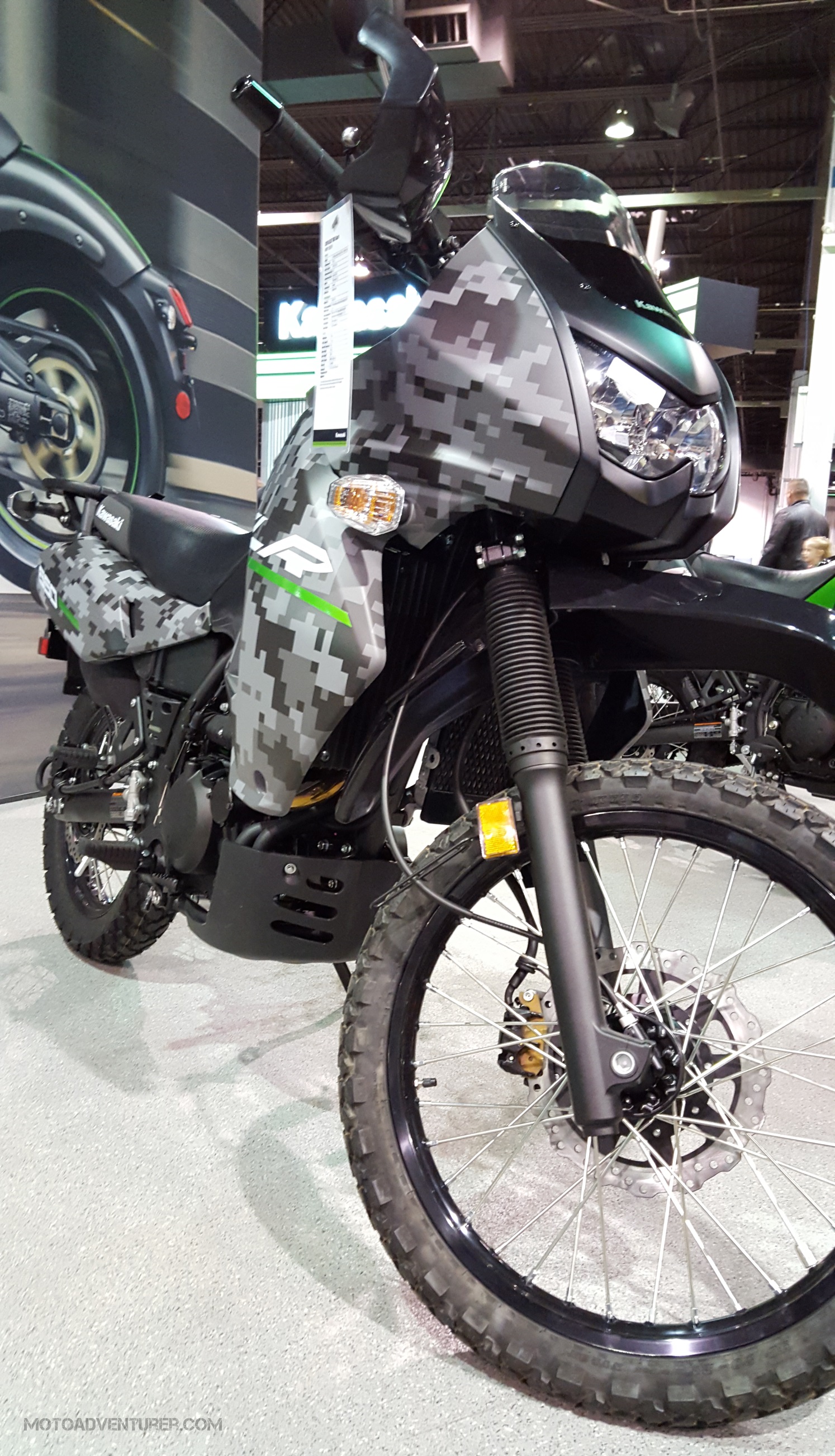
At the moment I feel that Kawasaki is probably holding firm as the “vanilla” Japanese motorcycle company. Coming from a guy that probably has no idea what he’s talking about, most of the Kawasaki motorcycles on the market don’t strike me as overly remarkable, yet not poor investments either. I have an acquaintance that has a Versys 650, he’s taken it to track days and frequently rides it to the office. In talking with him, it’s clear that the Versys is, as advertised, a very versatile motorcycle, not exceptional in any one area, but flexible in virtually all categories. I see the KLR the same, the quintessential “adventure bike”; not a dirt bike, not a race bike, not a street bike; just an affordable, all-around, rugged machine. Lastly I see the Concours the same, not the most superior Sport Touring choice on the market, but it definitely brings a lot of value to the table.
Royal Enfield
I’m also impressed to see the amount of effort that Royal Enfield has spent on marketing in recent years. There’s a dealer not far from my house, so I’ve seen the (dated) Bullet 500 models up close before; the same for the Continental GT. While the Continental does have somewhat of a newer feel, I personally feel that the bikes as a whole just feel a bit behind the times. There’s something to be said about “stone ax simple” (as my buddy Jeff says), that is a selling point to me, but for ninety plus percent of American motorcyclists, the Enfield is showing its age (albeit mostly because of what appears to be third world manufacturing quality). That said, I’m hoping to see the new Himalayan find its way to American shores. It may be a long shot, but Royal Enfield designed a new 400 cc engine for the Himalayan, hopefully this is the beginning of a new chapter for what is arguably the oldest surviving motorcycle brand.
Honda Powersports
Honda brought another large booth to the Chicago show this year. Unfortunately, I really feel like Honda has fallen flat as of late, nothing new is really noteworthy, and there are some bikes that have no target audience in my opinion (NM4?). I also don’t understand the emphasis on the Honda DCT “automatic” bikes, or at least “Automatic” option for a lot of bikes, which I feel are essentially aimed at no one (more on that in a moment). Certainly I don’t scorn technological advances, but I question the target audience, i.e. electric bikes, they’re awesome, but only a limited few can truly realize the potential (motorcycles are just toys anyway right?).
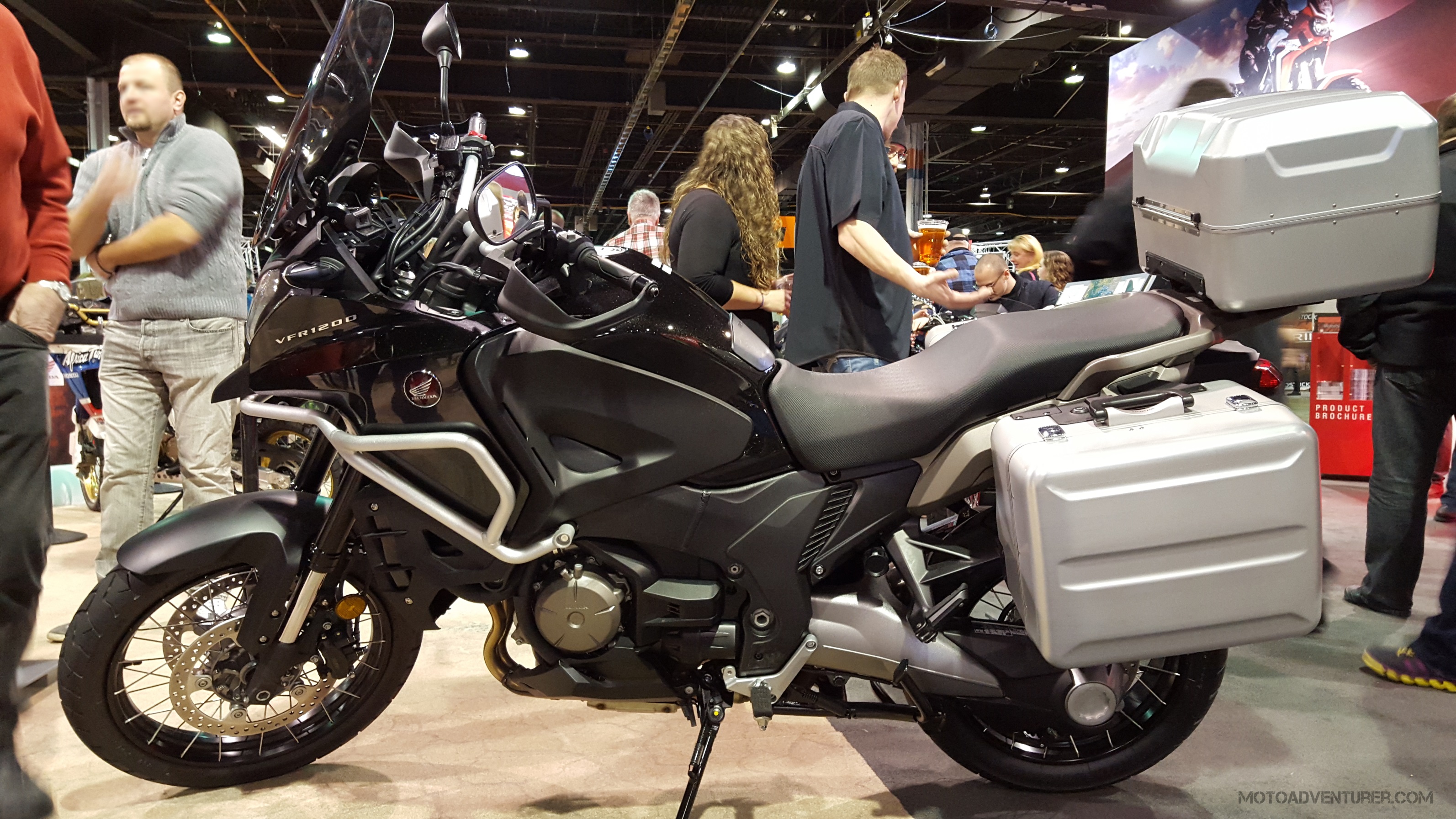
That said, I was excited to see Honda release the new VFR1200X. I will say that like the NC700X, I use “Adventure” in quotes as the bike is almost certainly more roadworthy than dirt worthy, but at least Honda has produced a model to compete against the big bore ADV bikes like the 1200 GS and Tiger Explorer. The VFR1200X also sports a V4, which I’m told is pretty impressive, hopefully someday I’ll get the chance to experience one for myself. At the same time, the 1200X is one of those DCT model bikes that I don’t understand. Honestly, how many riders are of stature or experience that can handle a 1200 cc V-4 engine but don’t want to shift? I would think DCT would be reserved for 800 cc and down, aimed at smaller and less experienced riders, but that’s just me.
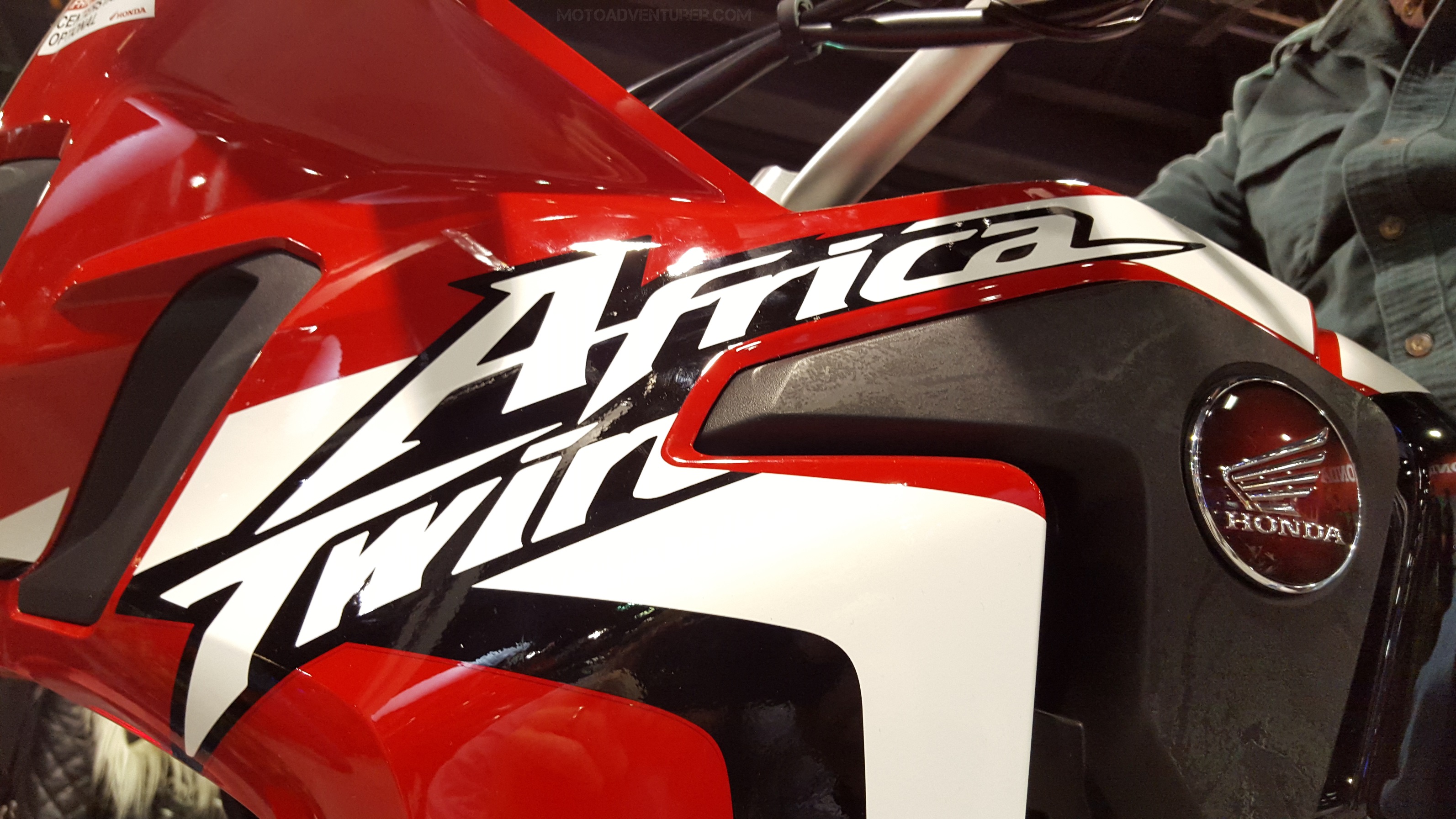
I also got my first look at the new Honda Africa Twin (CRF1000L). News of the Africa Twin was really exciting considering that Honda, who is quite competitive in the dirt, had yet to release a truly dirt worthy Adventure bike. I’m personally met with mixed emotions as I have, on paper, compared the new Africa Twin to the 800 GS and Tiger 800 XCx. The Africa Twin appears to have comparable kit to the established ADV bikes, long travel & adjustable suspension, spoke wheels, and selectable traction control modes. Unfortunately, the new Africa Twin lacks throttle by wire, selectable fuel maps, and cruise control. The display model at the show also felt unrefined or “incomplete”, but I suspect it was an early bike off the line, so it may not have had the fit and finish of the showroom bikes. Honestly what probably concerns me the most of that the new Honda 998cc parallel twin power plant is a completely new design, I’m concerned that Honda may have significant warranty and recall issues that have plagued most of the other manufacturers in recent years. At some point I’ll finally get to talk to someone who actually owns one and get an honest review of how it stacks up against the competition.
Victory Motorcycles
I feel like Polaris has somewhat neglected Victory after the acquisition and relaunch of Indian in recent years. It seems like more of the same from my perspective, as most of the Victory lineup essentially shares interchangeable parts. On the other hand, news of this new “Victory Octane Concept” was exciting. I was hoping that like the Indian Scout, Victory would have a new power plant the Octane and subsequent variations to follow. Obviously we now know that the new Octane is undoubtedly the Scout’s sister bike (arguably twin sister…), which is good or bad depending on where your loyalty lies. The Octane is probably the better buy compared to the Scout (more displacement for less money) but that assumes you can handle the stereotypical hard lines of the Victory. Either way, hopefully this new bike starts a new Chapter for Victory as they continue to differentiate themselves from the rest of the cruiser market.